



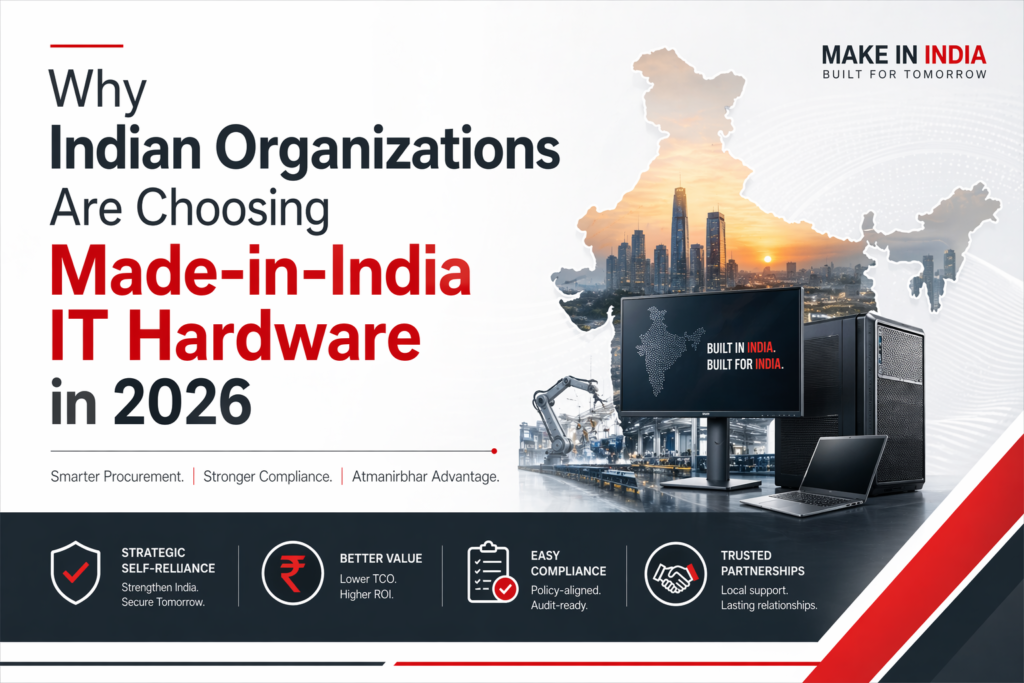
India’s IT hardware landscape is undergoing a fundamental shift. Government bodies, enterprises, and educational institutions are increasingly turning to domestically manufactured IT hardware — and this isn’t just policy-driven patriotism. It’s a calculated move rooted in cost efficiency, supply chain resilience, data sovereignty, and long-term strategic advantage.
With India’s electronics production jumping from ₹1.9 lakh crore in 2014–15 to ₹11.3 lakh crore in 2024–25, the domestic hardware ecosystem has matured significantly. Organizations that once defaulted to imported desktops, thin clients, and servers are now finding that Made-in-India alternatives deliver comparable performance at a fraction of the total cost of ownership.
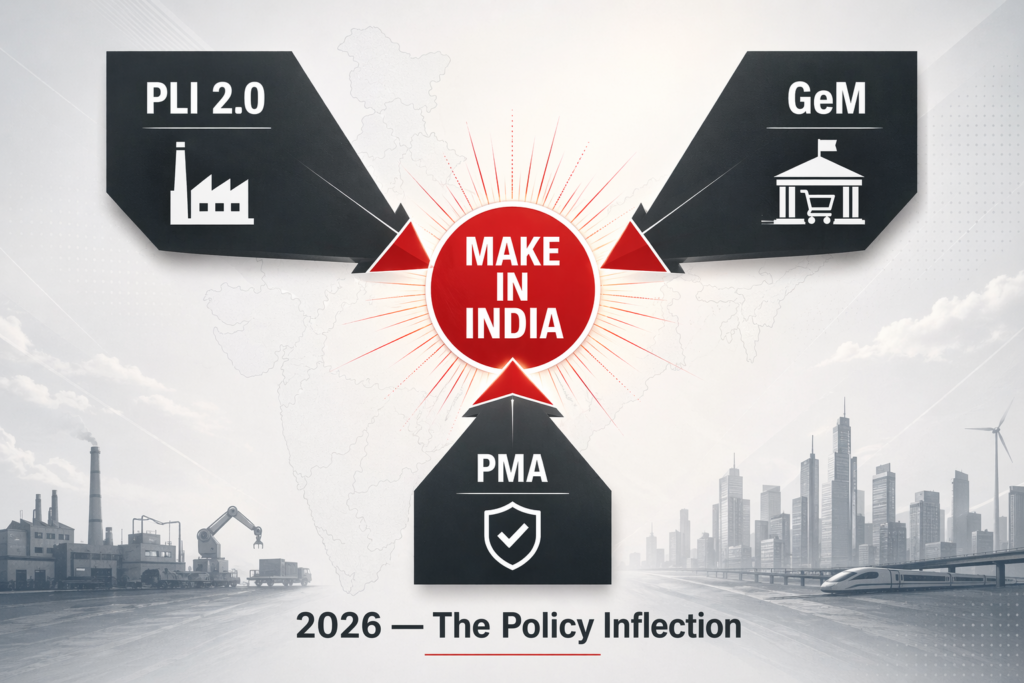
The Policy Push: PLI, GeM, and Preferential Market Access
The Indian government has put substantial policy muscle behind domestic IT hardware manufacturing. The Production Linked Incentive (PLI) 2.0 scheme for IT hardware, launched in May 2023, covers laptops, tablets, servers, and ultra-small form factor devices — with a production target of ₹3.5 lakh crore and the creation of 47,000 jobs.
By December 2025, the scheme had already driven cumulative production worth ₹16,531 crore, attracted ₹856 crore in investments, and created over 4,700 direct jobs. These aren’t aspirational numbers — they reflect real factory output and real employment.
Simultaneously, the Government e-Marketplace (GeM) has become the default procurement channel for public sector IT hardware. With ₹13.60 lakh crore in gross merchandise value, 1.64 lakh government buyer organizations, and 23 lakh registered sellers, GeM has created a transparent, competitive marketplace that inherently favours domestically manufactured products through preferential market access policies.
For government procurement officers evaluating bids on GeM, domestic manufacturers now offer a clear advantage: shorter lead times, local warranty support, and compliance with Make in India norms that carry weight in technical evaluations.
Total Cost of Ownership: The Real Equation
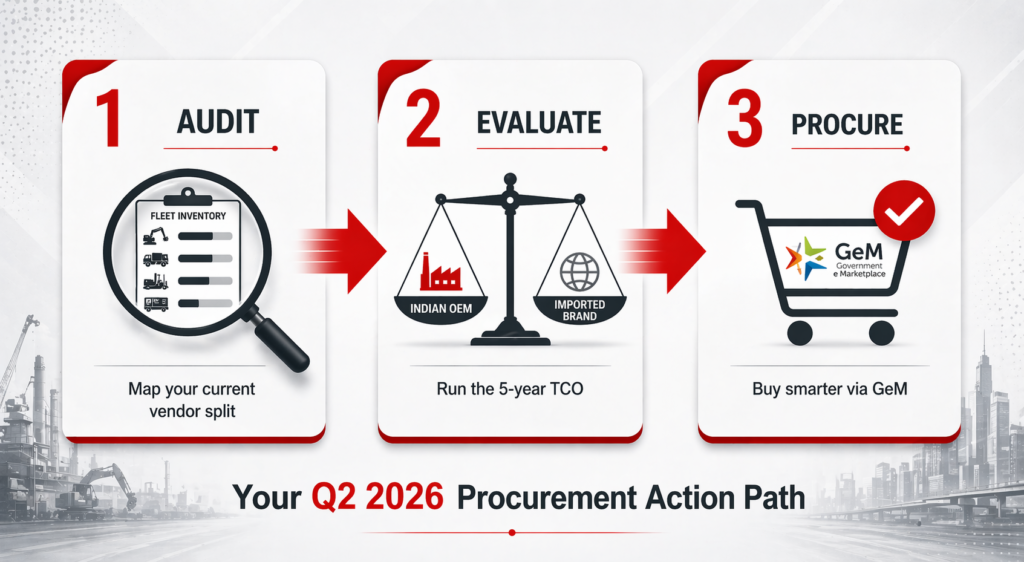
The conversation around Made-in-India hardware has evolved beyond “Buy Indian because it’s Indian.” Today’s procurement decisions are driven by a rigorous total cost of ownership (TCO) analysis — and domestic hardware consistently wins.
Consider a typical government deployment of 500 desktops. An imported machine may have a marginally lower unit price on paper, but the real costs emerge over the device lifecycle: import duties, extended shipping timelines, foreign-currency warranty claims, limited local service networks, and replacement part delays that can stretch into weeks.
A domestically manufactured desktop from an Indian OEM, by contrast, comes with local warranty fulfilment, next-business-day replacement in most cities, INR-denominated support contracts, and a spare parts ecosystem that doesn’t depend on international logistics. Over a 5-year device lifecycle, the TCO difference can be 15–25% in favour of domestic hardware — a significant saving when multiplied across hundreds or thousands of devices.
Data Sovereignty: Not Just a Buzzword
Data sovereignty has moved from conference-stage rhetoric to boardroom priority. With the Digital Personal Data Protection (DPDP) Act heading towards full enforcement by May 2027, and the Trusted Sources directive mandating hardware audits for categories like CCTV systems, IoT sensors, and networking equipment, organizations are being forced to re-examine their hardware supply chains.
The concern is straightforward: hardware manufactured offshore, with firmware and BIOS layers outside Indian oversight, presents a supply chain risk that no software patch can fully address. Domestically manufactured hardware — where the design, assembly, firmware loading, and quality testing happen within Indian facilities — provides a fundamentally different trust model.
The government’s own actions signal the direction. The migration of 1.2 million Central government email accounts to Zoho Mail (an indigenous platform), the sovereign cloud mandate for Aadhaar, GSTN, and e-governance systems — these moves reflect a systematic effort to reduce dependency on foreign-controlled infrastructure at every layer of the stack, from cloud to endpoint.
Supply Chain Resilience: Lessons from Recent Disruptions
The global chip shortage of 2021–2023 taught Indian organizations an expensive lesson. Procurement cycles that normally took 4–6 weeks stretched to 4–6 months. Projects stalled. Budgets lapsed. Deployment timelines for smart classrooms, government digitization projects, and enterprise refresh cycles were pushed back by quarters.
Organizations that had relationships with domestic manufacturers fared measurably better. Indian OEMs with local assembly and testing facilities could pivot faster — sourcing alternative components, maintaining buffer inventory, and fulfilling orders while global brands were quoting 16-week lead times.
This isn’t theoretical. Government PC procurement through GeM grew 10.6% year-on-year in 2024, with a noticeable shift toward domestic manufacturers who could guarantee delivery within committed timelines. The message from procurement teams was clear: reliability of supply matters as much as the spec sheet.
The Quality Question: Resolved
Five years ago, the hesitation around Indian-manufactured IT hardware was understandable. “Is it as good as the imports?” was a fair question. In 2026, that question has been decisively answered.
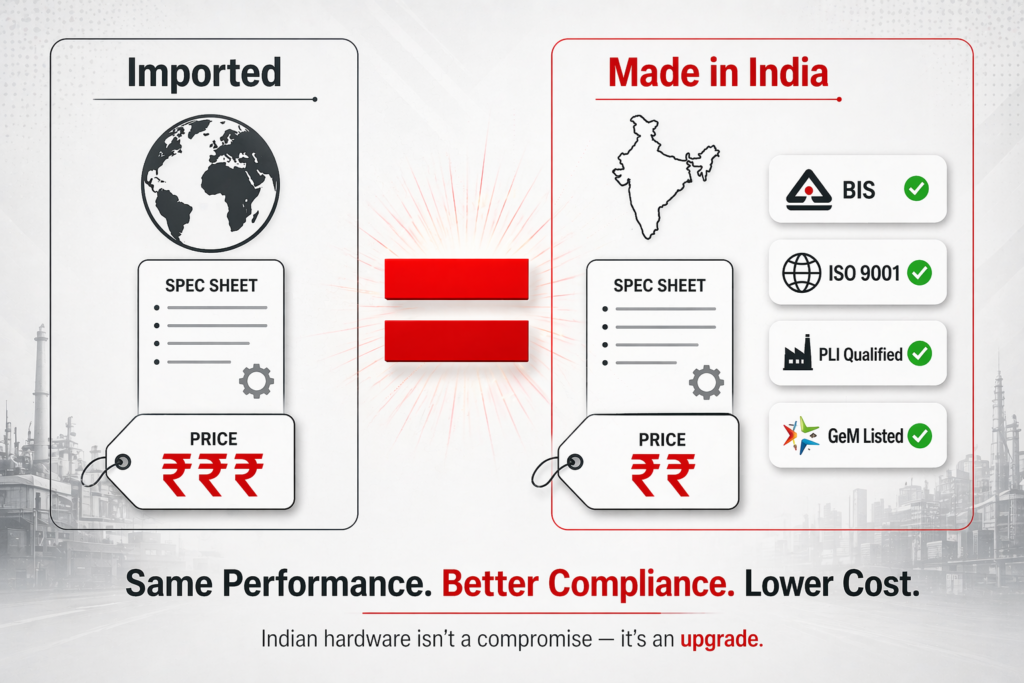
Indian OEMs now operate BIS-certified, ISO-audited manufacturing facilities. Products undergo the same burn-in testing, thermal cycling, and reliability benchmarking that global brands use. Many domestic manufacturers source processors, memory, and storage from the same global chipmakers — Intel, AMD, Samsung, Western Digital — that supply international brands.
The difference isn’t in the components. It’s in the value chain around those components: local design teams that understand Indian operating conditions (dust, humidity, voltage fluctuations), support teams in the same time zone, and an accountability structure that doesn’t disappear behind a regional distributor.
What This Means for Your Next Procurement Cycle
Whether you’re a government department planning your next GeM procurement, an enterprise IT head budgeting for a device refresh, or an educational institution deploying computer labs — the case for Made-in-India IT hardware has never been stronger.
The convergence of policy support (PLI incentives, preferential market access), economic advantage (lower TCO, INR-denominated contracts), strategic necessity (data sovereignty, supply chain resilience), and proven quality (BIS-certified, ISO-audited facilities) makes domestic hardware the rational choice — not just the patriotic one.
The organisations leading India’s digital transformation — from smart city deployments to AI-ready infrastructure — are already making this shift. The question isn’t whether Made-in-India IT hardware is ready. It’s whether your organisation is ready to make the switch.
Read next — the AI Infrastructure deep dive
The Make-in-India argument extends directly into the AI era. Our three-part AI Infrastructure series picks up where this post ends:
- Part 1 — The Real Cost of Cloud AI: why Indian enterprises are moving GPU workloads on-prem in 2026.
- Part 2 — Building Your AI Factory in India: a CIO’s playbook for 2026.
- Part 3 — Sovereign AI Starts with Sovereign Compute: the case for India’s on-prem AI stack.
Table: Make-in-India vs Imported IT Hardware — Decision Matrix
| Criteria | Make-in-India Hardware (e.g., RDP) | Tier-1 Import (MNC Brand) | Grey-Market Import |
|---|---|---|---|
| Lead Time | 2–4 weeks ex-factory (domestic stock) | 6–14 weeks (sea freight + customs) | 1–3 weeks but unpredictable |
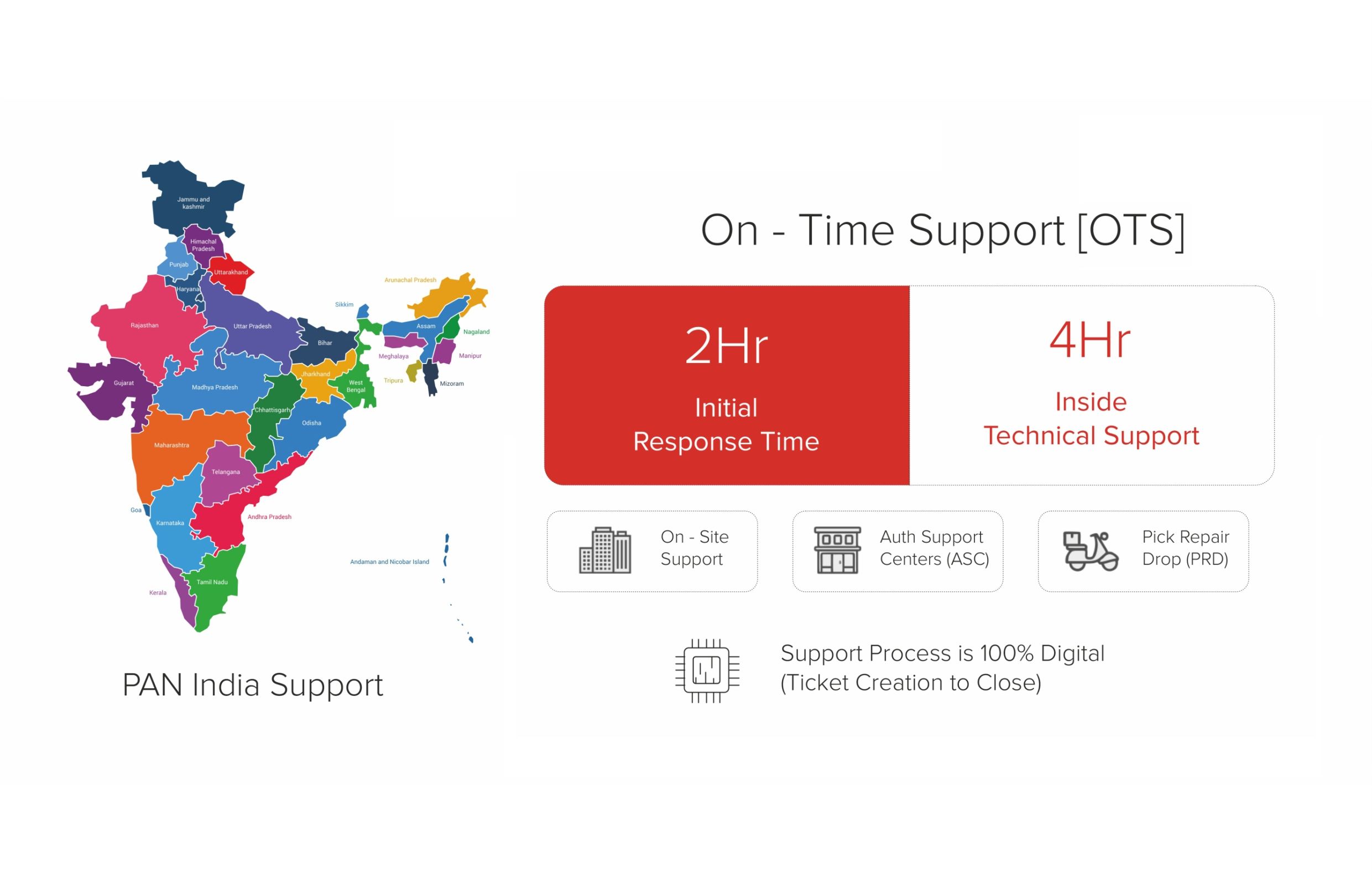
| Warranty Response | On-site NBD across 500+ pin codes | Depot-based, 5–10 business days typical | No structured warranty; vendor-dependent |
| GeM Compliance | Listed, BIS-certified, Class-1/2 eligible | Listed but Class-1 preference penalised | Not GeM-listed; cannot be procured by govt bodies |
| 5-Year Lifecycle Cost | Lower: local spares, no import-duty exposure | Higher: forex risk, imported spares premium | Highest: no SLA, high failure-replacement cost |
| Data Sovereignty | Hardware manufactured in India; supply chain auditable | Firmware/supply chain outside Indian jurisdiction | Unknown provenance; highest risk |
| PLI Scheme Eligibility | Yes — OEM and buyer both benefit from PLI incentives | No — import does not qualify | No |
| MeitY Trusted Source Status | Eligible to apply; several Indian OEMs approved | Requires separate Trusted Source audit | Not eligible |
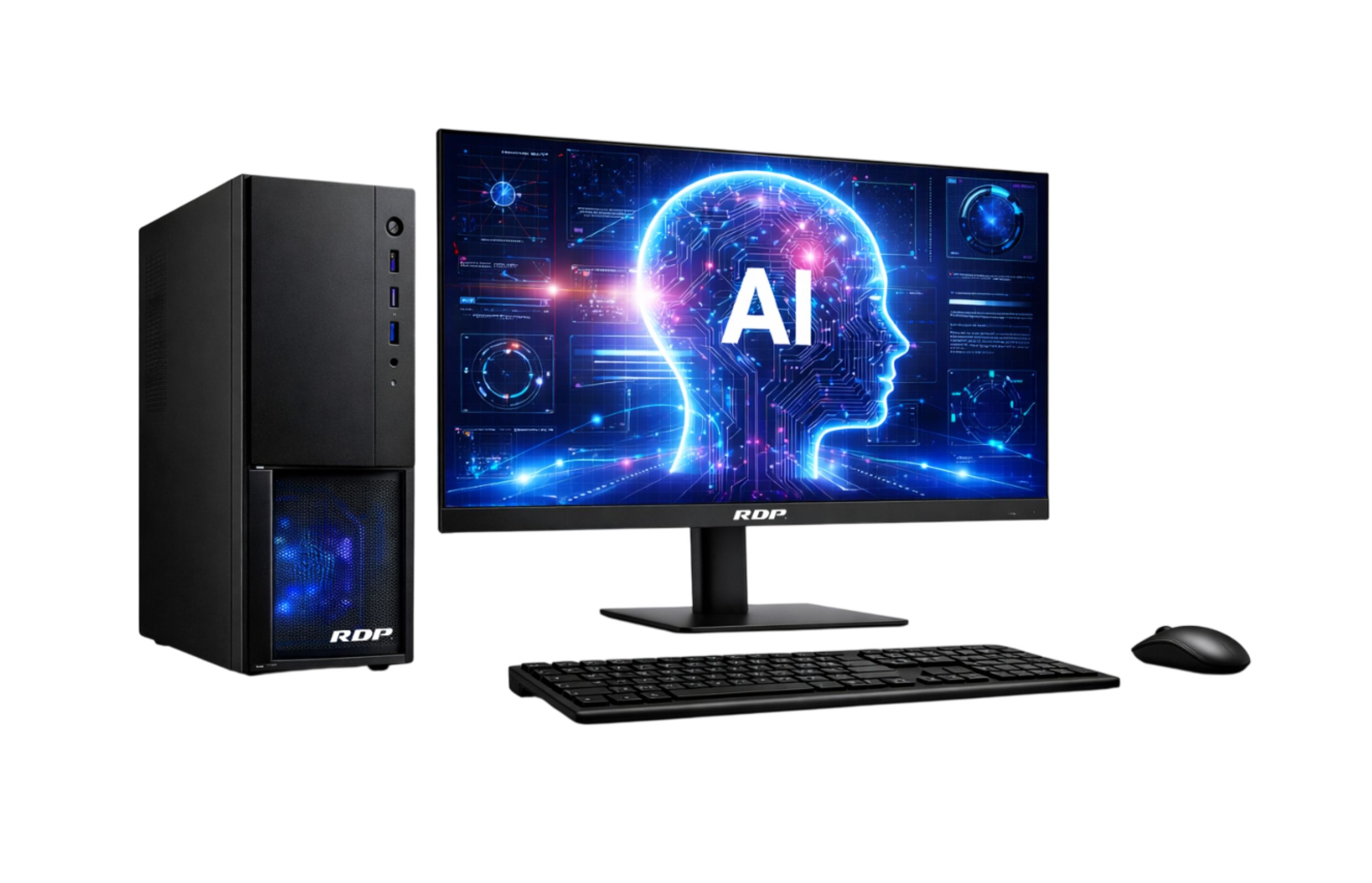
RDP Technologies Limited designs, manufactures, and supports IT hardware in India — desktops, thin clients, mini PCs, AI PCs, workstations, servers, and rack-scale AI infrastructure. 14 years. 100,000+ devices shipped. Over 1 million end users. 28,000 sq. ft. facility in Hyderabad. ISO 9001, PLI 2.0, MeitY and BIS registered.
Make in India. Built for an AI-Ready India. Reliability is Our Product.
If you are planning a GeM procurement, an enterprise device refresh, or a sovereign AI deployment — speak with our team. No sales pitch, just an honest fit review.
