
NVIDIA GB300 NVL72 Supercluster: Inside the 8-Rack Containerised AI Factory Node
The NVIDIA GB300 NVL72 supercluster is a containerised AI factory node that packs eight GB300 NVL72 racks into a single pre-integrated module — 576 Blackwell Ultra B300 GPUs and 288 Grace CPUs delivered, powered, cooled, networked, and commissioned as one unit. Rather than assembling superchips, boards, power, and fabric on-site over many months, the node arrives as a high-cube shipping module that hooks into grid and network and runs. This reference explains what is inside the node, how it behaves as a single accelerator, and where it fits for sovereign-AI, hyperscale, and enterprise AI-factory buildouts.
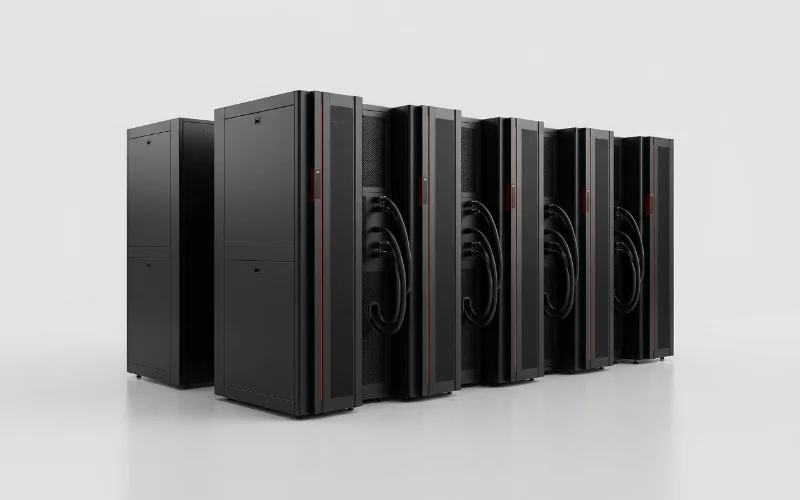
- One node = 8 GB300 NVL72 racks — 576 Blackwell Ultra B300 GPUs + 288 Grace CPUs, delivered as a single containerised module.
- ~11.5 EFLOPS FP4 peak / ~8.8 EFLOPS dense per node, engineered for real-time trillion-parameter reasoning and agentic AI.
- ~165.6 TB HBM3e + ~320 TB fast system memory, with a 1,040 TB/s NVLink domain so the GPUs behave as one coherent accelerator.
- Turnkey infrastructure: up to 1.8 MW warm-water direct-liquid cooling, 64× 33 kW power shelves, ConnectX-8 / BlueField-3 fabric, NVOS + AI Enterprise.
- Premium, constrained inventory — allocation is prioritised for strategic partners, not the open market.
What the GB300 NVL72 supercluster node is
The node is the AI-factory building block above a standalone GB300 superchip or a single NVL72 rack. Traditional piecemeal architecture — sourcing boards, power, cooling, and switching separately and integrating them on the data-center floor — does not scale to next-generation training and inference. The GB300 NVL72 supercluster answers that by shipping a completely integrated, production-ready supercomputer as one turnkey node. Eight liquid-cooled GB300 NVL72 racks are mounted inside a single high-cube container along with power distribution, cooling, storage, and fabric, so the customer receives compute capacity rather than a parts list.
Compute core: 576 Blackwell Ultra GPUs as one accelerator
Each node contains 576 NVIDIA Blackwell Ultra B300 GPUs and 288 Grace CPUs across its eight NVL72 racks. Inside the node the GPUs are joined by an NVLink domain delivering 1,040 TB/s of aggregate bandwidth, which lets all 576 GPUs operate as a single coherent accelerator with effectively zero-bottleneck communication. That coherence is what makes trillion-parameter models practical: model state and activations move across the domain at NVLink speed instead of being fragmented across slower inter-node links.
Node-level unified memory
The node exposes roughly 165.6 TB of HBM3e alongside about 320 TB of fast system memory. This large, tightly-coupled memory pool is what allows very large models and long context windows to stay resident rather than being paged, which is the difference between a supercluster that can hold a frontier model and one that constantly stalls on data movement.
Performance: engineered for agentic AI
Per node, the GB300 NVL72 supercluster delivers approximately 11.5 EFLOPS of peak FP4 (sparse) compute and around 8.8 EFLOPS dense. These are sustained figures targeted at real-time, trillion-parameter reasoning and next-generation agentic AI, where responsiveness under load matters as much as raw peak throughput. Against the prior Hopper generation, NVIDIA positions the platform at roughly 50× the overall AI-factory output, 10× faster user responsiveness, and 5× more throughput per watt.
| Specification | Per containerised node |
|---|---|
| Racks | 8× GB300 NVL72 |
| GPUs | 576× Blackwell Ultra B300 |
| CPUs | 288× Grace |
| GPU memory | ~165.6 TB HBM3e |
| System memory | ~320 TB fast system memory |
| NVLink domain bandwidth | 1,040 TB/s aggregate |
| Peak compute (FP4 sparse) | ~11.5 EFLOPS |
| Dense compute | ~8.8 EFLOPS |
| Cooling | Warm-water direct liquid cooling, in-row CDU up to 1.8 MW |
| Power | 64× 33 kW shelves, redundant busbars + BMS |
| Fabric | ConnectX-8 (800 Gb/s), BlueField-3 DPUs; Quantum-X800 InfiniBand or Spectrum-X Ethernet |
| Software | NVOS + NVIDIA AI Enterprise (576 GPU subscriptions), Mission Control, DOCA |
Critical infrastructure: power, cooling, and the data spine
Thermal and power delivery are built into the node. Cooling is warm-water direct liquid cooling (DLC) with an in-row coolant distribution unit rated for up to 1.8 MW of thermal dissipation. Power uses a heavy-duty redundant architecture of 64× 33 kW shelves with integrated busbars and comprehensive safety/BMS features. The data spine is a high-speed fabric built on ConnectX-8 (800 Gb/s) NICs and BlueField-3 DPUs, configurable with either Quantum-X800 InfiniBand or Spectrum-X Ethernet, and high-speed NVMe storage arrays are integrated directly with the internal management switches.
The orchestration and software stack
The node ships as a full stack, not bare metal. At the foundation, NVOS (the NVIDIA operating system) manages the hardware layer directly. Above it, NVIDIA AI Enterprise is included with 576 individual GPU subscriptions, and fleet orchestration is handled by Mission Control and DOCA services. This is what lets a strategic partner treat the node as a managed AI factory rather than a rack of servers to hand-configure.
Deployment: turnkey site integration
Because the node is a pre-integrated high-cube module, it bypasses years of traditional data-center construction. Commissioning follows three stages: the module arrives pre-integrated and containerised; a plug-and-play architecture is designed for immediate grid and network hookup; and handover includes comprehensive training and detailed operations-and-maintenance documentation. The result is time-to-first-token measured against logistics and grid readiness rather than multi-year build cycles.
Where it fits
The GB300 NVL72 supercluster is optimised for large-scale training, post-training alignment, real-time inference, and agentic reasoning at trillion-parameter model scale. NVIDIA positions it for sovereign-AI initiatives, hyperscale deployments, top-tier research institutions, and enterprise AI factories. For India-based sovereign-AI programs in particular, the containerised, self-contained form factor supports on-premises and colocation deployment where data residency and in-country control are requirements. Availability is a practical constraint: this is premium, allocation-limited inventory prioritised for strategic partners, so lead time and eligibility are part of the planning conversation, not an afterthought.
Frequently asked questions
How many GPUs are in one GB300 NVL72 supercluster node?
576 NVIDIA Blackwell Ultra B300 GPUs and 288 Grace CPUs, spread across eight GB300 NVL72 racks inside a single containerised module.
How much memory and interconnect bandwidth does a node have?
Approximately 165.6 TB of HBM3e plus around 320 TB of fast system memory, with a 1,040 TB/s NVLink domain that lets all 576 GPUs act as one coherent accelerator.
What performance does a node deliver?
Roughly 11.5 EFLOPS peak FP4 (sparse) and about 8.8 EFLOPS dense per node — sustained figures aimed at real-time trillion-parameter reasoning and agentic AI, positioned at up to 50× the overall output of the Hopper generation.
How is the node powered and cooled?
Warm-water direct liquid cooling with an in-row CDU up to 1.8 MW, and a redundant power architecture of 64× 33 kW shelves with integrated busbars and BMS.
Who is it for and is it readily available?
It targets sovereign-AI, hyperscale, top-tier research, and enterprise AI-factory deployments. It is premium, constrained inventory — allocation is prioritised for strategic partners rather than sold on the open market.
Ready to deploy?
Talk to an RDP architect about power, cooling and lead time.