
AI Workstation TCO in India: Duties, GST and the Cloud Crossover
Overview
Buying a mid-tier AI workstation in India is financially simpler than most buyers assume: GPUs and workstations largely enter at 0% basic customs duty under the ITA-1 agreement, the 18% IGST is a creditable input for GST-registered businesses, and the real comparison is against cloud GPU rental settling near $2–3/GPU-hour for H100-class on-demand in 2026. For a machine used daily by an engineer or small team, the ownership case usually closes inside 12–24 months — but only if you count the full stack: power, UPS, warranty, and the residual value a workstation retains that cloud spend never does. This article works the arithmetic for CFO and procurement review.
Key takeaways
- ITA-1 keeps basic customs duty at 0% for most GPU and computer hardware; 18% IGST applies but is input-creditable for GST-registered buyers.
- Cloud H100-class on-demand sits around $2–3/GPU-hour in 2026; a daily-driver workstation crosses that cost line in roughly 12–24 months of steady use.
- Utilisation honesty decides the verdict: interactive development uses a local card far more effectively than its
nvidia-smiaverage suggests, because idle local time costs nothing. - Hidden lines — UPS, power quality, extended warranty/AMC, and the engineer-hours cloud orchestration consumes — move the answer more than sticker price.
- Bursty training campaigns and short projects still rent better; the hybrid pattern (owned seats + rented bursts) is the stable end state.
What you actually pay at the border
Most GPU cards, workstations and servers enter India at 0% basic customs duty under ITA-1 commitments, with the effective import charge being 18% IGST — which, as import-tax analyses such as rawcompute’s GST breakdown note, is fully creditable against output GST for registered businesses. Practical implications: the “India premium” on properly imported hardware is logistics, channel margin and forex, not tax; buying from an Indian OEM or system integrator with GST invoicing keeps the credit chain clean; and grey-market imports that dodge IGST also forfeit warranty and the input credit — a false economy at this price class.
The TCO frame: what to compare against what
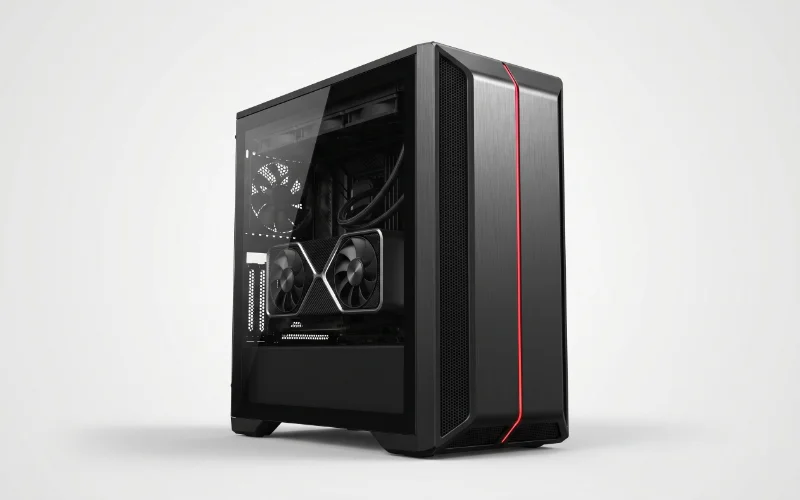
The correct cloud comparator for a QUASAR-class workstation is not one H100 hour — it is the instance an engineer would actually rent for daily development: a single high-VRAM GPU with attached storage, kept warm through the working day. At $2–3/hour equivalents, 8 hours a day, 22 days a month, that is roughly $350–600/month before storage, egress and idle-instance waste. Against that, amortise the workstation over 3–4 years, add power (a loaded tower draws ~0.8–1.3 kW at the wall — at ₹8–10/kWh, roughly ₹1,500–3,000/month at heavy daily use), UPS capacity, and an extended warranty or AMC. Vendor TCO studies — Lenovo’s 2026 edition claims break-even in months for high-utilisation on-prem — are directionally right but assume utilisation most teams don’t hit; run your own numbers at 30%, 50% and 70% duty cycles before believing anyone’s chart.
The utilisation argument nobody prices correctly
Cloud economics punish idleness: a warm instance bills whether or not the engineer is typing. Local hardware inverts this — idle minutes cost electricity rounding error, so interactive work (the bursty think-run-think loop of development, evaluation and demos) is structurally cheaper on owned silicon even at modest average utilisation. The corollary: workloads that are genuinely continuous and elastic — multi-week training campaigns, one-off large jobs — keep renting, increasingly at IndiaAI-affiliated rates approaching $1/GPU-hour for eligible workloads. The stable pattern we see across Indian teams matches the graduation logic in our team-scaling guide: owned interactive seats, rented burst capacity, and a first shared server when contention data justifies it.
Hidden lines that decide the verdict
Four items routinely missing from workstation quotes. Power quality: a 1 kW+ tower on Indian office power wants an online UPS sized with headroom — budget it with the machine, not after the first brownout mid-fine-tune. Warranty depth: default 3-year cover with next-business-day onsite response is worth real money against a card class where replacement lead times can run weeks; AMC options extend life to year 5. Data gravity: local hardware means client code, proprietary datasets and DPDP-scoped data never transit a foreign cloud region — for services firms this is frequently the deciding argument, ahead of cost (see DPDP-ready planning). Residual value: three-year-old professional GPUs retain meaningful resale or redeployment value as inference seats; cloud spend retains none.
Worked comparison at three duty cycles
| Scenario | Cloud cost / month (approx.) | Owned cost / month (36-mo amortised) | Verdict |
|---|---|---|---|
| Light use (2 h/day) | $90–180 | Fixed regardless of use | Cloud wins; buy entry CARINA-class if data must stay local |
| Daily driver (6–8 h/day) | $350–600 + storage/egress | Amortisation + ~₹2–3k power | Ownership typically crosses over at 12–24 months |
| Heavy hybrid (day interactive + night batch) | $700–1,200 | Same fixed base | Ownership clearly wins; utilisation is the multiplier |
| Burst training campaign (2–6 weeks) | Rental at $1–3/GPU-h | Poor fit — capacity idles after | Rent, in-country where possible |
Frequently asked questions
Is there import duty on GPUs and workstations in India?
Basic customs duty is 0% for most GPU and computing hardware under ITA-1; the import levy that matters is 18% IGST, which GST-registered businesses claim back as input credit. The effective tax cost for a registered buyer is close to nil.
At what usage does buying beat cloud rental?
As a rule of thumb: consistent daily interactive use (6+ hours) crosses over within 12–24 months against $2–3/GPU-hour cloud rates. Occasional or project-bound use stays cheaper rented.
Should we buy through an integrator or import directly?
An Indian OEM/integrator with GST invoicing preserves input credit, warranty and onsite support, and removes forex and logistics risk. Direct import saves little once IGST credit is counted and adds warranty friction.
How should we budget power and UPS?
Plan for 0.8–1.3 kW at the wall per loaded high-end tower, an online UPS with 30%+ headroom, and roughly ₹1,500–3,000/month in electricity at heavy daily use at typical commercial tariffs.
Does the workstation hold value?
Professional-class GPUs redeploy well as inference or junior-engineer seats after their frontline life, and carry resale value cloud spend never does — include a residual line (10–20% at year 3) in the TCO to keep the comparison honest.
Ready to deploy?
Talk to an RDP architect about power, cooling and lead time.