
Air-Cooled vs Liquid-Cooled GPU Racks: When to Switch
Air cooling runs out of headroom at roughly 35 kW per rack. Below that, well-designed airflow is fine; above it, direct-to-chip liquid cooling becomes necessary, and beyond ~100 kW per rack, immersion cooling is the practical option. Modern GPU racks have blown past these lines — a Blackwell NVL72 rack reaches ~140 kW, which air physically cannot dissipate — so dense AI deployments are liquid by requirement, not preference.
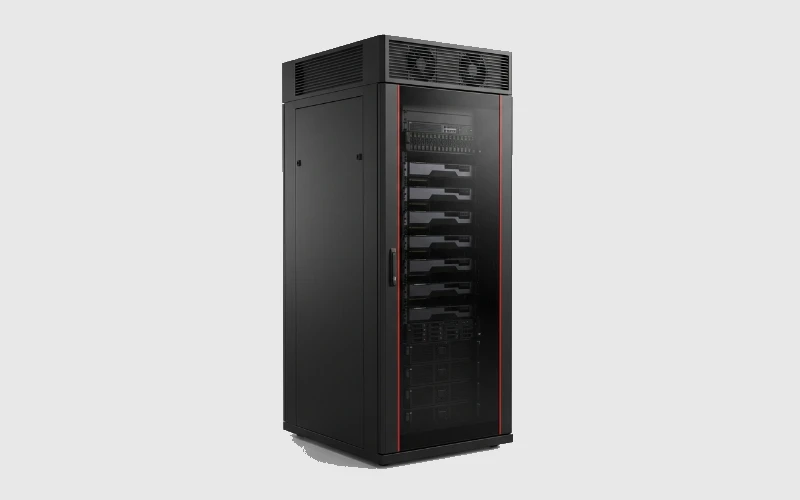
TL;DR — the thresholds
- ≤ ~35 kW/rack → air cooling works with proper airflow/containment.
- > ~35 kW/rack → direct-to-chip liquid required (Network World, 2026).
- > ~100 kW/rack → immersion cooling, with PUE as low as ~1.02.
- Reality: GPU rack density rose from 15 kW → ~132 kW, with 240 kW expected in 2026; a GB200 NVL72 ≈ 140 kW — liquid is non-negotiable at that density (Syaala, 2026).
What this covers
When a GPU deployment must move from air to liquid cooling, the density thresholds that force the change, and what each option requires. It's a facility-planning explainer, not a mechanical design spec.
Why density forces the switch
Cooling is bounded by physics: air can only carry so much heat per unit volume. The practical ceiling for air is ~30–40 kW/rack (a ~50 W/cm² heat-flux limit), beyond which airflow can't keep silicon in spec (SLYD, 2026). GPU racks have raced past that line — from 15 kW a few years ago to ~132 kW today, and ~240 kW expected in 2026 — so the question for dense AI is no longer *if* liquid, but *which* liquid.
The options, by density
Table 1 — Cooling method by rack density (2026).
| Rack density | Method | Notes |
|---|---|---|
| ≤ ~35 kW | Air | airflow containment, hot/cold aisle; simplest |
| ~35–100 kW | Direct-to-chip liquid | cold plates on GPUs/CPUs + CDUs, leak detection, compatible racks |
| > ~100 kW | Immersion | servers in dielectric fluid; PUE as low as ~1.02 |
Direct-to-chip (D2C): coolant plates sit directly on the hot components; a coolant distribution unit (CDU) moves heat to a facility loop. This is the mainstream path for Blackwell-class racks — a 140 kW NVL72 rack cannot be air-cooled and requires D2C infrastructure (CDUs, leak detection, compatible rack design) (Network World, 2026).
Immersion: whole servers sit in a dielectric fluid; best for the very highest densities, with excellent efficiency but a bigger facility change.
When to switch — the decision
- Building a node or two (≤35 kW/rack)? Air is fine; design good containment.
- Consolidating nodes into dense racks, or deploying NVL-class racks? Plan direct-to-chip liquid from day one — retrofitting later is costly.
- Targeting extreme density / best PUE? Evaluate immersion.
Assumptions & scope
Thresholds are industry rules of 2026 and vary with rack design, ambient, and target temperatures — confirm with your facility and vendor. A planning explainer, not a mechanical spec.
Where RDP GPU Mart fits
RDP GPU Mart configures GPU systems for both regimes — air-coolable single/multi-GPU servers, and liquid-ready DRACO rack-scale deployments — with India-based support to plan the facility envelope (power, CDU, cooling) alongside the hardware. *(Discuss a liquid-cooled rack or request a quote at RDP GPU Mart.)*
FAQ
At what density do I need liquid cooling? Above ~35 kW/rack, direct-to-chip liquid becomes necessary; above ~100 kW, immersion (Network World, 2026).
Can a Blackwell NVL72 rack be air-cooled? No — at ~140 kW/rack it requires direct-to-chip liquid cooling with CDUs and leak detection.
Is a single 8-GPU node air-coolable? Yes — at ~10 kW it's within air limits; liquid becomes necessary as you pack nodes into dense racks past ~35 kW.
What is a CDU? A coolant distribution unit — it circulates coolant to the cold plates and transfers heat to the facility loop in a direct-to-chip system.
—
Related
- Reference Architecture: 8× H200 On-Prem AI Training Node
- What Is an AI Factory? Rack-Scale AI Explained
- Reference Architecture: Sovereign AI Cluster (Scalable Unit)
Research log (Rule #1)
1. Network World (2026) — AI rack densities make liquid cooling non-negotiable (>35 kW; NVL72 140 kW). https://www.networkworld.com/article/4149069/why-ai-rack-densities-make-liquid-cooling-nonnegotiable.html 2. SLYD (2026) — AI data center cooling requirements (air limit ~35 kW, 50 W/cm²). https://slyd.com/guides/cooling-requirements 3. Syaala (2026) — GPU rack density timeline (15→132→240 kW). https://syaala.com/blog/gpu-rack-density-timeline-2026 4. Energy-Solutions (2026) — liquid immersion vs air (PUE ~1.02). https://energy-solutions.co/articles/sub/data-center-cooling-liquid-immersion-vs-air 5. CoreSite (2026) — liquid cooling for high-density AI racks. https://www.coresite.com/blog/liquid-cooling-steps-up-for-high-density-racks-and-ai-workloads
Ready to deploy?
Talk to an RDP architect about power, cooling and lead time.