
GPU Sizing for Agentic AI Workloads (2026)
Agentic AI changes the sizing question: it isn't just a GPU problem. The GPU still runs the model, but the orchestration layer — scheduling sub-tasks, routing tool calls, passing state between agents — is CPU-intensive, so plan a much richer CPU-to-GPU ratio (~1:1 to 1.4:1, roughly 86–120 CPU cores per GPU) and fast, GPU-near memory to protect time-to-first-token. Size the GPU for the model as usual, then provision CPUs and memory for the agent loop.
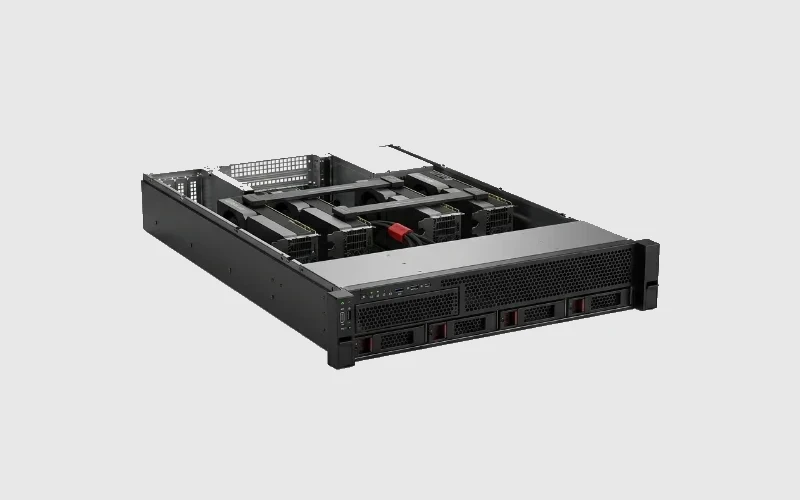
TL;DR — the decisions
- CPU:GPU is rebalancing from ~1:8 toward 1:1–1.4:1 (~86–120 CPU cores per GPU) as agentic work grows (TrendForce, 2026; Spheron, 2026).
- Orchestration is CPU work — tool routing, sub-agent coordination, "is the task done?" checks land on the CPU.
- Latency targets: keep TTFT < 2 s and inter-token latency ~100–130 ms for responsive agents (quantized models hold this even at ~160 concurrency).
- Memory distance matters — KV cache and shared multi-agent state near the GPU protect TTFT and tokens/second.
What this sizes
The full server balance — GPU, CPU, memory — for agentic AI: systems where an LLM plans, calls tools, spawns sub-agents, and iterates, rather than answering a single prompt. It complements the LLM inference sizing guide, which covers the GPU/VRAM half.
Why agents are CPU-hungry
A single chatbot turn is GPU-dominated. An agent loop adds orchestration the CPU handles: scheduling sub-tasks, routing tool/API calls, passing data between sub-agents, and evaluating whether the request is fulfilled (Astera Labs, 2026). SemiAnalysis has noted CPU processing can account for 50–90% of total latency in agentic workloads. The scale of the shift is stark: Arm estimates a traditional AI data center needs ~30 million CPU cores per gigawatt, but the agent era pushes that to ~120 million — a 4× increase (TrendForce, 2026).
How to size it
1. GPU for the model. Use standard inference math — e.g. a 70B on 1× H200 (FP8) serves the reasoning core. → *How Much VRAM for a 70B / 405B LLM?* 2. CPU for the loop. Target ~1:1 to 1.4:1 CPU:GPU (≈86–120 cores/GPU); heavy tool-calling and multi-agent coordination push toward the higher end. 3. Memory near the GPU. Provision ample fast system RAM and keep KV cache / shared state close — memory distance drives TTFT and tokens/second in multi-turn, multi-agent sessions. 4. Validate to SLO. Confirm TTFT < 2 s and ITL ~100–130 ms at your target concurrency; quantized models hold these even at ~160 concurrency (Spheron, 2026).
Assumptions & scope
Agentic inference with tool use and sub-agents; ratios are 2026 guidance and vary with how tool/orchestration-heavy your agents are. Validate CPU:GPU and latency on your stack. Estimates, not a quote.
Where RDP GPU Mart fits
RDP GPU Mart configures balanced agentic-AI servers — the right GPU for the model plus enough CPU cores and fast memory for the agent loop, so orchestration doesn't become the bottleneck. India-built, INR-transparent, DPDP-aware. *(Configure an agentic-AI server or request a quote at RDP GPU Mart.)*
FAQ
How is sizing agentic AI different from a chatbot? Chatbots are GPU-dominated; agents add CPU-intensive orchestration (tool routing, sub-agent coordination), so you provision far more CPU and memory alongside the GPU.
What CPU-to-GPU ratio for agentic AI? Plan ~1:1 to 1.4:1 — roughly 86–120 CPU cores per GPU, higher for tool-heavy agents (TrendForce, 2026).
What latency should an agent hit? Keep TTFT under ~2 s and inter-token latency ~100–130 ms for responsiveness.
Does agentic AI need more GPUs? Not necessarily more GPUs — but a lot more CPU and memory per GPU; the model GPU is sized as usual.
—
Related
- How Much VRAM for a 70B / 405B LLM (Inference)?
- Right-Sizing a GPU Server for Enterprise RAG
- AI Infrastructure Buying Guide for CIOs
Research log (Rule #1)
1. TrendForce (2026) — agentic AI reshaping CPU:GPU ratio (30M→120M cores/GW). https://insights.trendforce.com/p/agentic-ai-cpu-gpu 2. Spheron (2026) — CPU-to-GPU ratio for agentic inference (86–120 cores/GPU, TTFT/ITL). https://www.spheron.network/blog/cpu-to-gpu-ratio-agentic-ai-inference/ 3. Astera Labs (2026) — Computex: agentic workloads, CPUs center stage. https://www.asteralabs.com/computex-2026-agentic-workloads-cpus-take-center-stage-for-ai-infrastructure/ 4. Red Hat / AMD (2026) — agentic AI infrastructure stack. https://www.redhat.com/en/blog/agentic-ai-demands-new-infrastructure-stack-amd-and-red-hat-deliver 5. NVIDIA — H200 datasheet (GPU half of the balance). https://www.nvidia.com/en-us/data-center/h200/
Ready to deploy?
Talk to an RDP architect about power, cooling and lead time.