
Sovereign AI in India: What It Takes to Build In-Country GPU Infrastructure
Sovereign AI means a nation can train, run, and govern AI on infrastructure, data, and models it controls in-country. India is building it fast — the IndiaAI Mission has deployed ~34,000 GPUs at ~₹65/GPU-hour and targets 100,000 public GPUs by end-2026, with national capacity expected past 200,000. For an enterprise or PSU, "sovereign" translates to on-prem or in-country GPU clusters, data residency under the DPDP Act, and India-supported hardware.
TL;DR — key takeaways
- Sovereign AI = control of compute, data, and models within national borders — not just "AI built locally."
- India's public backbone: ~34,000 GPUs live → 100,000 by December 2026, private buildouts pushing national capacity past 200,000 (IndiaAI, 2026; explainX, 2026).
- Funding anchor: ₹10,371.92 crore (~$1.25B) IndiaAI Mission, seven pillars, sanctioned March 2024.
- For enterprises/PSUs, sovereignty is concrete: in-country GPU clusters + DPDP data residency + India-supported hardware.
What "sovereign AI" actually means
Sovereign AI is the capacity of a country — or an organization within it — to develop and operate AI without dependence on foreign-controlled compute, data pipelines, or models. It rests on three controllable layers: compute (GPUs physically in-country, under domestic governance), data (kept resident and lawful under local rules), and models (trained on and for local languages, context, and policy). Missing any one layer breaks sovereignty — a locally built model trained on rented foreign cloud is not sovereign.
India's sovereign-AI backbone (2026)
The IndiaAI Mission, sanctioned at ₹10,371.92 crore in March 2024, runs on seven pillars: AI compute, foundation models, datasets, application development, AI safety, startup support, and skills. On compute, MeitY's IndiaAI division empanelled service providers for a shared GPU pool and has scaled rapidly: ~34,000 GPUs deployed, offered to startups, researchers, and government at ~₹65 per GPU-hour, with an announced path to 54,000 then 100,000 public GPUs by December 2026 (Digital India / MeitY, 2026). Private deployments by Reliance, Tata, and hyperscalers building India-based capacity are expected to push national GPU capacity past 200,000 by year-end (explainX, 2026). Indian foundation models (e.g. the Sarvam family) sit on top of this stack.
What it takes to build in-country GPU infrastructure
An enterprise or PSU pursuing sovereign AI assembles the same layers at its own scale:
- In-country compute. GPU servers or clusters physically located and operated in India — on-prem or in an Indian data center — not shared foreign cloud.
- Data residency. Under the DPDP Act, personal and sensitive data must be handled lawfully and often kept in-country; the training and inference GPUs must sit where the data is allowed to live.
- The scalable unit. Design in repeatable blocks — a node (e.g. 8× H200), a rack, a scalable unit — so capacity grows predictably. See the reference-architecture guides.
- Power, cooling, networking. Dense GPU clusters need lossless fabrics (NDR InfiniBand or equivalent), serious power distribution, and often liquid cooling above a threshold.
- India-based support. Sovereignty is fragile if hardware support depends on a foreign supply chain — local manufacturing and support reduce that risk.
Assumptions & scope
Figures are 2026 government/press statements and targets; deployment numbers change quarterly — verify current status against IndiaAI/MeitY releases. This is a strategy/architecture explainer, not procurement advice for a specific tender.
Where RDP GPU Mart fits
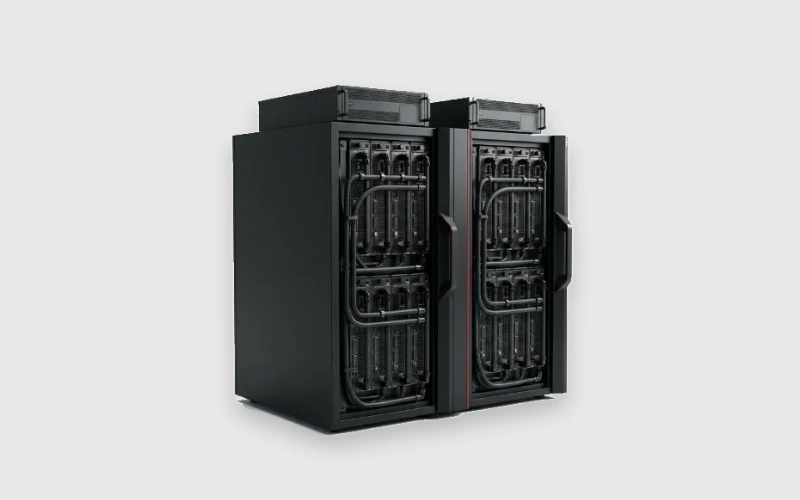
RDP GPU Mart is built for exactly this: India-designed, India-manufactured, India-supported AI infrastructure — from workstations to DRACO-class rack-scale GPU systems — with INR-transparent pricing and DPDP-aware, in-country deployment. For an enterprise or PSU building sovereign AI, that closes the compute + support layers domestically while your data stays resident. *(Explore rack-scale options or request a sovereign-AI cluster quote at RDP GPU Mart.)*
FAQ
What is sovereign AI? The ability to develop and run AI on compute, data, and models a nation controls in-country — spanning GPUs, data residency, and locally relevant models.
How many GPUs does India have under the IndiaAI Mission? About 34,000 deployed in 2026, with a target of 100,000 public GPUs by December 2026 and national capacity projected past 200,000 (IndiaAI, 2026).
Does sovereign AI require on-prem? It requires in-country, governed compute. On-prem or an Indian-resident cluster qualifies; shared foreign cloud generally does not.
How does the DPDP Act affect AI infrastructure? It constrains where and how personal/sensitive data is processed, frequently requiring in-country, in-control compute — a core driver of sovereign-AI buildouts.
—
Related
- On-Prem vs Cloud GPU: True TCO for AI Training in India
- Reference Architecture: Sovereign AI Cluster (Scalable Unit)
- Government & PSU AI: Data-Residency-First GPU Infrastructure
Research log (Rule #1)
1. IndiaAI / abhs (2026) — 34,000 GPUs at ₹65/hr. https://www.abhs.in/blog/indiaai-mission-34000-gpus-cheap-compute-developers-2026 2. explainX (2026) — India sovereign AI status 2026 (100k/200k trajectory, Sarvam). https://explainx.ai/blog/india-sovereign-ai-status-indiaai-mission-2026 3. Digital India / MeitY (2026) — IndiaAI compute + startup support. https://www.digitalindia.gov.in/press_release/indiaai-mission-expands-ai-ecosystem-with-affordable-compute-and-startup-support/ 4. IndiaAI (2026) — IndiaAI compute capacity. https://indiaai.gov.in/hub/indiaai-compute-capacity 5. AI CERTs (2026) — India adds 20,000 sovereign GPUs. https://www.aicerts.ai/news/indias-gpu-infrastructure-expansion-adds-20000-sovereign-gpus/
Ready to deploy?
Talk to an RDP architect about power, cooling and lead time.