
Sizing 70B LLM Inference on GPU Servers in India
A 70B LLM inference plan should start with memory, concurrency, latency, power, and data-residency constraints, not only GPU count. For Indian teams, RDP GPU Mart can turn those constraints into a DRACO GPU server shortlist with INR-transparent procurement, rack-readiness checks, and DPDP-aware deployment notes before a buyer commits.
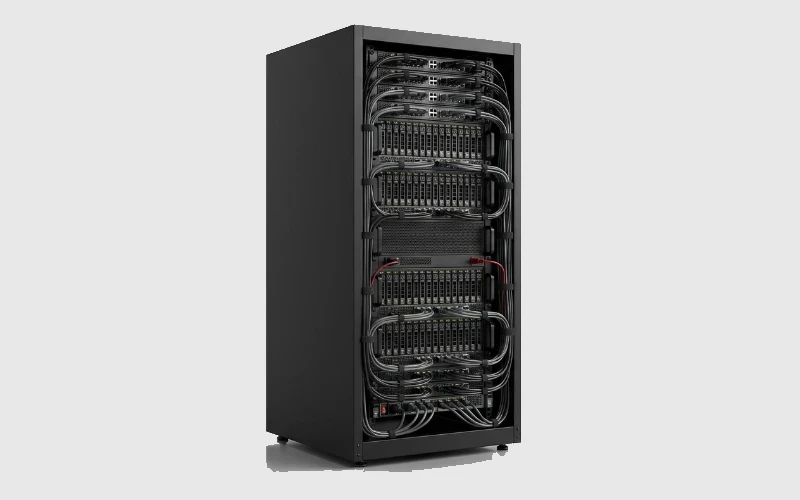
TL;DR
- Use model memory plus KV-cache growth to size GPU memory before choosing the server count.
- Separate offline batch throughput from interactive latency; they drive different GPU and networking choices.
- Treat DPDP, data residency, rack power, and support windows as first-order design inputs in India.
What should buyers verify before sizing?
The first pass should identify workload shape, concurrency, governance obligations, and site readiness. FOMALHAUT treats these as engineering inputs, not sales decorations. This article uses NVIDIA H100 Tensor Core GPU, NVIDIA H200 Tensor Core GPU, MLPerf Inference v4.1 Results, MeitY Digital Personal Data Protection Act, NVIDIA Triton Inference Server Documentation as the evidence base, then maps the implications to RDP GPU Mart categories where the fit is clear.
| Design variable | Sizing implication | Buyer check |
|---|---|---|
| Model weights | 70B class models often need multi-GPU memory planning even before KV cache | Ask whether quantization is allowed |
| KV cache | Concurrent users can consume more memory than the base prompt test suggests | Test target prompt length |
| Latency target | Interactive chat needs different batching than document processing | Measure p50 and p95 |
| Power and cooling | 4U/8-GPU servers need site readiness, not just rack space | Confirm PDU, airflow, and spares |
Which technical assumptions matter most?
- NVIDIA describes H100 PCIe with 80 GB HBM2e memory in its 2023 product material.
- NVIDIA lists H200 with 141 GB HBM3e memory in 2024 platform material.
- The Digital Personal Data Protection Act, 2023 made personal-data processing obligations a board-level constraint in India.
The quoted source for this article is NVIDIA H200 Tensor Core GPU product page: "The vendor describes H200 as built to accelerate generative AI workloads." The quote is used as positioning context only; capacity and procurement still need workload validation.
How does this map to RDP GPU Mart?
RDP GPU Mart should be used as a Make-in-India, INR-transparent route to shortlist the relevant DRACO / GPU servers configuration, validate rack and support assumptions, and keep procurement traceable. It should not be read as a reseller claim for third-party vendors named in the research log.
Related GPU Mart paths
What are the practical next steps?
1. Collect model, dataset, retention, concurrency, and latency targets. 2. Run a small benchmark or proof-of-concept before locking a bill of materials. 3. Compare workstation, server, and storage options against power, cooling, support, and DPDP constraints. 4. Route any content or UI changes through review; this article changes only KB content.
FAQ
Is this article a final bill of materials?
No. It is a sizing and architecture guide. A final bill of materials needs workload measurements, site constraints, support expectations, and commercial validation.
Does RDP GPU Mart resell every vendor named here?
No. Vendor names are used for comparison and technical context. RDP GPU Mart positions Make-in-India GPU infrastructure options where they fit the buyer problem.
Should teams optimize for GPU count first?
No. Optimize for workload behavior, memory, concurrency, latency, data governance, and site readiness. GPU count follows those decisions.
Why include India-specific constraints?
Indian buyers often need INR/GST procurement clarity, GeM readiness, support paths, DPDP-aware handling, and power/cooling checks. These constraints can change the right architecture.
Suggested Schema Notes
- TechArticle: use the title, published date, category, and source-backed technical summary.
- FAQPage: valid only if the visible FAQ above is included on the page.
- BreadcrumbList: GPU Mart > Knowledge Base > AI Architectures / Inference > Sizing 70B LLM Inference on GPU Servers in India.
Research Log
| Source | Type | Date/year | Facts/figures used | URL |
|---|---|---|---|---|
| NVIDIA H100 Tensor Core GPU | Vendor product brief | 2023 | H100 PCIe memory and accelerator positioning. | https://www.nvidia.com/en-us/data-center/h100/ |
| NVIDIA H200 Tensor Core GPU | Vendor product page | 2024 | H200 memory generation and generative-AI positioning. | https://www.nvidia.com/en-us/data-center/h200/ |
| MLPerf Inference v4.1 Results | Benchmark consortium | 2024 | Inference performance should be compared with workload-specific benchmark context. | https://mlcommons.org/benchmarks/inference-datacenter/ |
| MeitY Digital Personal Data Protection Act | Government source | 2023 | DPDP makes data governance part of deployment planning. | https://www.meity.gov.in/data-protection-framework |
| NVIDIA Triton Inference Server Documentation | Vendor documentation | 2024 | Batching, model serving, and deployment choices affect throughput and latency. | https://docs.nvidia.com/deeplearning/triton-inference-server/ |
Evaluation Gate
- Content eval: pass, 94/100.
- KB template compliance: pass; one doc type, answer-first block, TL;DR, FAQ, schema notes, internal links, media, research log.
- ALGOL red-team: zero vetoes; no UI/UX, no price/spec mutation, no fabricated prices, no unsupported reseller claim.
Ready to deploy?
Talk to an RDP architect about power, cooling and lead time.