
Day-2 Operations for Rack-Scale AI: Failures, Monitoring and Service
Overview
Buying a rack-scale AI system is a project; operating it is a discipline. The best public data point on what awaits: Meta reported 419 unexpected interruptions in 54 days while pretraining Llama 3 405B on up to 16,384 H100s — roughly one interruption every three hours at that scale, dominated by GPU and HBM faults. A single NVL72-class rack is far smaller, but it concentrates 72 GPUs, 18 NVSwitch chips, thousands of liquid-cooling joints and a dense cable plant into one enclosure, and researchers note component counts make failure rates per system higher than 8-GPU nodes, not lower. Day-2 readiness — monitoring, spares, checkpoint discipline and service workflow — decides whether the rack delivers its benchmark economics or bleeds them into downtime.
Key takeaways
- Expect interruptions as routine: GPU/HBM faults dominate large-fleet failure data; plan for graceful degradation, not perfect uptime.
- DCGM-class active health checks (memory, compute, PCIe, NVLink bandwidth) plus thermal/power telemetry catch most failures before they kill jobs; operators report large downtime reductions from systematic monitoring.
- Checkpoint cadence is an economic calculation: checkpoint cost versus expected loss per interruption — at rack scale, minutes-level resume beats hours-level rerun.
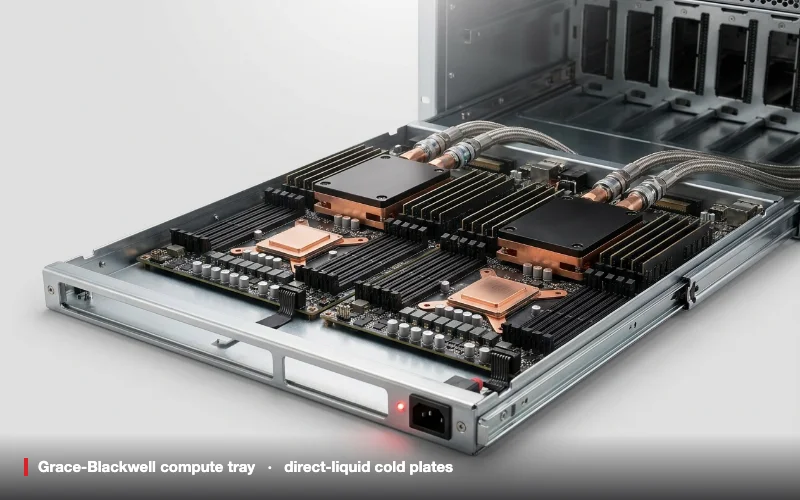
- Liquid-cooled serviceability is tray-level with quick-disconnect fittings — no loop drain — but demands trained hands and in-country spares to keep MTTR in hours.
- Contract the operating model with the hardware: spares location, response SLA, escalation depth and firmware management belong in the purchase negotiation.
What actually fails, and how often
Fleet studies and operator playbooks agree on the ranking: GPU and HBM memory errors first (including silent-degradation modes like row-remapping exhaustion and rising correctable-error rates), then interconnect — flapping NVLink lanes, optics and cables — then software/driver faults, with liquid-cooling incidents rare but high-consequence. Two operational truths follow. First, failures cluster early: burn-in at commissioning (48–72 hours of full-load stress with DCGM diagnostics) surfaces infant mortality before production does. Second, degradation precedes failure: a GPU whose ECC correctable errors trend upward or whose clocks throttle under stable thermals is announcing its exit — fleets that act on these signals convert crashes into scheduled swaps.
The monitoring stack that earns its keep
The base layer is NVIDIA DCGM: continuous background health checks, on-demand deep diagnostics (memory stress, compute stress, PCIe and NVLink bandwidth verification), and Prometheus-exportable metrics. Layer on: thermal and power telemetry per tray correlated with facility CDU data (a rising GPU-temperature-at-constant-load curve is a coolant-flow problem, not a GPU problem); NVLink/fabric error counters with per-lane granularity; and job-level correlation so a failed training step maps to a component in minutes. Operator experience collected in guides like Introl’s monitoring playbook credits systematic monitoring with up to ~70% reduction in failure-related downtime — the highest-ROI line in the ops budget.
Checkpoint discipline: the arithmetic of interruptions
For training and fine-tuning, decide checkpoint cadence by expected-loss math: if an interruption costs the time since the last checkpoint plus restart overhead, and your system’s interruption rate is once per N hours, checkpointing every 30–60 minutes bounds the loss to trivial while a daily checkpoint gambles a shift’s compute. The enabling requirement is storage bandwidth — writing a multi-terabyte state in minutes rather than an hour — which is a first-class sizing input in our checkpoint storage guide. For serving fleets, the equivalent discipline is graceful drain: health-triggered removal of a degrading GPU from the serving pool before it fails mid-request.
Servicing a liquid-cooled monolith
Modern rack-scale designs made the right serviceability trade: compute trays connect to the cooling manifold through quick-disconnect fittings, so a tray swap does not drain the loop, and deployment guides such as Leviathan’s GB300 commissioning walkthrough describe tray-level replacement as the standard field operation. What that still requires: technicians trained on wet-mate procedures and torque specs, leak-detection verification after every intervention, ESD and lifting equipment for 30–60 kg trays, and — the India-specific line — spares stocked in-country. A tray that must clear customs turns a four-hour MTTR into a two-week outage; make spare-pool location and replenishment SLA explicit contract terms, alongside the facility obligations covered in our facility readiness guide.
Operational readiness checklist
| Domain | Minimum standard | Failure it prevents |
|---|---|---|
| Commissioning | 48–72 h burn-in + DCGM full diagnostics | Infant-mortality faults in production |
| Monitoring | DCGM + thermal/power/fabric telemetry, alerting on trends | Silent degradation becoming job-killing failure |
| Checkpointing | 30–60 min cadence, minutes-level restore, tested monthly | Hours of lost training per interruption |
| Service | Trained tray-swap capability + in-country spares, SLA’d | Weeks-long MTTR on imports |
| Firmware | Staged updates, rollback plan, change windows | Fleet-wide regressions from unstaged updates |
| Runbooks | Leak response, thermal excursion, fabric flap — rehearsed | Improvisation during high-consequence incidents |
Frequently asked questions
How often will a single rack-scale system fail?
No public per-rack MTBF exists; extrapolating fleet data, expect component-level events monthly-to-quarterly on a 72-GPU system — mostly GPU/HBM and link errors caught by monitoring. The operational goal is converting them to scheduled swaps, not preventing them outright.
Does a tray swap take the whole rack down?
Typically no — quick-disconnect liquid fittings allow tray-level service, and schedulers or serving pools drain the affected GPUs. Jobs spanning the full NVLink domain do pause; checkpoint discipline bounds the cost.
What team does one rack need?
Not a large one: a competent infrastructure engineer with GPU-fleet training, a service contract with tray-level response, and monitoring wired to someone’s pager. The skills gap is liquid-cooling procedure and fabric diagnostics — both trainable, both contractible.
Is silent data corruption a real risk?
Yes at scale — degrading HBM and interconnect can corrupt without crashing. Mitigations: ECC monitoring with trend alerts, periodic DCGM deep diagnostics, loss-curve anomaly review during training, and evaluation-set regression checks on serving fleets.
Should firmware updates be applied promptly?
Deliberately, not promptly: stage on a maintenance window with rollback verified, one system before fleet. GPU firmware regressions are rare but expensive; a quarter-old stable version usually beats last week’s release for production racks.
Ready to deploy?
Talk to an RDP architect about power, cooling and lead time.