
Hosting 100 kW Racks in India: Facility Readiness for Rack-Scale AI
Overview
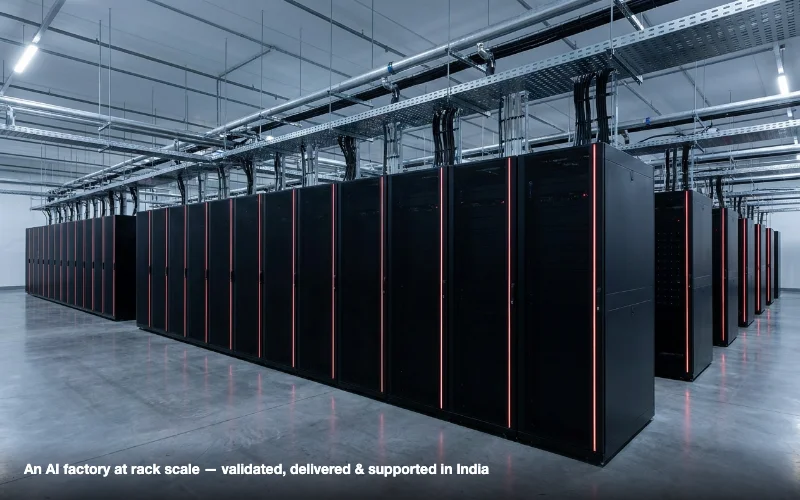
A single DRACO-class rack-scale system — a GB300 NVL72 draws roughly 120–140 kW in one cabinet — exceeds the design density of most Indian datacenter halls built before 2024, so facility readiness, not hardware availability, is the long pole in flagship AI deployments. The market is moving fast: India’s colocation build-out is targeting a reported 15 GW within five years, from under 2 GW today, with AI-ready campuses rising in Mumbai, Hyderabad, Pune, Chennai and Visakhapatnam — but buyers signing for a 2026–27 deployment must verify liquid-cooling capability, floor loading and power contracts hall by hall, not trust market headlines. This guide is the facility checklist for 100 kW+ rack deployments in India.
Key takeaways
- Above roughly 35 kW/rack direct-to-chip liquid cooling becomes effectively mandatory; a 120 kW NVL72-class rack is designed around it from the start.
- The facility must supply coolant distribution (CDUs), facility water loops, 415 V three-phase power at unprecedented per-rack amperage, and ~1.5–2 tonne point floor loading.
- India’s AI-ready capacity is concentrated in new-build campuses; legacy halls in the same cities usually cannot be retrofitted economically past ~50 kW/rack.
- Cooling can consume up to ~40% of the power bill when poorly engineered — PUE commitments belong in the colo contract, not the brochure.
- On-premises 100 kW+ deployment is feasible for campuses with spare MW-scale power, but permitting, DG backup and water infrastructure typically add 9–18 months.
Why one rack now breaks a whole hall
Legacy Indian colo halls were engineered for 4–10 kW racks with room-level air cooling; premium halls stretched to 20–30 kW with containment. A rack-scale AI system concentrates a hall row’s worth of load into one cabinet: 120 kW+ of IT load, matching heat rejection, and a mass approaching two tonnes on casters. Analyses of 100 kW-class rack engineering, such as Introl’s build guide, make the practical point: everything — busbar ampacity, breaker coordination, CDU placement, leak detection, floor structure — must be designed for the density, which is why AI capacity in India is overwhelmingly new-build rather than retrofit.
The liquid cooling stack a DRACO-class rack expects
NVL72-class systems ship with direct-to-chip cold plates and expect the facility to provide the other half of the loop: rack- or row-level CDUs exchanging heat into a facility water system, supply temperatures per the manufacturer’s window (warm-water designs improve efficiency and suit Indian ambient conditions), redundant pumps, and leak detection with automated isolation. Air still matters — 10–15% of the load (NICs, drives, PSUs) rejects to air even in liquid-cooled racks. The rack-versus-cooling decision logic is covered in our containerised AI factory article — containerised and modular deployments exist precisely to bypass hall retrofit constraints.
Questions that separate AI-ready colos from AI-marketed ones
Put these in the RFP. What contiguous kW can you deliver to a single rack position today — and what is contracted versus planned? Which liquid cooling topology do you support (rack CDU, row CDU, immersion), and who owns the CDU maintenance? What PUE do you commit to at my density, measured how? What is the floor’s point-load rating on the delivery path as well as the final position? What is the utility power story — dedicated feeder, DG backup sized for the full liquid-cooled load, renewable pairing? Mumbai, Hyderabad and Chennai new-builds increasingly answer all five well; the same brands’ older halls often cannot — verify the specific building, not the operator.
On-premises and sovereign deployments
Enterprises and public-sector buyers with data-residency mandates — the pattern pushed by the DPDP Act and IndiaAI Mission sovereign-compute programmes — sometimes need the rack on their own campus. Feasibility gates: MW-scale spare power with utility and DG redundancy, space for external heat rejection (dry coolers or cooling towers, with water availability a real constraint in several Indian metros), structural floor capacity, and staff or a service partner for liquid-loop operations. Expect 9–18 months from decision to first token for a greenfield room, versus weeks into a ready colo position — a schedule difference that often decides the whole architecture, as discussed in our sovereign AI cluster reference architecture.
Facility readiness checklist
| Domain | Requirement for 120 kW rack | Legacy hall typical | Verify by |
|---|---|---|---|
| Power to rack | 415 V 3-phase, ~200 A-class feed, A+B | 32–63 A feeds | Busbar/breaker schedule, site walk |
| Cooling | DTC liquid loop + CDU + 10–15 kW air | Room/row air only | CDU spec, water loop P&ID, PUE commitment |
| Floor | ~1.5–2 t point load + delivery path | 800–1,200 kg/m² | Structural certificate |
| Backup | DG + UPS sized for full liquid-cooled load incl. pumps | IT-load-only sizing | Single-line diagram review |
| Operations | Liquid-loop SLAs, leak response, spares in-country | Air-era runbooks | Contract SLA annex |
Frequently asked questions
Can any existing Indian datacenter host a GB300-class rack?
Only halls engineered or upgraded for direct-to-chip liquid cooling and ~120 kW+ rack positions — overwhelmingly new-build AI campuses in metros like Mumbai, Hyderabad, Chennai and Pune. Verify the specific hall’s delivered (not planned) capability.
Is immersion cooling required at this density?
No — current rack-scale systems are engineered for direct-to-chip cold plates with facility water. Immersion is an alternative pursued in some designs above 100 kW but is not what NVL72-class products expect.
What does the facility side add to project cost?
In colo, expect premium per-kW pricing for liquid-cooled positions plus CDU service fees; on-premises, the mechanical-electrical fit-out for a single-rack room commonly rivals a mid-six-figure (USD) hardware line and 9–18 months of schedule.
How much of the power bill goes to cooling?
Poorly engineered facilities can burn up to ~40% of total power on cooling; well-designed warm-water liquid systems bring facility overhead down dramatically. Contract a measurable PUE at your density rather than accepting campus-average marketing figures.
Does India have enough datacenter capacity for AI deployments?
The pipeline is large — operators target roughly 15 GW within five years against under 2 GW installed — but AI-ready liquid-cooled positions remain scarce and are contracted early. Reserve capacity in parallel with hardware procurement, not after.
Ready to deploy?
Talk to an RDP architect about power, cooling and lead time.