
Quality Inspection at Line Rate: Latency Budgets and Edge GPU Choice
Overview
Inline visual inspection is the most common industrial AI deployment and the one most often specified incorrectly. Teams benchmark a model at some frames per second, conclude the hardware is adequate, and then discover in commissioning that the system misses parts. The reason is that line-rate inspection is governed by a hard deadline per part, not by average throughput: if the line indexes every 900 milliseconds, every stage from camera trigger to reject actuator must complete inside that window, every time. This article shows how to construct that budget and choose hardware against it.
Key takeaways
- Cycle time is the specification — parts per minute converts directly into a hard per-part deadline.
- Budget every stage, not just inference: trigger, capture, transfer, preprocess, infer, post-process, actuate.
- p999 decides acceptance — one missed deadline per thousand parts is a real escape rate.
- Image transfer and preprocessing often exceed inference on high-resolution cameras.
- Determinism beats peak speed — fixed batch of one, pinned memory, no dynamic allocation.
Converting line speed into a deadline
Begin with the mechanical reality. A line producing 60 parts per minute gives one second per part; at 120 parts per minute it is 500 milliseconds. The inspection system does not get all of that: the part must be in position and stable before capture, and the reject mechanism must actuate before the part leaves the station. What remains for the vision system is typically 50 to 70 percent of the nominal cycle.
From that residual, subtract the stages you do not control: camera exposure and readout, image transfer over the interface, and actuator response. What is left is the compute budget, and it is often far tighter than the model benchmark suggested. Doing this arithmetic before selecting hardware avoids the most expensive class of commissioning surprise.
Where the time actually goes
| Stage | Typical share of budget | Main risk |
|---|---|---|
| Trigger and settle | Fixed, mechanical | Vibration extends settle time |
| Exposure and sensor readout | 5-20 ms | Low light forces longer exposure |
| Image transfer to host | 5-30 ms | Scales with resolution and interface |
| Preprocessing and transfer to GPU | 5-25 ms | Often larger than expected |
| Model inference | 5-40 ms | The stage everyone benchmarks |
| Post-processing and decision | 1-10 ms | Non-maximum suppression can spike |
| Actuation signal | Fixed, mechanical | PLC scan cycle adds latency |
The row that surprises teams is preprocessing and host-to-GPU transfer. A 20-megapixel image is tens of megabytes; moving and converting it can cost more time than running the network on it. Keeping preprocessing on the GPU, using pinned memory and avoiding unnecessary format conversions frequently recovers more latency than upgrading the accelerator.
Why p999 is the acceptance criterion
An inspection system that meets its deadline 99.9 percent of the time misses one part per thousand. On a line producing a million parts a year that is a thousand uninspected parts, and because misses cluster around whatever causes the latency spike, they are not randomly distributed across defect types. For safety-relevant or regulated products that is not acceptable.
Latency spikes in GPU inference come from predictable sources: memory allocation during a request, garbage collection or Python interpreter pauses in the host application, dynamic batching waiting for a batch that never fills, driver-level power state transitions, and contention from any other process sharing the GPU. Each has a deterministic fix, and together they usually matter more than the choice of accelerator.
Designing for determinism
Five practices make the difference. Fix batch size at one and disable dynamic batching, accepting lower throughput for predictable latency. Pre-allocate all buffers at startup and never allocate during a cycle. Pin the model in memory and lock GPU clocks to avoid power-state transitions. Dedicate the GPU to the inspection process rather than sharing it with analytics or a second station. And keep the hot path out of interpreted code where possible, or at minimum out of any path that can trigger garbage collection.
These are the same disciplines that apply to robot control loops, and for the same reason — both are hard-deadline systems wearing the clothes of a throughput system. The edge deployment context is developed in the manufacturing vision AI edge deployment playbook.
Edge device or cell server
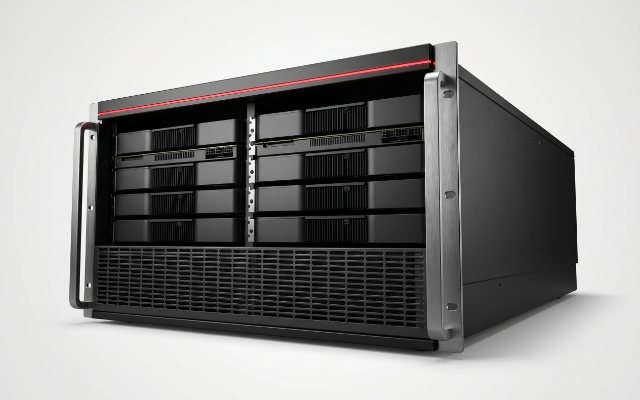
The choice follows from station count and camera count. A single station with one or two cameras is well served by a compact edge device mounted near the line: low power, no additional cabinet, short cable runs. Several stations, or a station with many high-resolution cameras, is better served by a ruggedised server in a cell cabinet, because consolidating avoids managing a dozen separate devices and gives headroom for model updates.
The threshold in practice is around four to six camera streams, or wherever image transfer distance becomes awkward. Two constraints push toward the cabinet in Indian plants specifically: ambient temperature, since a sealed edge device in a hot plant throttles, and physical security of the hardware. Against that, a cabinet needs conditioned power and a network path with deterministic latency to each station, which is its own engineering task. The comparison of both patterns is in the manufacturing vision AI GPU server playbook.
What to put in the acceptance test
Specify the deadline, not the frame rate. A credible acceptance test runs at full line rate for a sustained period — a full shift at minimum — and reports the distribution of end-to-end latency from trigger to decision, including p99 and p999, plus a count of any cycle that exceeded the deadline. It should run with the line in its normal state, including whatever vibration, lighting variation and network traffic normally exist.
Add two clauses. A degraded-mode test: what the system does when it cannot complete in time, which should be an explicit safe behaviour such as flagging the part for manual inspection rather than passing it silently. And a thermal soak, running the same test at the highest ambient temperature the location reaches, since throttling under Indian summer conditions is a common late discovery. The general sizing method sits in sizing GPU compute for computer vision.
Frequently asked questions
How do I convert line speed into an inspection latency budget?
Divide 60 by parts per minute to get cycle time, then subtract mechanical settle time and actuator response. The vision system typically gets 50 to 70 percent of nominal cycle, and from that you subtract capture, transfer and preprocessing to find the compute budget.
Why does p999 latency matter for inspection?
Because a missed deadline means an uninspected part. At 99.9 percent compliance a line producing a million parts a year has a thousand escapes, and misses cluster around whatever causes the spike rather than distributing randomly across defect types.
What causes latency spikes in GPU inference?
Memory allocation during a request, interpreter or garbage collection pauses, dynamic batching waiting for an unfilled batch, GPU power-state transitions, and contention from other processes. Each has a deterministic fix, and together they usually matter more than the accelerator choice.
Is preprocessing really slower than inference?
Often, on high-resolution cameras. A 20-megapixel image is tens of megabytes to transfer and convert. Keeping preprocessing on the GPU, using pinned memory and avoiding format conversions frequently recovers more latency than a faster accelerator would.
Should I use an edge device or a cell server?
An edge device for one station with one or two cameras; a ruggedised cell-cabinet server above roughly four to six streams or several stations. In Indian plants, ambient temperature and hardware security push toward the cabinet, but it needs conditioned power and deterministic network paths.
Ready to deploy?
Talk to an RDP architect about power, cooling and lead time.