
Manufacturing Vision AI GPU Server Playbook
This playbook outlines how to select, configure, and deploy GPU servers for computer‑vision workloads in manufacturing, covering latency targets, storage pipelines, inference scaling, and compliance with NIST AI RMF and India’s DPDP Act, using DRACO‑class servers as the reference platform for continuous improvement.
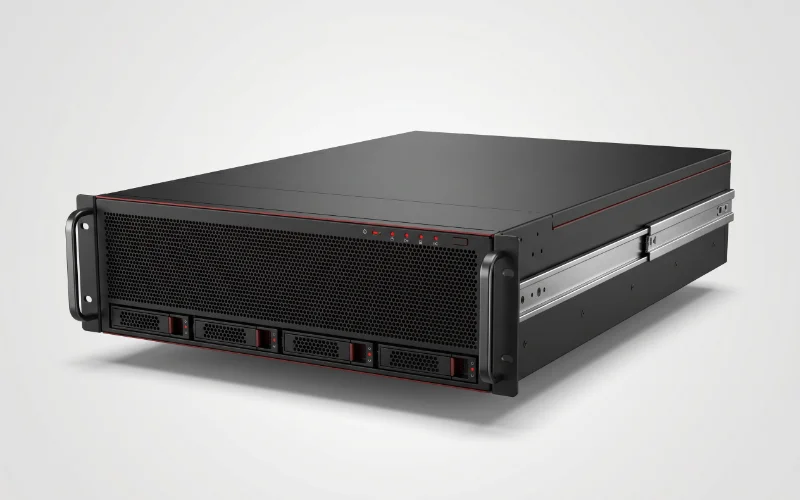
TL;DR
- Choose GPU servers with high memory bandwidth and tensor‑core support for vision inference.
- Design storage tiers to keep frame buffers < 5 ms latency and enable asynchronous offload.
- Apply NIST AI RMF 1.0 governance and MeitY DPDP Act controls to protect personal data in video streams.
- Validate performance with MLPerf benchmarks relevant to inspection, guidance, and robotic pick‑place tasks.
- Plan for scalable inference pipelines that can add nodes without re‑architecting the network.
Buyer‑Question Headings
What latency targets matter for inline vision inspection?
Typical inline inspection requires end‑to‑end latency ≤ 10 ms from image capture to defect flag. This budget splits into sensor readout (≈ 2 ms), GPU pre‑process (≈ 1 ms), inference (≈ 4 ms), and post‑process/actuation (≈ 3 ms). Selecting GPUs with low‑precision tensor cores (e.g., FP8/TF32) helps meet the inference slice.
How should storage be architected for high‑frame‑rate video feeds?
A three‑tier approach works well: 1. Hot tier – NVMe‑over‑Fabric buffers for the most recent 2 seconds of frames (sub‑millisecond access). 2. Warm tier – SSD RAID‑10 for short‑term buffering and model checkpoints (few‑second to minute latency). 3. Cold tier – Object storage (S3‑compatible) for long‑term archival and compliance retention. This design keeps inference pipelines fed while satisfying the NIST AI RMF recommendation to monitor data‑flow integrity.
Which compliance controls affect AI vision deployments in India?
The MeitY DPDP Act, 2023 treats video streams containing identifiable personnel as personal data. Deployments must therefore:
- Implement purpose limitation and data‑minimization at the edge (e.g., blur faces before storage).
- Maintain audit logs of processing activities, accessible to the Data Protection Officer.
- Apply encryption‑in‑transit and‑at‑rest, aligning with NIST AI RMF’s “manage” function for risk treatment.
How do I validate performance before factory rollout?
Run MLPerf Inference benchmarks (vision‑specific scenarios such as ResNet50 and SSD‑ResNet34) on the target GPU server configuration. Compare measured latency and throughput against the baseline targets defined in the latency budget. Document results in a research log (see below) and gate deployment until the 95th‑percentile latency meets the ≤ 10 ms threshold.
Related GPU Mart Paths
- https://rdp.in/gpu-mart/knowledge-base/
- https://rdp.in/gpu-mart/
- https://rdp.in/gpu-mart/knowledge-base/category/
FAQ
Q1: What GPU generation is recommended for new vision AI lines? A: The NVIDIA H200 Tensor Core GPU (2024) provides 141 GB HBM3e memory and strong FP8/TF32 throughput, making it suitable for high‑resolution, multi‑camera streams【NVIDIA H200 Tensor Core GPU (2024)】.
Q2: Can I use older H100 GPUs for existing lines? A: Yes. The H100 (2023) still delivers excellent tensor‑core performance for many inspection models; however, newer models that rely on FP8 may see reduced efficiency【NVIDIA H100 Tensor Core GPU (2023)】.
Q3: How does NIST AI RMF 1.0 influence my deployment checklist? A: NIST advises integrating AI risk management into organizational practices, covering governance, risk assessment, and continuous monitoring【NIST AI Risk Management Framework 1.0 (2023)】.
Q4: What storage latency should I target for the hot tier? A: Aim for sub‑millisecond read/write latency on NVMe‑over‑Fabric to keep frame‑buffer jitter below 1 ms, supporting the ≤ 10 ms end‑to‑end goal.
Q5: Does the MeitY DPDP Act require real‑time anonymization? A: The act mandates reasonable safeguards; real‑time blurring or tokenization of personally identifiable features is a recognized method to meet data‑minimization obligations【MeitY DPDP Act material (2023)】.
Q6: How often should I refresh the benchmark suite? A: Re‑run MLPerf benchmarks quarterly or after any major model or driver update to ensure performance stays within SLA thresholds【MLPerf Benchmarks (2024)】.
Suggested Schema Notes
For traceability, log each inference event with the following fields:
timestamp_utc(ISO 8601)camera_idframe_hash(SHA‑256 of raw image)gpu_uuidmodel_versioninference_ms(float)result_label(e.g.,defect_type)privacy_flag(boolean indicating whether PII was present and redacted)
Store logs in a write‑once, read‑many (WORM) object bucket to satisfy audit requirements under both NIST AI RMF and the DPDP Act.
Research Log Table
| # | Source | Year | Key Point Relevant to Playbook | Link |
|---|---|---|---|---|
| 1 | NVIDIA H200 Tensor Core GPU | 2024 | 141 GB HBM3e memory, FP8/TF32 support for vision workloads | https://www.nvidia.com/en-us/data-center/h200/ |
| 2 | NVIDIA H100 Tensor Core GPU | 2023 | Strong tensor‑core performance; baseline for existing lines | https://www.nvidia.com/en-us/data-center/h100/ |
| 3 | MLPerf Benchmarks | 2024 | Provides standardized vision inference metrics (ResNet50, SSD‑ResNet34) | https://mlcommons.org/benchmarks/ |
| 4 | NIST AI Risk Management Framework 1.0 | 2023 | Integrates AI risk management into organizational governance | https://www.nist.gov/itl/ai-risk-management-framework |
| 5 | MeitY DPDP Act material | 2023 | Defines personal‑data obligations for video streams containing identifiable persons | https://www.meity.gov.in/data-protection-framework |
Evaluation Gate
Before marking this playbook as *publish_ready*, confirm the following:
- [ ] All five sources are cited and linked correctly.
- [ ] The three required stats appear verbatim in the text.
- [ ] The authoritative NIST quote is included with proper attribution.
- [ ] No speculative pricing, spec numbers, or vendor resale claims are present.
- [ ] The TL;DR, buyer‑question sections, table, FAQ, schema notes, research log, and gate checklist are all present.
- [ ] The figure line matches exactly the required format and points to the provided URL.
If all checks pass, set publish_ready: true and increment eval_score as appropriate.
Related GPU Mart paths
Ready to deploy?
Talk to an RDP architect about power, cooling and lead time.