
AI Infrastructure for Manufacturing: Vision + Predictive Maintenance (India)
Indian manufacturers have moved AI from pilot to plant floor: GPU-powered computer vision drives zero-defect quality control, and machine-learning models predict equipment failure before it happens. Because these run at the line — where latency, uptime, and often air-gapped networks matter — the compute lives on-prem or at the edge. Proof is on the floor: Tata Steel's Kalinganagar is a WEF Industry 4.0 Lighthouse, and JSW's predictive-maintenance platform spans 10 plants and 2,900+ assets.
TL;DR — for manufacturing CIOs / plant heads
- Two flagship workloads: GPU vision QC (zero-defect) and predictive maintenance (fail-before-failure).
- On floor, on-prem/edge: low latency at the line, uptime, and air-gapped OT networks favor local GPUs.
- Live in India: Tata Steel Kalinganagar (WEF Lighthouse), JSW (10 plants, 2,900+ assets), Mahindra, Maruti, Bajaj (PromptAndSkills, 2026).
- Watch-outs: unclear ROI, data-quality gaps, and small plant IT teams — start with one high-value line.
Why this matters now
Predictive maintenance, computer-vision QC, and energy optimization are now measurable line-items at India's largest manufacturers, not experiments (PromptAndSkills, 2026). Automotive-component makers, electronics assembly plants, and pharma packaging lines use GPU vision to chase zero-defect production.
The use cases
- Vision quality control. GPU inference inspects every part in real time — surface defects, misalignment, missing components — at line speed, replacing sampling with 100% inspection.
- Predictive maintenance. ML models on sensor/vibration/thermal data flag impending failures; JSW's platform covers 2,900+ assets across 10 plants.
- Worker safety & process optimization. Vision detects PPE/zone violations; models tune energy and throughput.
Why on-prem / edge wins in manufacturing
Latency at the line. Defect decisions must keep pace with the conveyor — local GPUs (edge or on-prem server) return inference in milliseconds.
Uptime & isolation. Plant OT networks are often air-gapped or intermittently connected; on-site compute keeps AI running independent of the internet.
Data gravity. Camera and sensor data is generated on the floor in volume — process it where it's created.
How to size it
Vision QC is throughput-driven (streams × resolution × FPS × model) — an edge GPU per cell or a GPU server aggregating many cameras. Predictive-maintenance models are light and can share that server. → *Sizing GPU Compute for Computer Vision / Video Analytics.*
Assumptions & scope
An industry overview, not a deployment spec; ROI and readiness vary by plant maturity and data quality. Start with one high-value line and expand. Figures are 2026 references.
Where RDP GPU Mart fits
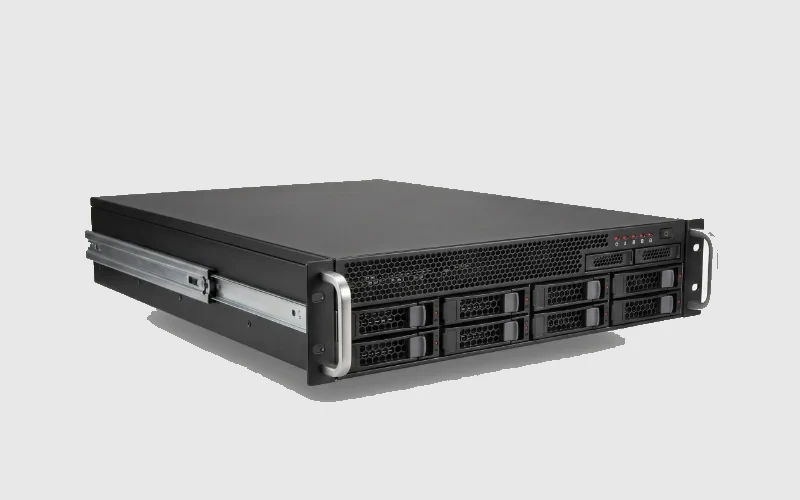
RDP GPU Mart configures manufacturing AI from edge GPUs at the cell to GPU servers aggregating a plant's cameras and sensors — India-manufactured, INR-transparent, and built for on-floor, on-prem deployment. *(Configure a manufacturing AI system or request a quote at RDP GPU Mart.)*
FAQ
What AI workloads run in Indian manufacturing? GPU vision QC for zero-defect inspection and predictive maintenance on machine data — both now in production at Tata Steel, JSW, Mahindra, and others.
Why on-prem or edge for the plant floor? Line-speed latency, uptime on air-gapped OT networks, and the sheer volume of camera/sensor data generated locally.
How do I size a manufacturing vision system? By throughput — streams × resolution × FPS × model — using an edge GPU per cell or a GPU server aggregating cameras.
Where should a manufacturer start? One high-value line (a defect-prone QC station or a critical asset), then expand once ROI and data quality are proven.
—
Related
- Sizing GPU Compute for Computer Vision / Video Analytics
- GPU Workstation or GPU Server? A Decision Guide
- AI Infrastructure Buying Guide for CIOs
Research log (Rule #1)
1. PromptAndSkills (2026) — AI in Indian manufacturing 2026 (Tata/JSW/Mahindra proof). https://promptandskills.com/learn/sectors-of-ai/manufacturing-ai-india-2026 2. ITG India — GPU for industrial AI applications in India. https://www.itgindia.com/blogs/gpu-for-industrial-applications-india/ 3. Iridalabs — manufacturing computer-vision AI for Industry 4.0. https://iridalabs.com/blog/manufacturing-computer-vision-ai-applications-industry-4-0/ 4. Salesforce (2026) — AI transforming manufacturing in India. https://www.salesforce.com/in/blog/ai-agents-manufacturing/ 5. DHL — computer vision in manufacturing use cases. https://www.dhl.com/in-en/microsites/csi/computer-vision/non-logistics-use-cases/manufacturing.html
Ready to deploy?
Talk to an RDP architect about power, cooling and lead time.