
CDUs Explained: Sizing Coolant Distribution for 50-200 kW AI Racks
Overview
Once a rack passes roughly 30-50 kW, air stops working and the conversation moves to liquid. The component that makes liquid cooling a system rather than a plumbing diagram is the coolant distribution unit (CDU): the pump, heat exchanger, filtration and control loop sitting between the cold plates on your GPUs and the building’s heat rejection. Choose it badly and you get either an underperforming cluster or a stranded facility investment. This article covers the CDU types, how sizing actually works, and why supply temperature is the specification with the biggest long-term cost impact in Indian conditions.
Key takeaways
- A CDU isolates two loops — a clean secondary loop to the servers, and the facility primary loop.
- L2L needs facility water; L2A does not — liquid-to-air rejects heat to room air, useful where no water loop exists.
- Capacities span a wide range — in-rack L2A units from around 5-20 kW, in-row L2A up to about 240 kW, L2L supporting 50 kW to 200+ kW per rack.
- Differential pressure matters as much as kW — if you have not specified minimum dP at the required flow, you have not specified a CDU.
- Warmer supply saves money — 40-45 C supply versus 30-35 C enables far more free-cooling hours; roughly 15-25% annual cooling energy per 5 C.
What a CDU actually does
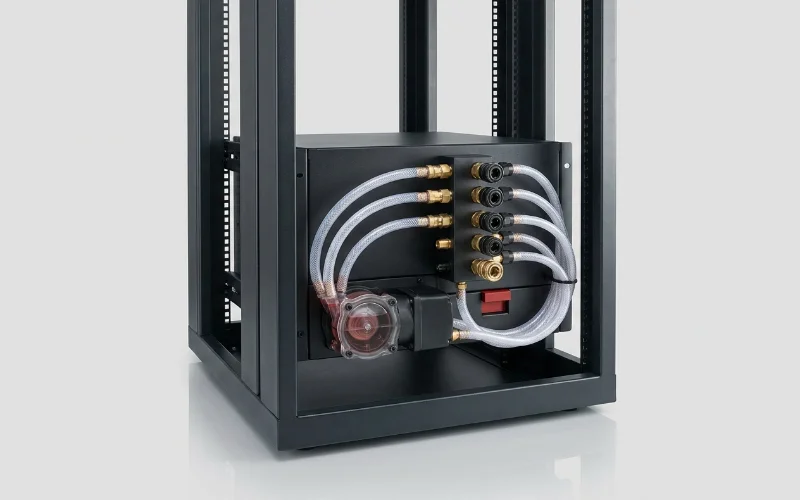
Direct-to-chip liquid cooling runs coolant through cold plates mounted on GPUs and CPUs. That coolant must be pumped, kept clean, held at the right temperature and pressure, and its heat moved out of the room. The CDU does all four. Critically, it separates the secondary loop — the controlled, filtered circuit that touches your expensive hardware — from the primary loop, which is facility water or a chilled-water plant. That isolation is the point: server cold plates have narrow channels intolerant of particulates and chemistry problems, and you do not want building water in them.
Liquid-to-liquid versus liquid-to-air
L2L CDUs transfer heat from the technology cooling system into facility water, and suit sites with a stable existing water loop. They carry the highest densities, supporting roughly 50 kW to 200+ kW per rack — the range required by H100, H200 and MI300X class clusters. L2A CDUs reject heat to air instead, needing no facility water at all. That makes them valuable for retrofits, single-rack pilots, and buildings where plumbing a water loop is impractical or slow. The trade is that the heat still lands in your room, so room-level cooling must absorb it.
Form factors and where they fit
| Form factor | Typical capacity | Facility water | Best fit |
|---|---|---|---|
| In-rack L2A | ~5-20 kW | Not required | Single rack, pilot, edge site |
| In-row L2A | Up to ~240 kW | Not required | Retrofit rows without a water loop |
| Sidecar L2A | Rack-scale (e.g. ~200 kW class) | Not required | Beside the rack; no plumbing works |
| In-row / floor-mount L2L | 50 kW to 200+ kW per rack | Required | Purpose-built AI halls at scale |
Sidecar units are physically substantial — a published example measures roughly 1,100 x 1,415 x 2,000 mm and weighs about 1,145 kg dry — so floor loading and aisle space are part of the decision, not an afterthought.
Sizing: the numbers that actually matter
Three disciplines separate a specification from a wish. First, size on peak IT load, not average — training runs hold sustained near-peak draw for hours, unlike enterprise workloads. Second, specify the pump curve and pressure-drop budget across the whole secondary loop: manifolds, hoses, quick-disconnects and cold plates all consume differential pressure, and a CDU that meets your kW figure but cannot deliver minimum dP at required flow will not cool the servers. Third, plan the redundancy mode explicitly — N, N+1 or 2N — because a pump failure in a liquid-cooled rack is a thermal event on a timescale of seconds, not minutes.
Why supply temperature is the Indian lever
The single most consequential number for operating cost is the CDU supply temperature. Running a warmer supply of 40-45 C rather than 30-35 C allows far more hours of free cooling without mechanical chillers, with published guidance suggesting every 5 C increase can cut annual cooling energy by roughly 15-25%. This matters more in India than in temperate markets: warm-water cooling means many sites can reject heat with dry coolers for a large part of the year rather than running chillers continuously. Modern GPUs are designed for warm-water operation, so the constraint is usually facility design and operator comfort rather than the silicon. Pair this with our water quality guidance and the 100 kW facility readiness checklist before finalising a design.
Frequently asked questions
What is a CDU in data center cooling?
A coolant distribution unit contains the pump, heat exchanger, filtration and controls that circulate coolant through server cold plates. It isolates the clean secondary loop serving your hardware from the facility primary loop.
What is the difference between L2L and L2A CDUs?
Liquid-to-liquid units transfer heat into facility water and support the highest densities, roughly 50 kW to 200+ kW per rack. Liquid-to-air units reject heat to room air and need no facility water, which suits retrofits and pilots, but the heat remains in the room.
How do I size a CDU?
Size on peak IT load rather than average, then verify the pump can deliver the required flow at the minimum differential pressure across your entire secondary loop including manifolds, hoses and cold plates. Decide redundancy mode explicitly, since pump failure is a fast thermal event.
Should I run warmer coolant?
Generally yes. Supply at 40-45 C rather than 30-35 C enables many more free-cooling hours, with published guidance of roughly 15-25% lower annual cooling energy per 5 C increase. Modern GPUs are designed for warm-water operation.
Can I deploy liquid cooling without facility water?
Yes, using liquid-to-air CDUs in in-rack, in-row or sidecar form. They avoid plumbing work entirely, which is why they suit single-rack pilots and retrofits, but room cooling must absorb the rejected heat.
Ready to deploy?
Talk to an RDP architect about power, cooling and lead time.