
Reference Architecture: 8× H200 On-Prem AI Training Node
This reference architecture specifies a single 8× NVIDIA H200 GPU node — the standard building block for on-prem AI training and heavy inference. It delivers 1,128 GB of HBM3e (8 × 141 GB) joined by in-node NVLink, scales out to multi-node clusters over NDR InfiniBand, and draws roughly 10 kW at the node. It fits full fine-tuning of 70B models, inference of models up to 405B (quantized), and is the atomic unit you replicate to build a cluster.
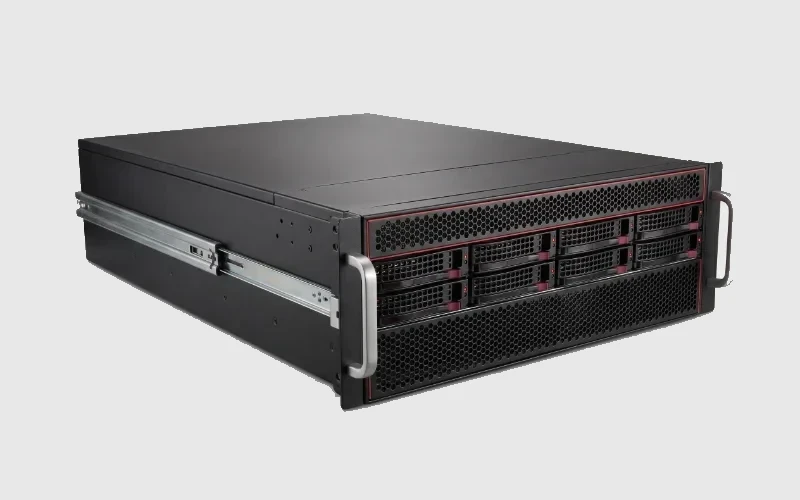
TL;DR — what's validated
- Compute: 8× H200 SXM = 1,128 GB HBM3e, ~4.8 TB/s per GPU, fused by NVLink into one node-scale accelerator.
- Scale-out: NDR InfiniBand (400 Gbps/dir, ConnectX-7) across nodes for gradient sync.
- Facility: ~10 kW/node; air-coolable at single-node density, liquid recommended as you pack nodes into dense racks.
- Fits: full fine-tune of 70B; inference to 405B (quantized); the repeatable unit for cluster growth.
Overview & the building block
The atomic unit is one 8-GPU node. Everything larger is a multiple of it: two nodes, a rack, a scalable unit. Designing in nodes keeps capacity, power, and network planning predictable.
Key components
Compute — GPU. 8× NVIDIA H200 SXM, 141 GB HBM3e each (1,128 GB aggregate), ~4.8 TB/s bandwidth (NVIDIA H200 datasheet). NVLink joins the 8 GPUs so they train as one large accelerator.
Compute — CPU & memory. Dual server CPUs and ≥1–2 TB system RAM to feed data loaders and stage checkpoints; PCIe Gen5 for host-GPU and NIC bandwidth.
Networking. Two planes: in-node NVLink (GPU↔GPU at memory speed) and scale-out NDR InfiniBand (400 Gbps/direction, ConnectX-7) for multi-node gradient sync, plus out-of-band (OOB) management. Under-provisioning the scale-out fabric starves the GPUs during all-reduce.
Storage. An all-flash / parallel-FS tier fast enough to keep 8 GPUs saturated — training stalls on data loading more often than on FLOPS. → *Storage Architecture for AI Training.*
Software/management. Standard GPU stack (drivers, CUDA, NCCL), a training framework with ZeRO/FSDP for sharding, plus cluster scheduling and monitoring.
Design requirements (power, cooling, space)
- Power: GPUs ~5.6 kW (8 × 700 W) + CPUs/NICs/fans → ~10 kW/node; size PDUs and circuits accordingly.
- Cooling: a single node is air-coolable; as you consolidate nodes toward >35 kW/rack, move to direct-to-chip liquid (Network World, 2026). → *Air-Cooled vs Liquid-Cooled GPU Racks.*
- Space & environment: rack U-height, weight, airflow/coolant paths, ambient temperature, redundancy (N/N+1).
Validated configurations
- 1 node (this RA): 8× H200, single-server training/inference; full fine-tune of 70B; 405B inference (quantized).
- 2–4 nodes: NDR InfiniBand fabric, ZeRO-3 across nodes for larger training runs.
- Larger is supported but customer-specific — validated to a small scalable unit; beyond that, design to the workload.
Assumptions & scope
Dense 8× H200 SXM node; NDR InfiniBand scale-out; figures are planning specs — validate power/cooling with your facility and framework. Specs current July 2026; re-check the vendor datasheet.
Where RDP GPU Mart fits
The DRACO 8× H200 GPU server is exactly this node, built and supported in India — INR-transparent, DPDP-aware, and designed to scale from one node to a cluster. *(Configure the 8× H200 server or request a cluster quote at RDP GPU Mart.)*
FAQ
What can an 8× H200 node do? Full fine-tuning of a 70B model, inference of models up to 405B (quantized), and it's the repeatable unit for building larger clusters.
How much power does an 8× H200 node use? Roughly 10 kW (GPUs ~5.6 kW plus CPUs, NICs, and cooling).
Do I need InfiniBand? NVLink handles in-node; for multi-node training use NDR InfiniBand (400 Gbps/dir) or a lossless Ethernet fabric, or all-reduce stalls the GPUs.
Air or liquid cooling for this node? A single node is air-coolable; move to direct-to-chip liquid as you pack nodes past ~35 kW/rack.
—
Related
- Air-Cooled vs Liquid-Cooled GPU Racks
- InfiniBand vs Spectrum-X vs Ethernet for AI Clusters
- Storage Architecture for AI Training
Research log (Rule #1)
1. NVIDIA — H200 datasheet (141 GB HBM3e, 4.8 TB/s). https://www.nvidia.com/en-us/data-center/h200/ 2. Network World (2026) — AI rack densities make liquid cooling non-negotiable (>35 kW). https://www.networkworld.com/article/4149069/why-ai-rack-densities-make-liquid-cooling-nonnegotiable.html 3. Spheron (2026) — 8× H200 node memory (1,128 GB) context. https://www.spheron.network/blog/gpu-vram-requirements-fine-tune-llm-2026/ 4. Introl (2026) — H100/H200/B200 (NVLink, bandwidth). https://introl.com/blog/h100-vs-h200-vs-b200-choosing-the-right-nvidia-gpus-for-your-ai-workload 5. Syaala (2026) — GPU rack density timeline (kW/rack). https://syaala.com/blog/gpu-rack-density-timeline-2026
Ready to deploy?
Talk to an RDP architect about power, cooling and lead time.