
Vera Rubin NVL144: What the 2026 Training Platform Changes for Cluster Design
Overview
Vera Rubin NVL144 is the rack-scale platform NVIDIA has positioned to follow GB300 NVL72 for frontier training, with volume production reported for the second half of 2026. For cluster architects the practical answer is this: the scale-up domain stays rack-shaped, but memory, interconnect and power all step up together. That combination changes how many racks a given training run needs, and it changes what a facility has to support before the first rack arrives.
Key takeaways
- The rack stays the scale-up domain — 144 Rubin GPUs, updated Vera CPUs, NVLink 6 and ConnectX-9 in one liquid-cooled MGX rack.
- HBM4 is the headline change — a 2048-bit interface and a large bandwidth step over the HBM3e in Blackwell-class parts.
- NVLink 6 is reported at 3.6 TB/s per GPU of scale-up bandwidth, roughly double NVLink 5.
- Power is the gating item — Rubin-class racks continue the climb past 120 kW, and 800 VDC distribution lands with the generation after.
- Design the hall for the next platform, not the current one. Racks refresh in about three years; buildings do not.
What the NVL144 platform actually is
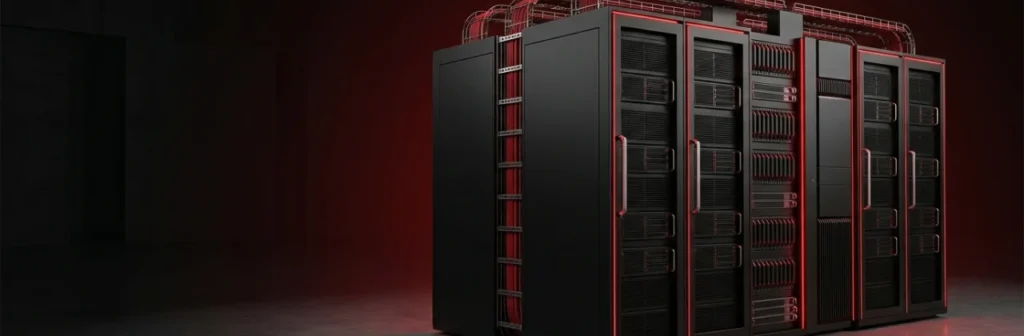
NVL144 is a rack, not a server. NVIDIA describes the Vera Rubin platform as six new chips assembled into one AI supercomputer: the Rubin GPU, the Vera CPU, NVLink 6 switches, ConnectX-9 NICs, plus the supporting DPU and scale-across silicon. The rack is liquid-cooled MGX, and reported figures put the platform at roughly 3.6 exaflops of FP4 compute with a variant (NVL144 CPX) positioned higher for inference-heavy prefill work.
The number that matters for design is 144 GPUs in a single NVLink domain. That is double the 72-GPU domain of GB300 NVL72, and it is the reason model-parallel strategies change: a tensor- or expert-parallel group that previously spanned two racks over the scale-out fabric can now sit inside one rack at NVLink speed. If your parallelism plan is currently shaped around a 72-GPU boundary, that plan gets simpler — and faster — on this platform.
HBM4: the specification that moves first
Rubin is an HBM4 part. The generational change is architectural, not incremental: HBM4 doubles the memory interface from 1024 bits to 2048 bits per stack, which is how it reaches bandwidth that HBM3e cannot approach at sane clocks. NVIDIA’s platform materials cite 288 GB of HBM4 per Rubin GPU at up to roughly 22 TB/s, a substantial multiple of Blackwell-generation HBM3e; independent reporting has cited differing per-die and per-package figures, so treat capacity numbers as provisional until final datasheets are published.
Why this matters more than FLOPS: large-model training is increasingly memory-bandwidth-bound, not arithmetic-bound. Optimiser states, activations and gradient buffers all move at HBM speed. When bandwidth roughly doubles while arithmetic throughput improves by a smaller ratio, the practical effect is higher achieved utilisation on the same model — which is a cheaper win than adding GPUs. Pair that with the precision work covered in FP8 to FP4 cluster sizing and the memory footprint per parameter falls at the same time the bandwidth to serve it rises.
NVLink 6 and ConnectX-9: the fabric keeps pace
A wider scale-up domain is only useful if the links inside it keep up. NVLink 6 is reported at 3.6 TB/s of scale-up bandwidth per GPU, roughly double NVLink 5 in Blackwell. That ratio is deliberate: doubling the domain size and doubling per-GPU link bandwidth keeps bisection behaviour roughly constant as the rack grows, so collectives do not degrade as you widen tensor parallelism.
Outside the rack, ConnectX-9 raises per-node scale-out bandwidth for the InfiniBand or Ethernet fabric that stitches racks into a cluster. The design discipline here has not changed — rail-optimised topology, non-blocking within a scalable unit, careful oversubscription only at the aggregation layer. Our note on GPU cluster networking still applies; the numbers move, the rules do not.
Power and cooling: the constraint that bites in India
This is where most Indian deployments will meet reality. Per-rack power went from roughly 40 kW in the Hopper era to about 120 kW with Blackwell, and Rubin-class racks continue upward — with NVIDIA already preparing an 800 VDC architecture for the megawatt racks that follow in 2027. Liquid cooling is not optional at this density; direct-to-chip with a facility water loop and CDUs is the assumed baseline for MGX racks.
Two practical consequences. First, a colocation contract signed for 10-15 kW racks is not a Rubin contract, and renegotiating density is slower than buying hardware — see hosting 100 kW racks in India. Second, the electrical room, not the white space, is usually the binding constraint: transformer capacity, busway rating and UPS topology all have long lead times in Indian builds.
How Rubin compares with Blackwell Ultra
| Dimension | GB300 NVL72 (Blackwell Ultra) | Vera Rubin NVL144 (reported) |
|---|---|---|
| GPUs per NVLink domain | 72 | 144 |
| GPU memory type | HBM3e | HBM4 (2048-bit interface) |
| Scale-up bandwidth per GPU | NVLink 5, ~1.8 TB/s | NVLink 6, ~3.6 TB/s |
| Scale-out NIC | ConnectX-8 class | ConnectX-9 |
| Typical rack power | ~120 kW | Higher; 800 VDC arrives with the next generation |
| Availability | Shipping | Volume production reported H2 2026 |
What this means for a 2026 procurement decision
The honest framing is opportunity cost, not spec envy. A GB300-class rack bought in 2026 does useful work for its whole depreciation life; waiting for Rubin buys a better rack but forfeits months of training throughput and, for most Indian buyers, months of learning how to operate liquid-cooled infrastructure at all. The case for waiting is strongest when the facility is not ready anyway — if the electrical and cooling upgrade takes until late 2026, you may as well land on the newer platform.
The case for buying now is strongest when a team has a funded training programme, an existing hall that can take 120 kW, and a workload whose parallelism already fits a 72-GPU domain. We work this decision through in more detail in buy Blackwell Ultra or wait for Rubin. A common middle path is to build the facility for Rubin-class density while populating it with the generation that is actually shipping.
Frequently asked questions
What is NVIDIA Vera Rubin NVL144?
It is a rack-scale AI platform combining 144 Rubin GPUs with Vera CPUs, NVLink 6 switching and ConnectX-9 networking in a liquid-cooled MGX rack. It succeeds GB300 NVL72 for large-scale training, with volume production reported for the second half of 2026.
How is HBM4 different from HBM3e?
HBM4 doubles the memory interface width from 1024 to 2048 bits per stack, which is how it delivers a large bandwidth step rather than an incremental one. Because large-model training is often memory-bandwidth-bound, that translates into higher achieved GPU utilisation on the same model.
Does a 144-GPU NVLink domain change my parallelism plan?
Usually yes, and in a simplifying direction. Tensor- or expert-parallel groups that previously spanned two 72-GPU racks over the scale-out fabric can sit inside a single NVLink domain, which removes a slow hop from the critical path of every collective.
Do I need 800 VDC power for Rubin?
Not for NVL144 itself. NVIDIA has positioned 800 VDC distribution to arrive with the megawatt-class racks expected from 2027 onward. What NVL144 does require is liquid cooling and a rack power budget well beyond conventional enterprise densities.
Should Indian buyers wait for Rubin or buy Blackwell Ultra now?
It depends on facility readiness. If the hall already supports roughly 120 kW liquid-cooled racks and a funded workload is waiting, buying now converts capital into throughput. If the electrical and cooling upgrade runs into late 2026 anyway, the schedule argues for landing on the newer platform.
Ready to deploy?
Talk to an RDP architect about power, cooling and lead time.