
What Is an AI Factory? Rack-Scale AI Explained for Buyers
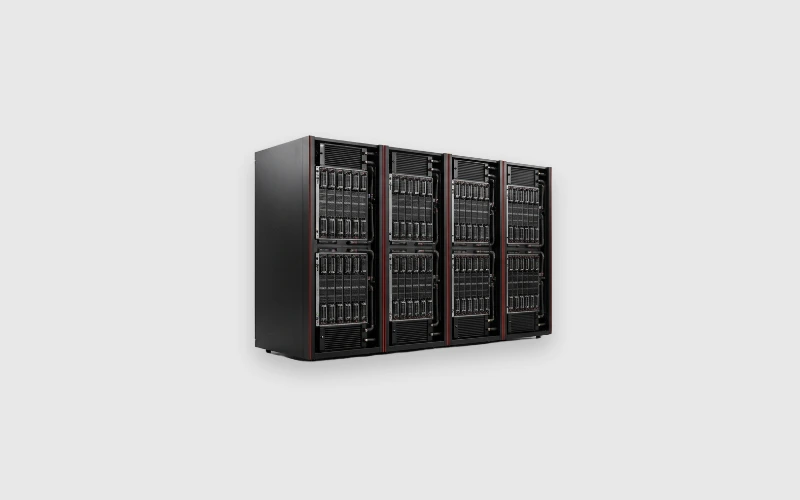
An AI factory is a rack-scale computing system engineered to do one thing at industrial scale: turn electricity and data into AI output (tokens). Instead of a single server, it treats an entire rack — dozens of GPUs joined by a high-bandwidth interconnect into one giant accelerator — as the unit of compute. The NVIDIA GB200 NVL72 is the canonical example: 72 GPUs linked as a single domain by NVLink, quoted by the vendor at up to 1.44 exaflops of FP4 (peak) and 130 TB/s of NVLink bandwidth (peak).
TL;DR — key takeaways
- An AI factory = a rack-scale system where the rack, not the server, is the unit of compute.
- Dozens of GPUs are fused by a high-bandwidth fabric (NVLink) into one large logical accelerator — ideal for trillion-parameter training and high-throughput inference.
- Vendor headline figures (e.g. "30× faster inference", "1.44 exaflops FP4") are peak/vendor claims — size on your measured workload, not the brochure.
- You need one when a single 8-GPU node can't hold or feed your model; most buyers do not — a node suffices.
What it is
Traditional servers scale *out*: you add boxes and stitch them with a network. An AI factory scales the interconnect first — it wires many GPUs together with a memory-speed fabric so they behave like a single, very large GPU. That matters because the biggest models are memory- and bandwidth-bound: the bottleneck isn't raw FLOPS, it's moving weights and activations between accelerators fast enough. Fusing a rack over NVLink removes that wall for models too large for one server.
How a rack-scale system works (NVL72 as the example)
The NVIDIA GB200 NVL72 joins 72 Blackwell GPUs into a single NVLink domain — one coherent accelerator addressed as a unit. NVIDIA quotes it at up to 1.44 exaflops of FP4 (peak) and 130 TB/s of aggregate NVLink bandwidth (peak), with claims of up to 30× faster real-time trillion-parameter inference versus the prior generation (vendor figure) (NVIDIA GB200 NVL72). Those numbers are marketing peaks — useful for relative scale, not for capacity planning. The building block is the rack; you scale by adding racks into a cluster over an NDR/next-gen InfiniBand or equivalent fabric.
Who actually needs one
- Frontier training — trillion-parameter models whose weights + optimizer state exceed a single node.
- High-throughput inference — serving very large models to many concurrent users where a node can't meet latency/throughput SLOs.
- Sovereign / neocloud operators — building shared AI capacity at scale.
Most enterprises do not need a full AI factory. A single 8-GPU node serves 70B–405B models and typical fine-tuning; the sizing guides show where a node is the right, cheaper answer. Reach for rack-scale only when the model or the concurrency genuinely exceeds one node.
Assumptions & scope
A conceptual explainer, not a deployment spec. Vendor performance figures are labeled peak/vendor and should be validated on your workload. Rack-scale systems carry serious power, cooling (typically liquid), and facility requirements — see the reference-architecture and cooling guides.
Where RDP GPU Mart fits
RDP GPU Mart spans the whole ladder — from single-GPU workstations to DRACO-class rack-scale AI systems — so Indian buyers can start at a node and grow to rack-scale on India-built, India-supported infrastructure, with INR-transparent pricing and DPDP-aware deployment. *(Explore rack-scale AI or request a quote at RDP GPU Mart.)*
FAQ
What is an AI factory in simple terms? A rack-scale computer that turns electricity and data into AI output at industrial scale, treating a whole rack of GPUs as a single accelerator.
What is the NVIDIA GB200 NVL72? A rack that links 72 Blackwell GPUs into one NVLink domain; NVIDIA quotes up to 1.44 exaflops FP4 and 130 TB/s NVLink (both peak) (NVIDIA).
Do I need an AI factory? Only if your model or concurrency exceeds a single 8-GPU node. Most workloads fit a node — start there.
Why NVLink instead of a normal network? Large models are bandwidth-bound; NVLink joins GPUs at memory speed so a rack behaves like one big GPU, removing the inter-GPU bottleneck.
—
Related
- Reference Architecture: 8× H200 On-Prem AI Training Node
- InfiniBand vs Spectrum-X vs Ethernet for AI Clusters
- Air-Cooled vs Liquid-Cooled GPU Racks: When to Switch
Research log (Rule #1)
1. NVIDIA — GB200 NVL72 (72 GPUs, 1.44 EF FP4 peak, 130 TB/s NVLink peak, 30× vendor claim). https://www.nvidia.com/en-us/data-center/gb200-nvl72/ 2. NVIDIA (2026) — Blackwell/GTC inference scaling context. https://developer.nvidia.com/blog/ 3. apxml (2026) — frontier-model memory scale (why rack-scale). https://apxml.com/models/llama-3-1-405b 4. SemiAnalysis (2026) — NVL-class rack architecture analysis. https://semianalysis.com/tag/ai-infrastructure/ 5. NVIDIA H200 datasheet — node-vs-rack context. https://www.nvidia.com/en-us/data-center/h200/
Ready to deploy?
Talk to an RDP architect about power, cooling and lead time.