
GB300 NVL72: Anatomy of a 120 kW Rack-Scale AI Factory
Overview
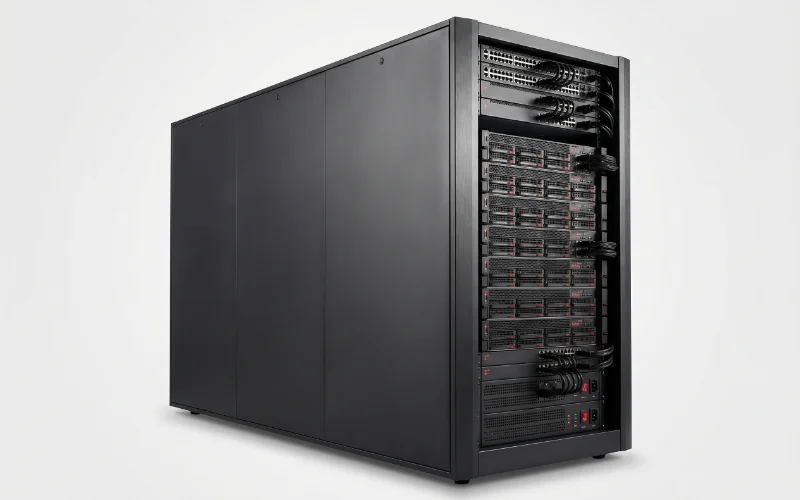
The NVIDIA GB300 NVL72 (Blackwell Ultra) marks the point where the rack, not the GPU, becomes the unit of compute. Seventy-two Blackwell Ultra (B300) GPUs and 36 Grace CPUs operate as a single NVLink domain delivering 1.08 ExaFLOPS of dense FP4, 20 TB of unified HBM3e memory, and roughly 50x the AI-factory output of a Hopper-generation system. A sustained 120 kW power draw and a 1.36-tonne footprint make direct-to-chip liquid cooling mandatory rather than optional. This reference architecture summarises the silicon, the rack, the cooling loop, the deployment topology, and the inference economics behind the investment.
Key takeaways
- 72 Blackwell Ultra GPUs + 36 Grace CPUs act as one NVLink domain — 1.08 ExaFLOPS FP4, 20 TB unified HBM3e.
- 1,400 W per chip makes direct-to-chip liquid cooling mandatory; budget a 150–200 kW in-rack CDU.
- A rack draws ~120 kW and weighs ~1.36 t — plan 480 V power and floor loading before delivery.
- Deploy in ~16 weeks; expect up to 25× tokens/s vs Hopper and up to 35× lower cost per token.
What you will learn
- The Blackwell Ultra (B300) step-up: 15 PFLOPS FP4, 288 GB HBM3e at 8 TB/s, 1,460 W TDP.
- How 72 GPUs plus 36 Grace CPUs act as one NVLink domain (130 TB/s, 20 TB unified memory).
- Why a 1,400 W-per-chip heat load forces a direct-to-chip liquid loop with an in-rack CDU.
- A 16-week, power-plant-grade deployment blueprint spanning power, cooling, and software.
- The economics: up to 25x tokens/sec versus Hopper and up to 35x lower cost per token.
The silicon: Blackwell Ultra (B300)
- 15 PFLOPS FP4 dense compute, a 66.7% lift over B200 for MoE inference.
- 288 GB HBM3e per GPU running at 8 TB/s.
- 1,460 W TDP, a 40% higher thermal limit that sustains boost clocks through heavy GEMM phases.
- Faster softmax/attention path that removes the Hopper and B200 attention bottleneck.
The rack: 72 GPUs as one NVLink domain
Eighteen compute trays house 72 Blackwell Ultra GPUs and 36 Grace CPUs (Arm Neoverse V2). Nine 5th-generation NVLink switch trays deliver 130 TB/s of aggregate bandwidth, with measured multi-node NCCL bus bandwidth near 836 GB/s. A unified memory fabric fuses 20 TB of GPU HBM3e with 17 TB of Grace LPDDR5X into one coherent space, removing cross-rack sharding latency for trillion-parameter models.
Generational step-function
| Spec | H100 node | B200 NVL72 | GB300 NVL72 |
|---|---|---|---|
| FP4 dense | N/A | 720 PFLOPS | 1,400 PFLOPS |
| Total memory | ~1.1 TB | 13.4 TB | 20 TB |
| Power / rack | ~10 kW | ~120 kW | ~120 kW |
| Cooling | Air / RDHx | Direct liquid | Direct liquid |
Cooling: the direct-to-chip liquid loop
A 1,400 W heat load per chip is captured by copper cold plates with 0.15-0.2 mm micro-channels targeting a low thermal resistance. Coolant flows at 20 L/min per GPU through 252 blind-mate quick connects and flow-balancing manifolds (delivery uniform within +/-5%). The rack strictly requires an in-rack Coolant Distribution Unit sized for 150-200 kW.
Deployment: a 16-week blueprint
Weeks 1-3, foundation and load study (floor loading, cooling-water spec, electrical capacity). Weeks 4-6, power (480 V three-phase switchgear, CDU placement, manifold pipe runs). Weeks 7-9, mechanical integration (1.36-tonne cabinet anchoring, coolant fill, pressure and leak testing). Weeks 10-16, network and software (InfiniBand/ConnectX-8 fabric, Triton/MLOps stack, plant-LLM production launch). The topology bridges OT and AI zones: plant floor, hardened data-aggregation bridge, the isolated AI infrastructure room, and the operations control room.
The economics: inference dominance
By 2026, inference is projected to take 55% of AI-optimised infrastructure spend, overtaking training, while inference cost falls roughly 10x annually. The GB300 NVL72 generation cuts per-token cost up to 35x versus Hopper, which reframes AI infrastructure as an operating-cost decision, not just a capability one.
Deploy now, or wait for Rubin?
For most operators the recommended path is to deploy B200/GB300 now and capture immediate inference ROI, avoiding the cost of idle or delayed compute; current-generation pricing has historically held up across next-generation announcements. Waiting for Rubin is warranted mainly for teams training trillion-parameter frontier models or needing million-token-context acceleration. The throughline: deploy Blackwell today, and prepare the facility (480 V power, liquid-cooling loop) for Rubin tomorrow.
Frequently asked questions
How much power and cooling does a GB300 NVL72 rack need?
~120 kW sustained on 480 V three-phase, with a 150–200 kW in-rack CDU for direct-to-chip liquid cooling. Plan floor loading for a ~1.36-tonne cabinet.
What is the typical lead time?
Rack-scale systems are project-based; a power-plant-grade deployment typically runs about 16 weeks across power, cooling, integration and software.
Can I buy a single rack, or only a full cluster?
Both. The GB300 NVL Rack is a Contact-for-Quote system — talk to an architect to size one rack or a multi-rack cluster.
Download the full blueprint (PDF · 15 pages)
Download the full blueprint (PDF)Ready to deploy?
Talk to an RDP architect about power, cooling and lead time.