
The Air-Cooled Middle: RTX PRO Servers Between Workstation and HGX
Overview
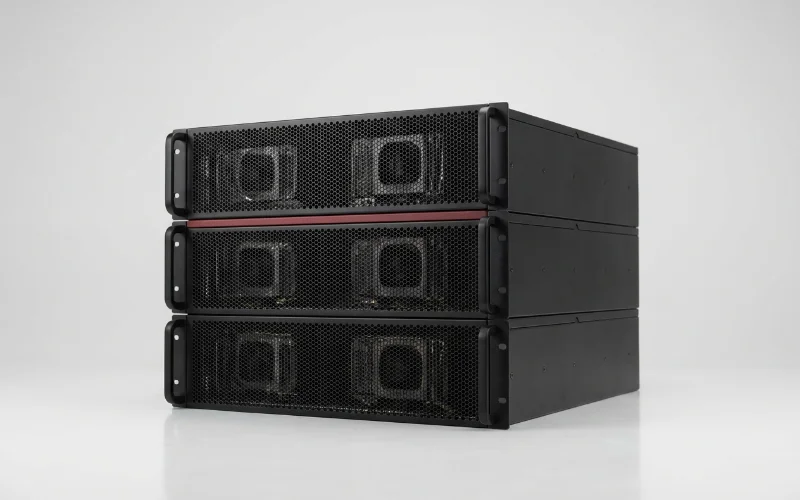
Between workstation towers and HGX/NVL flagship systems, a middle server class matured in 2026: MGX-based RTX PRO servers — up to eight passively cooled, dual-slot RTX PRO 6000 Blackwell Server Edition GPUs (96 GB GDDR7 each) in standard air-cooled chassis from every major system builder. For enterprises whose models sit under ~70B parameters and whose workloads mix LLM inference with rendering, digital twins and virtual workstations, this class delivers most of the capability of HBM-based flagship nodes at a fraction of the cost, power density and facility burden — vendor TCO comparisons claim 1.3–5× better value on enterprise workloads. This article positions the class honestly: what it does brilliantly, and where HGX-class nodes remain necessary.
Key takeaways
- An 8-GPU RTX PRO server carries 768 GB of aggregate GDDR7 — enough to serve multiple 70B-class models simultaneously — in a standard air-cooled rack.
- The class trades HBM bandwidth and NVLink for cost and deployability: GPUs interconnect over PCIe, so it suits replica- and pipeline-style serving, not tensor-parallel training.
- Air-cooled, ~30–60 kW-rack compatibility means Indian enterprises deploy it in existing halls — no liquid-cooling retrofit gate.
- Mixed-duty capability (inference + rendering + vGPU workstations) makes it the natural consolidation server for mid-size organisations.
- HGX/NVL-class systems remain the tool for large-model training, trillion-class serving and NVLink-domain workloads.
What this server class actually is
MGX is NVIDIA’s modular server reference design; system builders (Supermicro’s 20+ system portfolio, ASUS, GIGABYTE, MSI and others) ship 2U–6U configurations holding two to eight RTX PRO 6000 Server Edition cards — the passively cooled sibling of the workstation flagship, same 96 GB GDDR7 and Blackwell tensor cores, engineered for chassis airflow. Liquid-cooled MGX variants arrived in H1 2026 for denser configurations, but the class’s defining virtue is that the standard build runs on air in ordinary racks. Against an HGX B300 node, the differences are structural: GDDR7 instead of HBM3e (less bandwidth per GPU), PCIe instead of NVLink between GPUs, and a price and power envelope that fits enterprise procurement rather than AI-factory capex.
Where eight GDDR7 GPUs beat fewer HBM GPUs
Serving open-weight models at enterprise scale is replica-parallel: eight 96 GB cards run eight independent replicas of a quantised 70B model (or a mix — a 70B, several 8–32B specialists, embedding and rerank models), scheduled by vLLM-class engines. No inter-GPU bandwidth is consumed because nothing crosses GPUs. The same server renders, runs digital-twin workloads and hosts vGPU virtual workstations — the consolidation profile most mid-size Indian enterprises actually have, and the reason the class is marketed as the enterprise AI factory building block. Concurrency math follows our inference sizing checklist; for RAG platforms specifically, one such server hosts the entire routed portfolio described in our adaptive RAG article.
The facility argument, in kilowatts
An 8-GPU RTX PRO server draws roughly 4–6 kW — four to six of them fill a standard 30 kW air-cooled rack position that virtually every Indian datacenter and many server rooms already offer. Contrast the liquid-cooled 100 kW+ positions that flagship racks demand (see facility readiness): the MGX class removes the facility gate entirely, which for many buyers is worth more than any benchmark. Power per token is genuinely competitive on FP4-quantised inference thanks to Blackwell tensor cores; where the class pays its bandwidth tax is long-context, large-batch serving of very large models — HBM systems pull ahead there, which is the honest boundary.
Honest limits
Three workloads outgrow the class. Distributed training beyond PEFT scale: PCIe interconnect and GDDR7 bandwidth make it the wrong tool for multi-GPU pretraining; fine-tuning up to LoRA/QLoRA on single cards works fine, per the memory-math guide. Models needing tensor parallelism across GPUs: cross-GPU serving of 100B+ unquantised models pays a PCIe latency tax — possible, not optimal. NVLink-domain workloads: trillion-class and long-context reasoning serving belongs on the rack-scale systems compared in rack-scale vs scale-out. The mature enterprise pattern is layered: MGX-class servers as the volume serving and mixed-duty tier, HGX/NVL capacity — owned or rented — for the workloads that genuinely need it.
Server class comparison
| Attribute | 8× RTX PRO 6000 (MGX) | 8× B300 (HGX) | GB300 NVL72 |
|---|---|---|---|
| GPU memory | 768 GB GDDR7 | ~2.3 TB HBM3e | ~21 TB HBM3e (72 GPUs) |
| GPU interconnect | PCIe 5.0 | NVLink/NVSwitch (8-GPU domain) | NVLink 5 (72-GPU domain) |
| Cooling / rack | Air, standard racks | Air or liquid, high-density | Liquid, ~132 kW position |
| Best fit | Replica serving ≤70B, mixed enterprise duty | Training, large-model serving | Trillion-class serving, reasoning factories |
| Relative entry cost | Lowest | High | Highest (rack commitment) |
Frequently asked questions
Can an RTX PRO server really serve 70B models?
Yes — a quantised 70B fits comfortably in one 96 GB card, so an 8-GPU server runs eight independent replicas (or a model mix) with no inter-GPU traffic. Unquantised FP16 70B spans two cards via pipeline parallelism at some latency cost.
Why choose GDDR7 over HBM?
Cost and deployability: GDDR7 cards are dramatically cheaper per GPU and run air-cooled in standard racks. The trade is memory bandwidth, which matters most for long-context, large-batch serving of very large models — the workloads that justify HBM systems.
Is this class suitable for fine-tuning?
For LoRA/QLoRA on models to ~70B on single cards, yes — and eight cards run eight parallel experiments. Multi-GPU full-parameter training is the wrong workload: PCIe interconnect makes HGX-class nodes the right tool there.
What does deployment require from an Indian facility?
A standard air-cooled rack position: each server draws roughly 4–6 kW, so ordinary 20–30 kW racks hold several. No liquid cooling, no special floor loading — the class’s quiet superpower for Indian enterprise deployment.
Where does this class sit in RDP’s series model?
It is the workhorse of the GPU-server tier — above QUASAR desk-side workstations, below DRACO rack-scale systems: the consolidation server most mid-size enterprises should evaluate first for serving and mixed AI duty.
Ready to deploy?
Talk to an RDP architect about power, cooling and lead time.