
One Rack or Nine Nodes: The Rack-Scale vs Scale-Out Decision
Overview
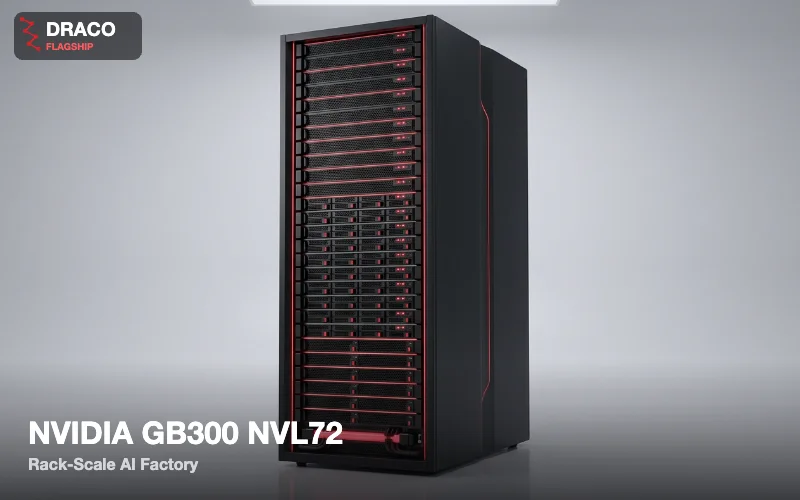
The defining choice at the flagship tier in 2026 is not which GPU but which unit of scale: nine discrete 8-GPU nodes (HGX B300-class) or one rack-scale system (GB300 NVL72) with the same 72 GPUs fused into a single NVLink domain. The technical difference is stark — an NVL72 rack exposes roughly 20–21 TB of HBM as one 130 TB/s NVLink 5 domain across all 72 GPUs, while discrete nodes cap the NVLink domain at 8 GPUs (~2.3 TB) and cross node boundaries over InfiniBand or Ethernet, per platform comparisons like Arc Compute’s analysis. Which one wins depends almost entirely on whether your models and serving patterns fit inside an 8-GPU island.
Key takeaways
- The NVLink domain is the real product: 8 GPUs/2.3 TB per HGX node versus 72 GPUs/~21 TB per NVL72 rack changes what a “single system” means.
- Reasoning-model inference — long chains of thought, huge KV caches, high-concurrency test-time compute — is the workload NVL72 was shaped for; NVIDIA cites order-of-magnitude gains per rack versus Hopper-era systems.
- Workloads that shard into 8-GPU islands (most training below frontier scale, most sub-400B serving) run excellently on discrete nodes at lower entry cost and simpler operations.
- Scale-out buys incrementally — add a node at a time; rack-scale buys a ~132 kW liquid-cooled commitment on day one.
- Failure and service models differ: a node is a replaceable unit in a fleet; a rack-scale system is a fleet in one enclosure with compute-tray-level service.
What a domain boundary costs
Within an NVLink domain, GPUs exchange data at up to 1.8 TB/s each with hardware-coherent access to pooled memory; across a domain boundary, traffic drops to network speeds — 400–800 Gb/s class per port — with software-managed communication. For workloads whose parallelism fits in 8 GPUs, the boundary is irrelevant. For those that do not — tensor-parallel serving of very large models, expert-parallel MoE routing, giant KV caches for long-context reasoning — every boundary crossing costs latency and throughput. The 72-GPU domain moves that boundary from “inside your model” to “outside your rack,” which is the entire architectural argument.
Workloads that justify the single domain
Three signatures. First, frontier-class and near-frontier serving: multi-hundred-billion-parameter and trillion-parameter-class models that need more than 2.3 TB of fast memory for weights plus KV cache. Second, reasoning-heavy inference: test-time compute multiplies KV-cache and token throughput demands, and vendor materials position Blackwell Ultra NVL72 specifically for reasoning-era AI factories, citing large per-megawatt throughput and latency gains over prior generations — treat exact multipliers as vendor-benchmarked, but the direction is well-established. Third, disaggregated serving at scale, where prefill and decode phases split across the domain. If your roadmap contains none of these within the depreciation life, the rack is capacity you will not use.
The case for staying discrete
Discrete 8-GPU nodes win on granularity and blast radius. Capital scales in node-sized steps rather than a rack-sized leap; a failed node degrades a fleet by one unit rather than complicating a monolith; air-cooled B300-class options exist for facilities that cannot deliver liquid cooling; and the operational skillset is familiar server administration plus the fabric engineering covered in our cluster networking guide. For enterprises fine-tuning and serving models under ~400B parameters — the overwhelming majority of Indian enterprise AI in 2026 — a row of HGX-class nodes remains the rational flagship, with the 8-GPU reference architecture as the template.
Procurement and operations: two different commitments
The NVL72 route commits you to ~132 kW liquid-cooled rack positions (see our India facility readiness guide), longer lead times, integrated-system service contracts, and a single-vendor stack from silicon to rack. The discrete route commits you to fabric design, more floor positions, and self-integration — but preserves vendor and facility optionality. Indian buyers should also weigh capacity-reservation reality: liquid-cooled colo positions and rack-scale allocations are both scarce and contracted early, so the two procurement clocks — hardware and facility — must run in parallel either way.
Decision table
| Factor | 9× HGX B300-class nodes | 1× GB300 NVL72 rack |
|---|---|---|
| NVLink domain | 8 GPUs / ~2.3 TB per node | 72 GPUs / ~21 TB, 130 TB/s fabric |
| Best-fit workload | Training/serving that shards to 8-GPU islands | Trillion-class serving, long-context reasoning, disaggregated inference |
| Facility | Air or liquid options, standard racks | ~132 kW liquid-cooled position, mandatory |
| Capital granularity | Node-sized increments | Rack-sized commitment |
| Failure blast radius | One node of a fleet | Tray-level service inside one system |
| Operations skillset | Server + fabric engineering | Integrated-system contract + liquid loop ops |
Frequently asked questions
Is an NVL72 rack faster than nine 8-GPU nodes with the same GPUs?
Only for workloads that cross 8-GPU boundaries — very large model serving, long-context reasoning, expert parallelism. Workloads that fit an 8-GPU island run comparably on discrete nodes at lower entry cost.
What model size forces the jump to rack scale?
As a rough line: models plus KV cache exceeding ~2 TB of fast memory — multi-hundred-billion-parameter serving at long context, or trillion-parameter-class work. Below that, tensor-parallel-8 within a node plus pipeline across nodes covers most needs.
Can you start discrete and move to rack-scale later?
Yes, and most organisations should: discrete nodes retain value as fine-tuning and mid-size serving capacity when a rack-scale system arrives. The facility work done for discrete liquid-cooled nodes also de-risks the later rack deployment.
How trustworthy are the 50× AI-factory-output claims?
They are vendor benchmarks comparing against Hopper-generation systems under specific reasoning-workload assumptions. Directionally real, numerically situational — benchmark your own workload profile before underwriting a business case on the multiplier.
Where does DRACO sit in RDP’s series model?
DRACO is RDP GPU Mart’s flagship tier: rack-scale and high-density multi-GPU systems — NVL72-class racks and 8-GPU HGX-class nodes — above the QUASAR mid-tier of desk-side machines. This article is the tier’s core sizing decision.
Ready to deploy?
Talk to an RDP architect about power, cooling and lead time.