
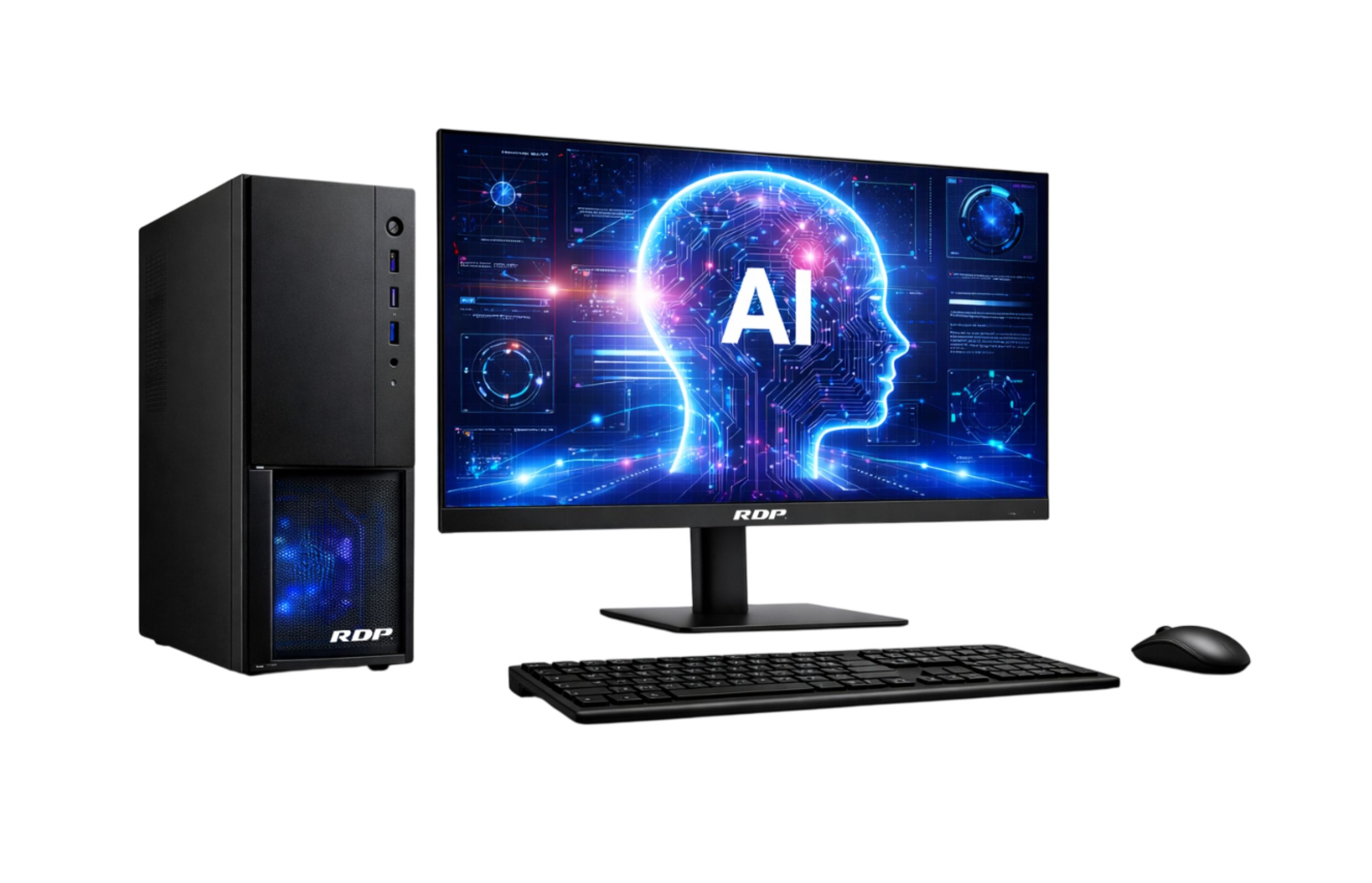



The workstation market in India is not monolithic. Three buyer segments — media and VFX studios, engineering and CAD teams, and emerging AI studios — each face different constraints around performance, software ecosystem fit, and total cost of ownership. This post examines where Indian OEMs compete head-to-head with the global Z, Precision, and ThinkStation incumbents, and where they are still catching up.
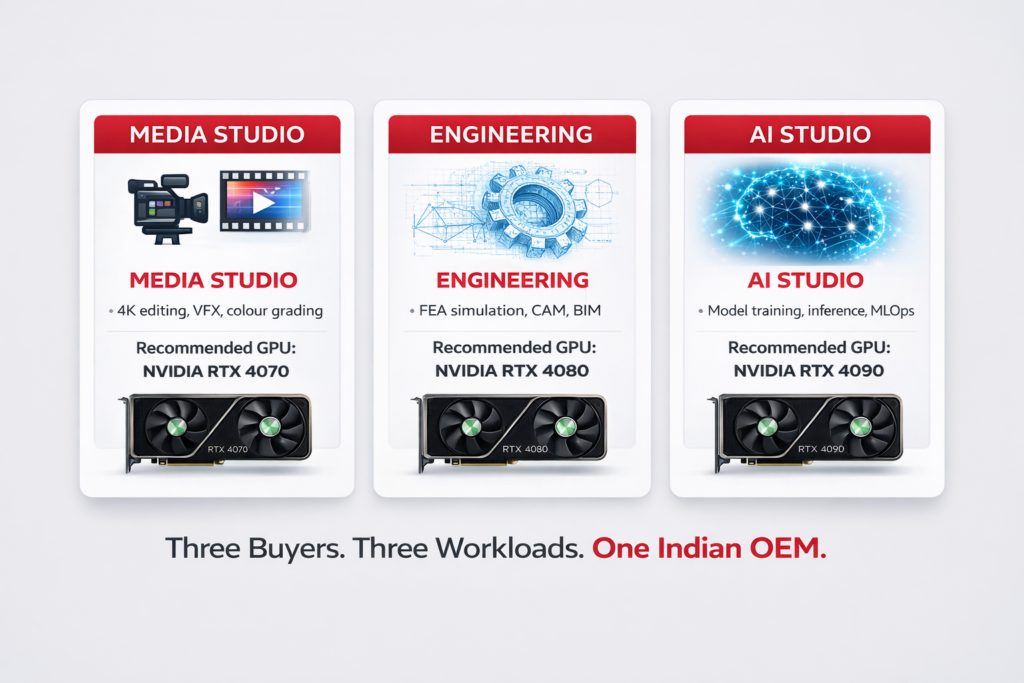
The Three Workstation Buyer Profiles
The workstation buyer is never generic. A VFX studio rendering high-frame-count composites faces a fundamentally different set of requirements than an automotive design team running parametric CAD, which itself differs sharply from an AI research group training large language models on GPU clusters. Each segment has distinct GPU, CPU, memory, and software certification demands.
Media and VFX studios prioritize GPU throughput and accelerated rendering pipelines. A facility running Nuke, After Effects, or Cinema 4D often operates in render-farm mode, where the workstation doubles as a development and proof-of-concept machine. These studios have locked software stacks — Adobe certification matters, and NVIDIA CUDA driver stability is non-negotiable. Engineering teams running CAD (CATIA, Solidworks, Fusion 360) care most about single-thread CPU performance, ISV application certification, and reliable multi-monitor configurations. AI research groups, the newest segment, demand high GPU memory (80GB, 96GB), multi-GPU scaling, and framework flexibility (PyTorch, TensorFlow, JAX). They are less reliant on proprietary ISV certifications and more focused on raw computational density.
Understanding your buyer type determines not just the machine you buy, but whether a given OEM can support you at all.
Where Indian OEMs Win: GPU Performance Tier and Total Cost
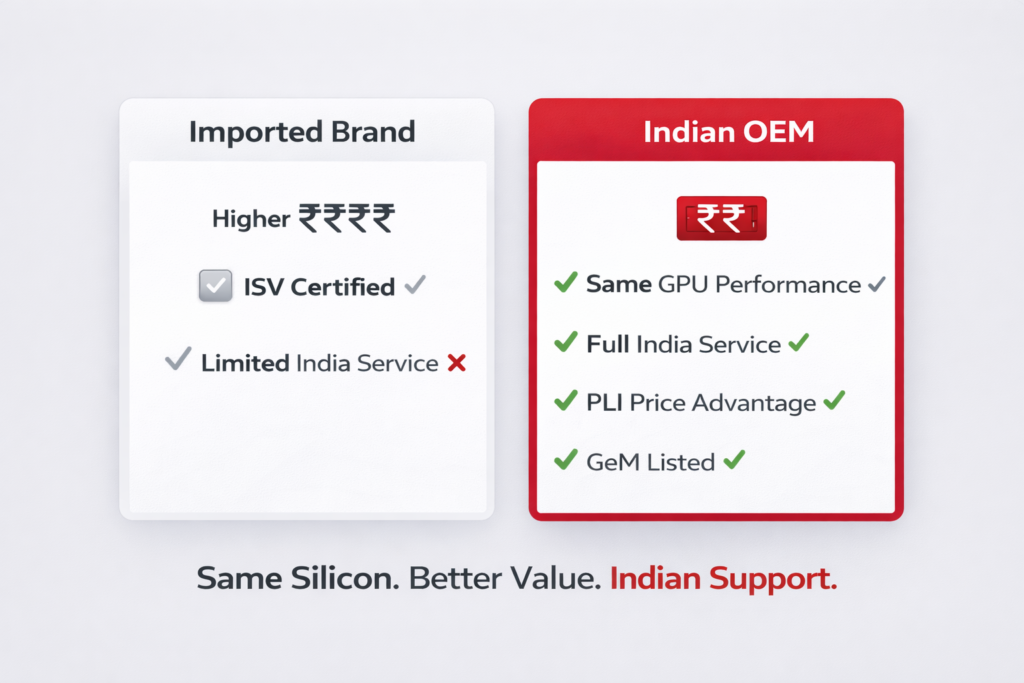
Indian OEMs, including RDP, have closed the gap significantly on GPU-accelerated workstations at the mid-to-premium price tier. The reason is structural: custom integration of NVIDIA RTX professional cards, thoughtful power delivery, and intelligent thermal design do not require decades of ISV partnership history. A well-engineered workstation with an RTX 6000 Ada card, 256GB of DDR5 RAM, and dual NVMe storage is functionally identical whether it carries a Dell, HP, or Indian OEM badge. The cost is often 15–25 per cent lower for an equivalent spec when sourced from a domestic manufacturer.
This is particularly true for AI studios. An AI research group needing four NVIDIA H100 GPUs (160GB total memory) with 64-core Threadripper PRO CPUs sees no performance difference between a Precision workstation and a well-configured domestic alternative. The software stack is framework-agnostic, and driver certification is handled at the GPU and OS level, not at the OEM level. For these buyers, RDP and peers offer comparable hardware at a procurement cost advantage and, increasingly, faster local support and customisation in India.
Entry-to-mid-tier GPU workstations (RTX 5000 Ada down to RTX 4500 Ada) show similar dynamics. A studio doing motion graphics and VFX compositing work can achieve the same production velocity on a made-in-India workstation at 20 per cent lower capex. Margin savings at this tier have real impact on freelancers and small production houses.
Where Indian OEMs Still Fall Short: ISV Certification Breadth and Support Footprint
The one unambiguous gap is breadth of formal ISV application certification. Autodesk’s Solidworks certification, Dassault’s CATIA sign-off, and Adobe’s Creative Cloud optimization carry weight in enterprises and large design consultancies. Dell’s Precision line, HP’s Z series, and Lenovo’s ThinkStation have spent fifteen-plus years accumulating these paper seals. A Precision 7960 comes with explicit certification for Revit, Fusion, AutoCAD, CATIA, and Solidworks — a fact that a procurement committee at a Fortune 500 automotive supplier will demand to see.
Most Indian OEMs, including RDP, do not yet carry equivalent breadth of ISV certification. This is not a technical barrier — the hardware runs the software perfectly well — but a commercial and contractual one. ISV certification requires vendor agreements, ongoing testing infrastructure, and liability frameworks. For a 14-year-old Indian OEM competing against global names, the cost-benefit of that certification programme does not yet justify itself if your customer base is primarily SMEs, studios, and research organisations.
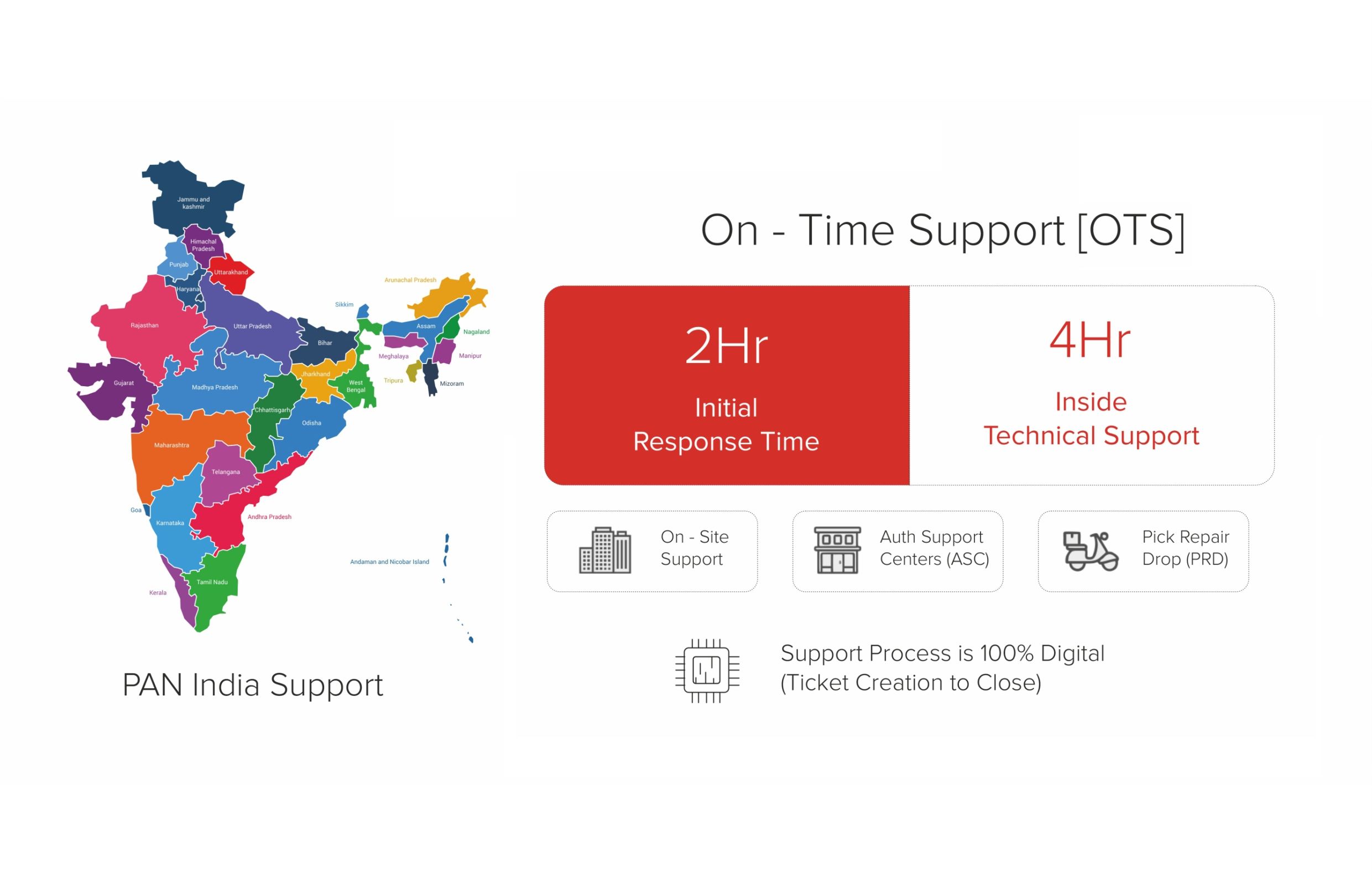
The second gap is service footprint outside Tier-1 metros. A multinational engineering firm with offices in Bangalore and Hyderabad can use RDP workstations. A design studio in Pune or a research group in a smaller city will find it harder to locate a trained RDP technician for on-site hardware diagnostics. Dell and HP have built service logistics that reach smaller cities; Indian OEMs are building this, but have not yet matched it.
Neither gap is permanent. As Indian OEMs build volume and market presence, certification partnerships will follow. But they matter today when evaluating whether a particular workstation brand is viable for your team.
Configuration Tiers: Three Real-World Builds
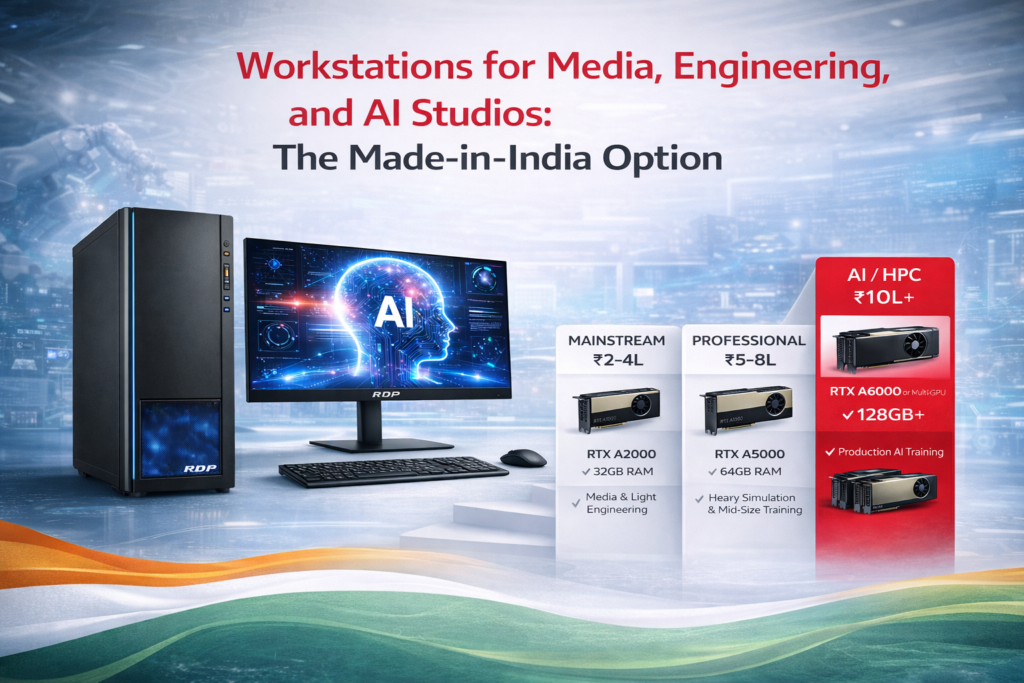
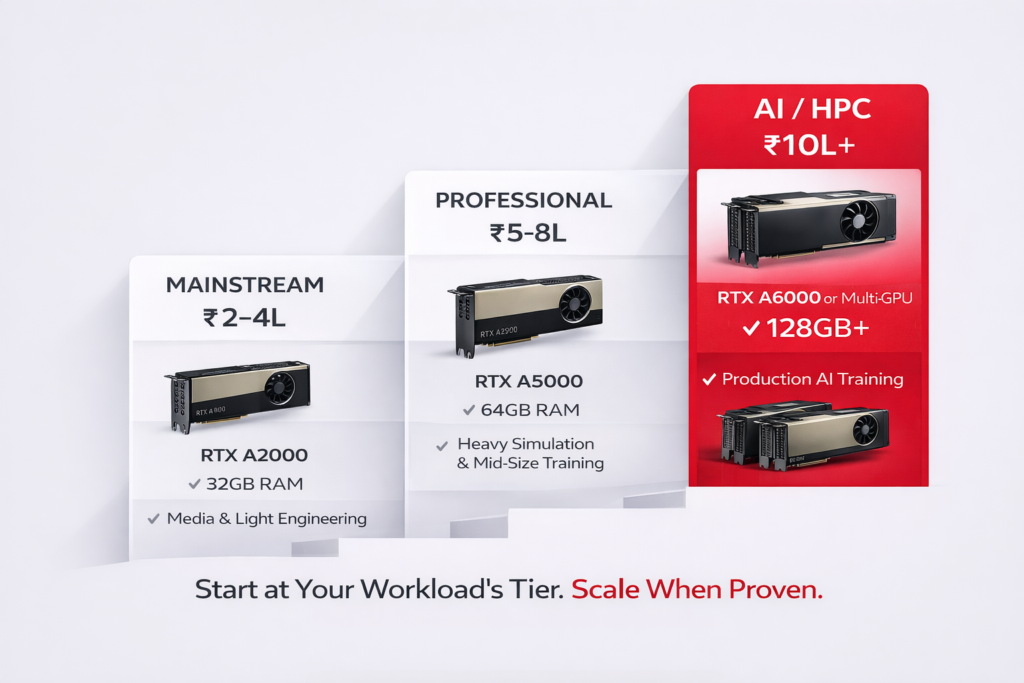
Consider three typical configurations at different price and performance points, all available from domestic OEMs as of 2026.
Entry-to-Mid Tier — VFX and Generalist Studio Work. 12-core Intel Xeon E5-2600 series or equivalent AMD, 128GB DDR4, single RTX 4500 Ada, 1TB NVMe, dual 24-inch 4K displays. Budget: ₹10–12 lakhs. Use case: motion graphics, product visualization, non-linear editing on Premiere Pro. Global equivalent: Dell Precision 5570. This tier is where Indian OEMs have smallest relative cost advantage, often 8–12 per cent.
Mid-Premium Tier — CAD Production and AI Prototyping. 32-core Intel Xeon W9-3595X or Threadripper 7995WX, 512GB DDR5, dual RTX 6000 Ada or single H100, 4TB NVMe SSD RAID, quad-monitor setup with 10GbE networking. Budget: ₹28–35 lakhs. Use case: large assembly CAD, AI model training on multi-modal datasets, render farm coordination. Global equivalent: HP Z6 G5, Precision 7960. Indian OEM advantage: 18–22 per cent cost reduction.
Enterprise AI Cluster — Distributed Training and Inference. Dual-socket Threadripper PRO 5995WX, 1.5TB ECC DDR5, four NVIDIA H100 or H200 GPUs, 8TB enterprise SSD, 40GbE networking, redundant PSUs, active loop cooling. Budget: ₹65–85 lakhs per node for a four-node cluster. Use case: large-language-model fine-tuning, computer vision pipelines, foundation-model inference. Global equivalent: bespoke Precision builds, Supermicro systems. Indian OEM advantage: 20–28 per cent, plus in-country integration and support.
At these tiers, spec-for-spec pricing is the primary decision variable. A research group evaluating RDP against Dell for an AI cluster will find that price difference material and service flexibility valued.
The Role of Domestic Supply Chains and Make in India
The workstation market is one domain where “Make in India” is not just a slogan but a pragmatic procurement story. A workstation manufactured in India—whether the OEM is foreign-owned or domestic—carries lower import tariffs, faster lead times, and simpler warranty logistics. More meaningfully, an Indian OEM can customize configurations in real time. If an AI studio needs an unusual GPU-to-CPU ratio or a bespoke thermal solution for a specific use case, they are more likely to get a technical conversation than a “not available” answer from a global OEM.
The Manufacturing India strategy for IT hardware is evolving. Organised domestic OEMs now handle chipset sourcing, assembly quality, and thermal engineering at a level comparable to multinational factories. The risk profile — lead times, currency exposure, supply-chain opacity — has improved markedly. For a studio or engineering firm seeking to diversify supply risk or reduce forex exposure on capex, the case for domestic workstations is stronger than it has been.
Governance and Ecosystem: The Missing Layer
One area where Indian OEMs will need to invest further is ecosystem integration. RDP and peers do not yet offer integrated solutions across the workstation, storage, and cluster-management stack. An AI research group procuring four workstations today may also need to build a storage fabric, a job-scheduling system, and GPU-management middleware. Dell’s partnerships with HPE, NetApp, and others provide integrated reference architectures. An Indian OEM can deliver the workstation, but the adjacent IT stack — storage, networking, orchestration — still requires separate RFPs and vendor negotiations.
This is changing. As Indian OEMs pursue larger enterprises, they will need to offer end-to-end AI factory blueprints, not just hardware boxes. The next phase of competition in India’s workstation market will be won not just on price and specs, but on whether an OEM can talk fluently about your entire compute environment.
Conclusion: Buyer’s Lens
If you are a media studio, engineering consultancy, or AI research group evaluating workstations in India in 2026, you now have genuine choice. Indian OEMs can deliver comparable performance at lower cost for GPU-accelerated and AI workloads. You pay a penalty on ISV certification breadth and—outside major metros—on support logistics. But if your workload is well-defined and your geography is tier-1 or tier-2 India, the made-in-India workstation option is now mature enough to warrant a serious RFP.
The global brands have history and certifications; domestic OEMs have price, flexibility, and local support. Choose based on which of those three matters most to your business.
Table: Workstation Selection by Use Case — Configuration and Indicative Price Range
| Use Case | CPU | GPU | RAM | Storage | Indicative Price (₹) |
|---|---|---|---|---|---|
| Media Editing (4K–8K video, colour grading) | Intel Core i9-14900K or AMD Ryzen 9 7950X | NVIDIA RTX 4080 / RTX 4090 (CUDA + NVENC) | 64–128 GB DDR5 | 2 TB NVMe OS + 8–16 TB RAID storage | ₹3.5–7 lakh |
| CAD / BIM (Revit, AutoCAD, SolidWorks) | Intel Xeon W or Core i9 (high single-thread) | NVIDIA RTX A4000 / A5000 (Quadro-class, certified drivers) | 64–256 GB ECC DDR5 | 1 TB NVMe + NAS access | ₹4–10 lakh |
| AI Training / Fine-Tuning (local, up to 70B params) | AMD Threadripper 7000 or Intel Xeon W9 | 2–4 × NVIDIA RTX 4090 or H100 PCIe | 128–512 GB DDR5 | 4 TB NVMe (fast checkpoint storage) | ₹12–40 lakh |
| Scientific Compute (CFD, FEA, bioinformatics) | Dual Intel Xeon Scalable or AMD EPYC | NVIDIA A100 or RTX 6000 Ada (double-precision) | 256 GB–1 TB ECC | 8 TB NVMe RAID | ₹20–60 lakh |
| AI Studio (inference serving, multi-user) | Intel Core Ultra or AMD Ryzen AI (NPU-enabled) | NVIDIA RTX 4070 / 4080 (inference-optimised) | 32–64 GB | 2 TB NVMe | ₹1.8–3.5 lakh |
RDP Technologies Limited designs, manufactures, and supports IT hardware in India — desktops, thin clients, mini PCs, AI PCs, workstations, servers, and rack-scale AI infrastructure. 14 years. 100,000+ devices shipped. Over 1 million end users. 28,000 sq. ft. facility in Hyderabad. ISO 9001, PLI 2.0, MeitY and BIS registered.
Make in India. Built for an AI-Ready India. Reliability is Our Product.
If you are evaluating IT hardware for your organisation — speak with our team. No sales pitch, just an honest fit review.
