



The Invisible Layer in India’s AI Story
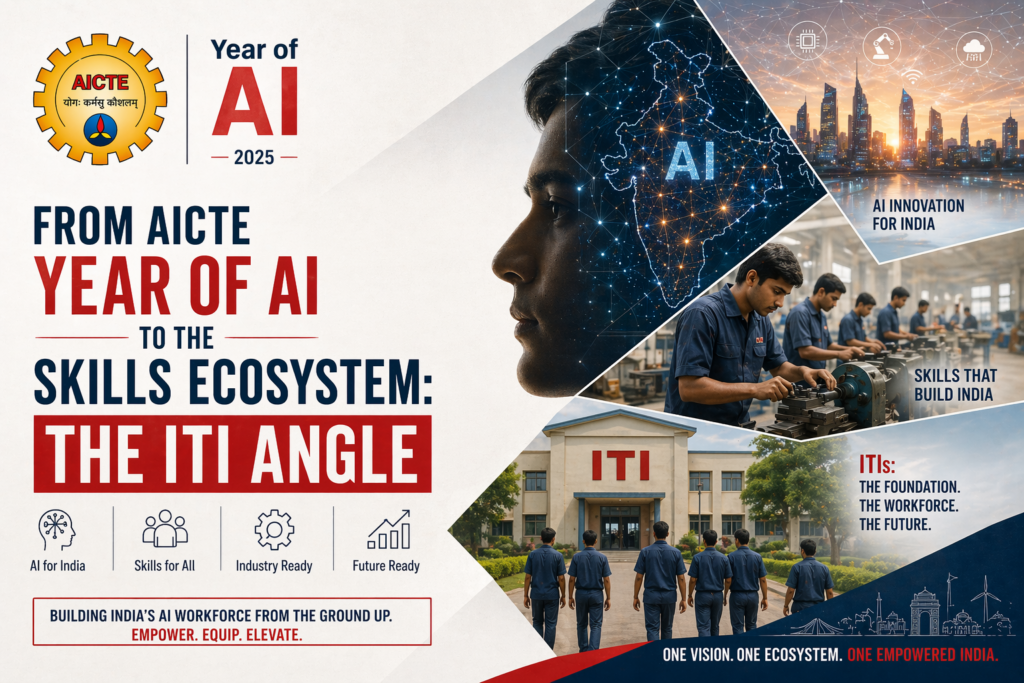
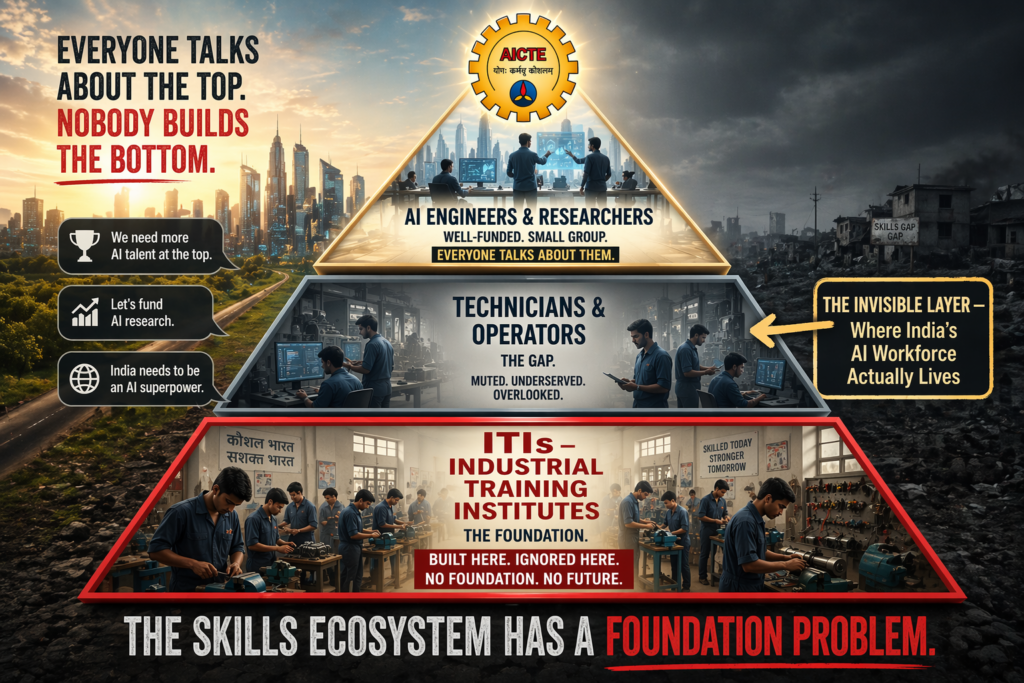
If the AICTE declaring 2025-26 as the Year of AI is the headline, the untold story is the ITI and polytechnic layer. Those approximately 14,000 ITIs and 10,000 polytechnics + engineering colleges produce India’s technical workforce—the engine that has powered the country’s IT services export machine for three decades. Yet when policy makers and investors talk about AI readiness, the conversation stops at higher education institutions and corporate R&D. The skills tier, which sits below both NEP 2020 school reforms and HEI mandates, remains under-resourced and under-counted.
This matters because workforce readiness is not a luxury—it is the threshold condition for economic velocity. India’s Skill India mission targets 400 million skilled workers by 2022; NSDC sectoral skill councils have begun mapping AI-adjacent roles. But infrastructure lags intent. A typical ITI principal today faces a choice between outdated industrial automation kits and enterprise-grade AI workstations priced for research labs, not classrooms. Entry-level AI PCs at ₹40,000–60,000 per seat, paired with structured curriculum, sit in the gap. That gap is the difference between a service economy and a workshop-of-the-world AI economy.
Why ITIs Are the Linchpin of AI Democratization
The ITI ecosystem is not infrastructure that serves nice-to-have advanced skills. It is the primary production line for India’s technical workforce. According to NSDC data, ITIs award approximately 1.2 million certifications annually across sectors including electronics, mechanical, electricals, and information technology. Polytechnic institutions add another 900,000+ graduates per year. Combined, these ~2.1 million yearly certifications vastly outnumber the ~800,000 four-year engineering graduates. Yet they remain invisible in AI workforce planning.
The reason is structural. During the AI boom, tech investment flowed to IITs, IIMs, and corporate data science hubs. Venture capital and academic prestige clustered where outcome attribution was clearest and scale assumptions were largest. But employability—the true measure of workforce readiness—happens lower in the skills ladder. An ITI graduate in electronics who learns AI-assisted troubleshooting, predictive maintenance, or embedded model inference does not need a GPU cluster. They need a machine that can run TensorFlow Lite, connect to edge sensors, and run inference locally. That is an AI PC. At ₹50,000 per seat, a 50-student lab costs ₹25 lakhs—material for a state skill mission or a polytechnic autonomy fund, not a venture bet.
The ITI angle on AI is therefore a workforce angle, not a prestige one. It is about how many electricians can diagnose faults using AI; how many electronics technicians can design circuit layouts with AI-assisted simulation; how many fabrication supervisors can optimize yield using predictive models. Scale in AI does not come from more PhDs. It comes from 2.1 million annual skilled workers who can use AI as a daily tool.
AICTE Year of AI: The Opportunity and the Gap
AICTE’s declaration of 2025-26 as the Year of AI is a policy signal of intent. The All India Council for Technical Education has mandated AI literacy across engineering curricula; it has encouraged institutions to integrate AI modules into core subjects; it has signaled that AI competency is now a baseline expectation for technical graduates. These moves are directionally correct. But AICTE’s remit is primarily engineering colleges and higher-education institutions. The ITI and polytechnic ecosystem, while regulated under AICTE and state vocational education boards, operates under different resource constraints and pedagogical rhythms.
An engineering college can retrofit a lab with enterprise-grade equipment because capex can amortize over a larger alumni network and employer reputation effects. An ITI or government polytechnic operates on razor-thin state budgets. A principal seeking to add AI to the electronics curriculum faces a real constraint: a ₹5 lakh capex budget can either buy three enterprise workstations (₹1.5 lakh each) gathering dust in a research corner, or 10 AI-enabled entry-level PCs that rotate through 50 students across three batches per year. The math is not subtle.
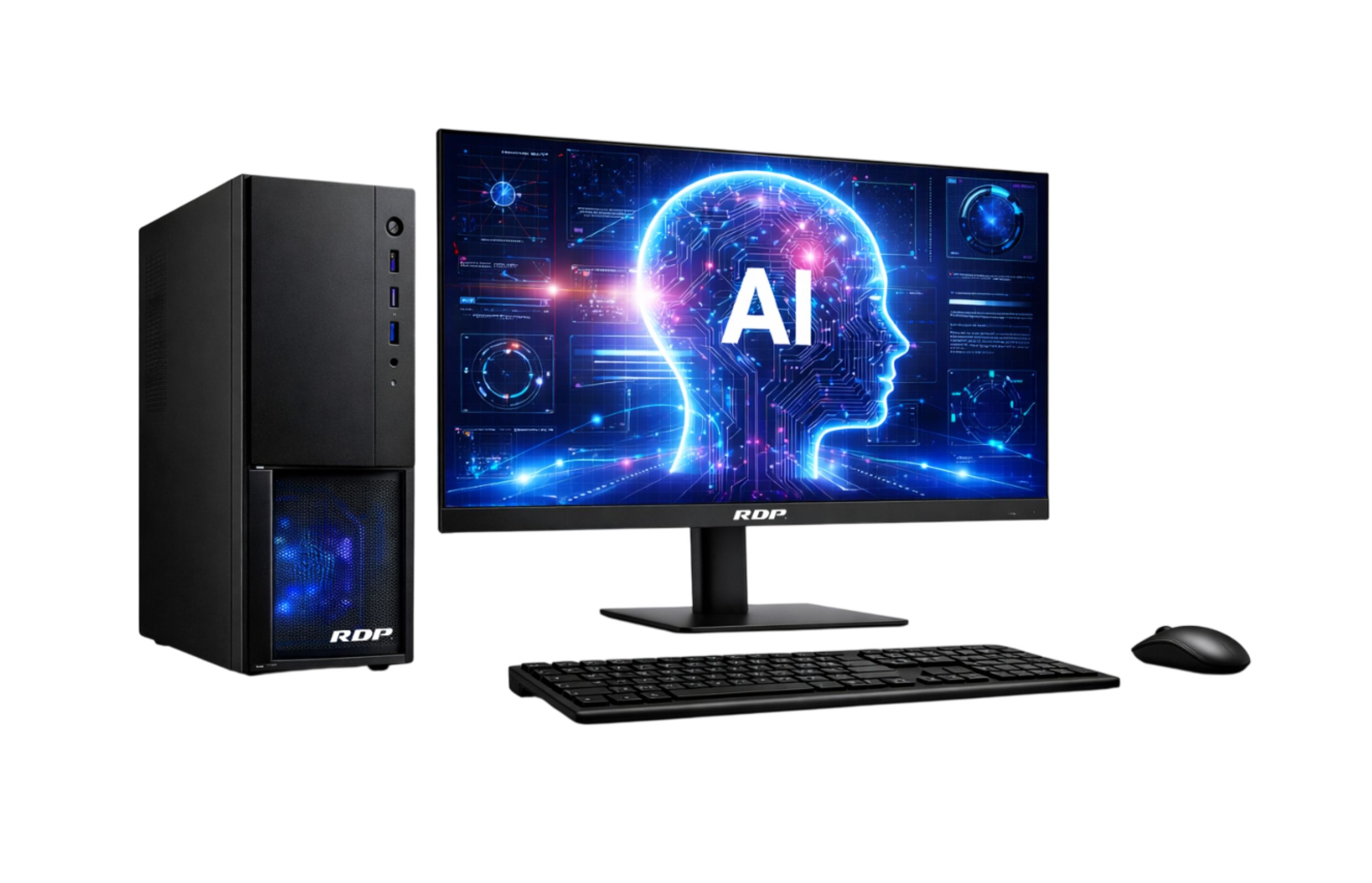
The opportunity lies in bridging this gap with hardware and curriculum designed explicitly for the ITI workflow. An AI PC at ₹40,000–60,000 is not a compromise. It is a tool designed for that use case. It runs Jupyter notebooks, TensorFlow, PyTorch, and edge inference frameworks without overhead. It connects to industry-standard sensors and microcontrollers. It survives the thermal and electrical variability of a multi-shift, high-utilization lab. Paired with structured curriculum from NSDC-accredited training partners, it becomes the infrastructure layer for AICTE’s Year of AI to actually reach the 14,000 ITIs that would otherwise be left behind. Read our analysis on why Indian organisations are choosing made-in-India IT hardware for similar workforce-scale deployments.
The Workforce Economics of AI Skill Distribution
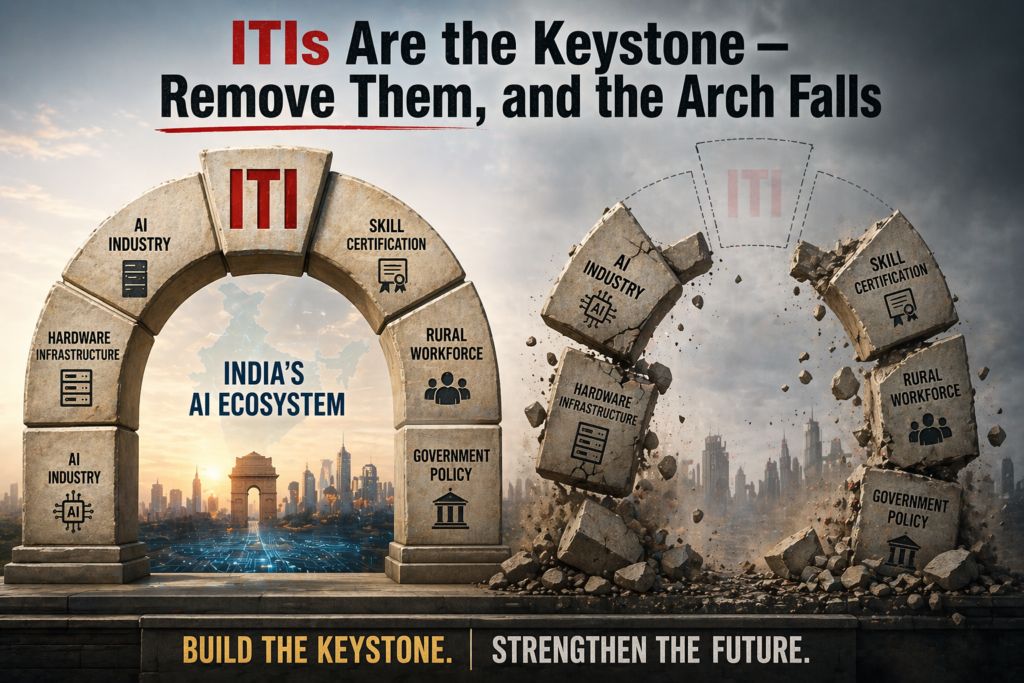
Skill India and NSDC have identified over 100 sectoral skill councils covering everything from automotive to telecom to renewable energy. AI as a cross-cutting competency is now appearing in the job descriptions across these sectors. A CNC operator at an automobile parts supplier can use AI for tool path optimization; a power systems technician can use predictive models for grid stability; a telecommunications installer can use anomaly detection for fault location. These are not imaginary roles. They exist. The labour demand is signalled by employer feedback to NSDC and state skill missions.
But there is a sequence to workforce economics. First comes infrastructure—the machine and the connectivity. Then comes curriculum—the structured pathway from novice to practitioner. Then comes certification—the signal of competency that employers recognize. Then comes placement—the pathway from training to employment. Today, steps one and three are partially present in the higher-ed layer. Steps one and two are nearly absent in the ITI layer. A ₹2 crore state skill mission investment in a 50-seat AI lab across three ITIs in a district, paired with curriculum developed by NSDC and teachers trained by industry partners, can produce 150 AI-literate technicians per year from that district alone. Multiply across 30 districts per state, across 15 major states, and the scale becomes visible: 67,500 AI-trained skilled workers per year. That is not a rounding error in India’s labour supply. That is a sector.
The ITI infrastructure play is therefore not about donations or charity. It is about unlocking a latent opportunity in India’s largest workforce production engine. The question policymakers and investors face is simple: Will AI skills stay concentrated in a small number of IIT and engineering college hubs, or will they distribute down the skills ladder to reach the 14,000 institutions and 2.1 million annual graduates who form the backbone of India’s technical economy?
From Make in India Hardware to Made-by-India AI Workforce
The case for Indian-built AI PCs in ITI labs is not primarily patriotic. It is economic and pedagogical. An entry-level AI PC designed for emerging markets—with thermal tolerance for classrooms without perfect cooling, with power efficiency for grids with variable voltage, with repair-ability for environments with limited service infrastructure—performs differently than a device designed for developed-world office environments. An Indian OEM building for the ITI workflow understands these constraints because they exist in the same ecosystem.
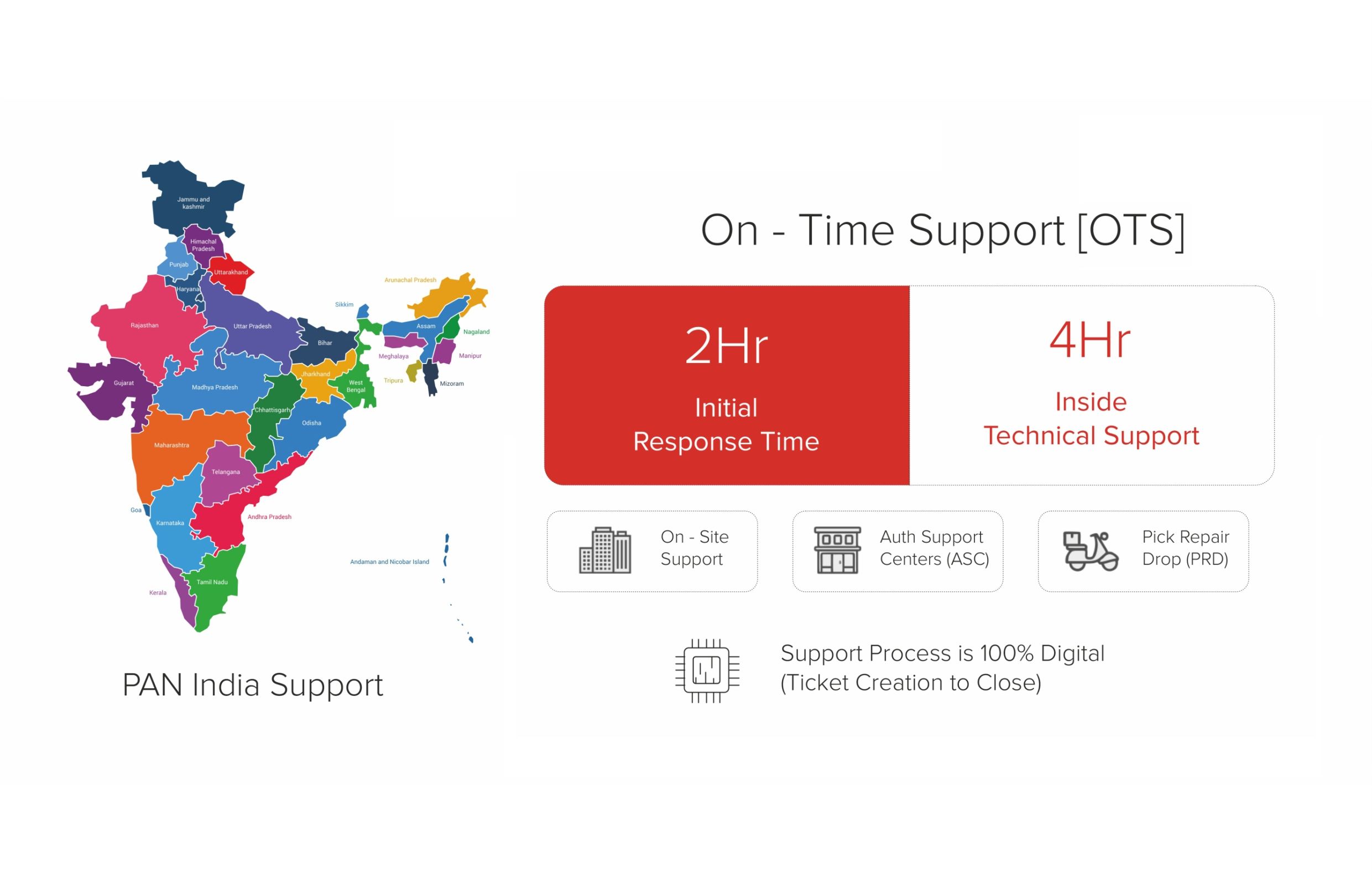
Moreover, ITIs are geographically distributed across Tier-2 and Tier-3 towns—exactly where local distribution, service, and training partner networks matter most. A multinational brand optimizes for urban hubs. An Indian maker optimizes for reach. Over time, this becomes a competitive moat. When a principal in a Tier-3 polytechnic faces a motherboard failure, they need a part and a technician within a week, not a shipping window to a regional center. The entire AI VIDYA stack—from hardware to curriculum to teacher training to employer placement—works only when infrastructure is reliably accessible.
The Made in India angle on AI PCs therefore converges with the workforce-readiness angle. Both point to the same conclusion: the ITI infrastructure gap is where India’s AI workforce bottleneck actually lives. Filling it requires hardware designed for that context, curriculum that bridges theory and shop-floor reality, and a distribution and support network that reaches Tier-2 and Tier-3 towns. It also requires a price point—₹40,000–60,000 per seat—that makes the economics work for 14,000 institutions with finite capex budgets.
The Path Forward: Integration, Not Substitution
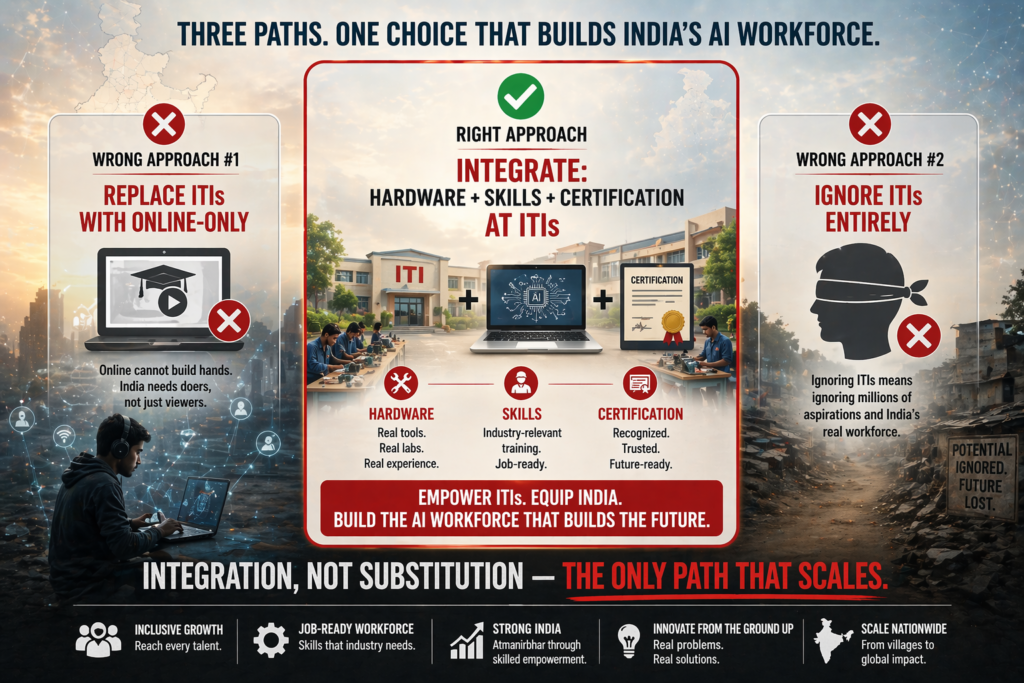
It is important to be clear about what this argument is not claiming. The ITI layer does not substitute for engineering college reforms or IIT research strength. India needs both the R&D output of elite institutions and the workforce production of the skills layer. NEP 2020 has rightly emphasized multidisciplinary learning and flexibility; AICTE’s Year of AI is rightly pushing AI literacy into engineering cores. But NEP and AICTE operate primarily in the higher-ed domain. The ITI and polytechnic layer operates under different constraints and reaches a fundamentally different population.
The path forward is integration, not competition. AICTE and NSDC can jointly develop AI-literacy curricula designed specifically for the ITI workflow. State skill missions and polytechnic autonomous bodies can use their capex allocations to build AI labs using entry-level hardware at scale. Employer feedback loops from sectoral skill councils can ensure curriculum maps to real job market signals. Teacher training programs can upskill ITI instructors in AI fundamentals without requiring them to be machine learning researchers. And Indian hardware makers can build products explicitly designed for this use case, with pricing, durability, and support models that recognize the ITI context.
This is not a gap in India’s AI policy framework. It is a gap in implementation, reach, and ecosystem coordination. Closing it is how India’s AI workforce—not just AI research—becomes world-leading. Fourteen thousand ITIs, ten thousand polytechnics, and 2.1 million annual graduates are too large to ignore, and too central to India’s competitive position to leave under-resourced. The Year of AI means nothing without them.
Related Reading
For the institutional mandate this skills-ecosystem layer plugs into, read about the 10/10/10 Mission for AI-ready institutions. Learn more about AI VIDYA — RDP’s full-stack education AI programme.
Table: AI Lab Requirements — AICTE vs NCVET vs State ITI Boards
| Requirement Area | AICTE (Engineering / Polytechnic) | NCVET (National Vocational) | State ITI Boards (Typical) |
|---|---|---|---|
| Compute Specification | Min. i5 / 16 GB RAM / discrete GPU for AI lab; GPU cluster recommended for PG programmes | i3 / 8 GB RAM acceptable for basic AI trade; GPU workstation for advanced batch | Varies by state — typically i3/i5, 8–16 GB, no GPU mandate yet |
| Software Requirements | Python ecosystem, TensorFlow/PyTorch, licensed simulation tools; cloud credits acceptable | NSDC-approved AI tools; open-source preferred; offline capability required | State-specified; often FOSS only due to budget constraints |
| Connectivity | Minimum 100 Mbps dedicated; Wi-Fi 6 in lab | 50 Mbps; offline-capable curriculum mandatory for remote campuses | 10–50 Mbps; significant rural connectivity gaps |
| Teacher Training | Faculty must complete AICTE-approved FDP (min. 40 hrs AI upskilling) | Assessor certification via sector skill council | State-run training; inconsistent across states; often underfunded |
| Industry Linkage | MoU with industry mandatory; placement cell with AI-sector partners encouraged | Mandatory apprenticeship (NAPS) component; employer co-assessment | Advisory; rarely enforced; depends on state industrial policy |
| Budget Band (lab setup) | ₹40 lakh–2 cr depending on programme level | ₹15–40 lakh | ₹8–20 lakh (state grant-dependent) |
RDP Technologies Limited designs, manufactures, and supports IT hardware in India — desktops, thin clients, mini PCs, AI PCs, workstations, servers, and rack-scale AI infrastructure. 14 years. 100,000+ devices shipped. Over 1 million end users. 28,000 sq. ft. facility in Hyderabad. ISO 9001, PLI 2.0, MeitY and BIS registered.
Make in India. Built for an AI-Ready India. Reliability is Our Product.
If you are evaluating IT hardware for your organisation — speak with our team. No sales pitch, just an honest fit review.
