



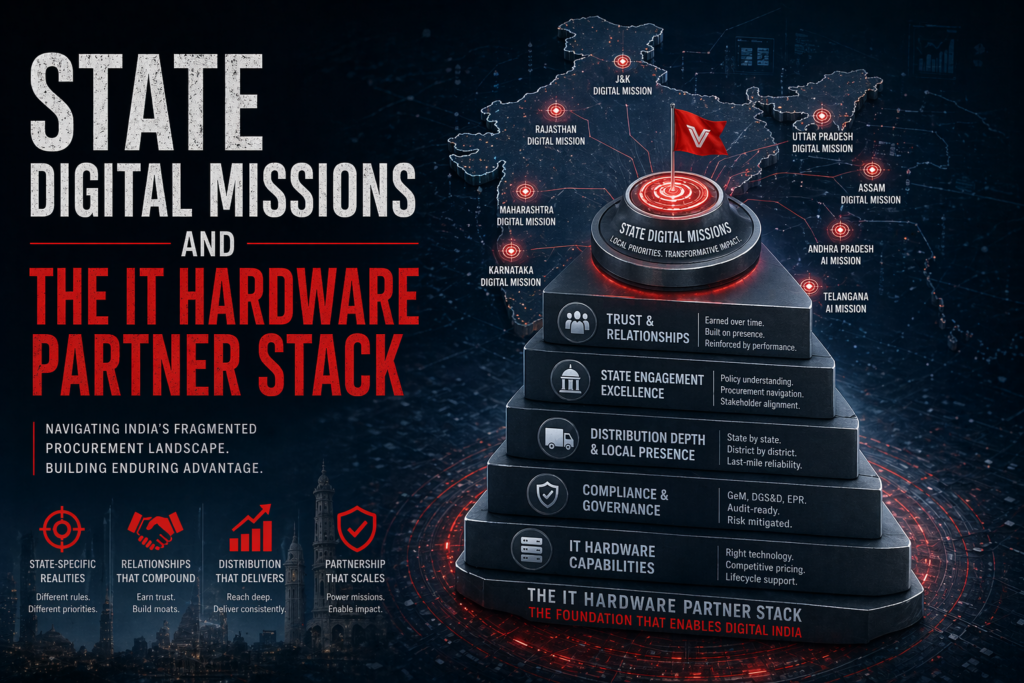
State digital missions are not one market; they are twenty-eight. What Andhra Pradesh wants from an AI hardware partner is not what Karnataka wants, and is not what Uttar Pradesh wants. The OEMs that win the next five years of state IT procurement will be the ones that understand each state’s operating model — not the ones with the largest central-PSU reference list.
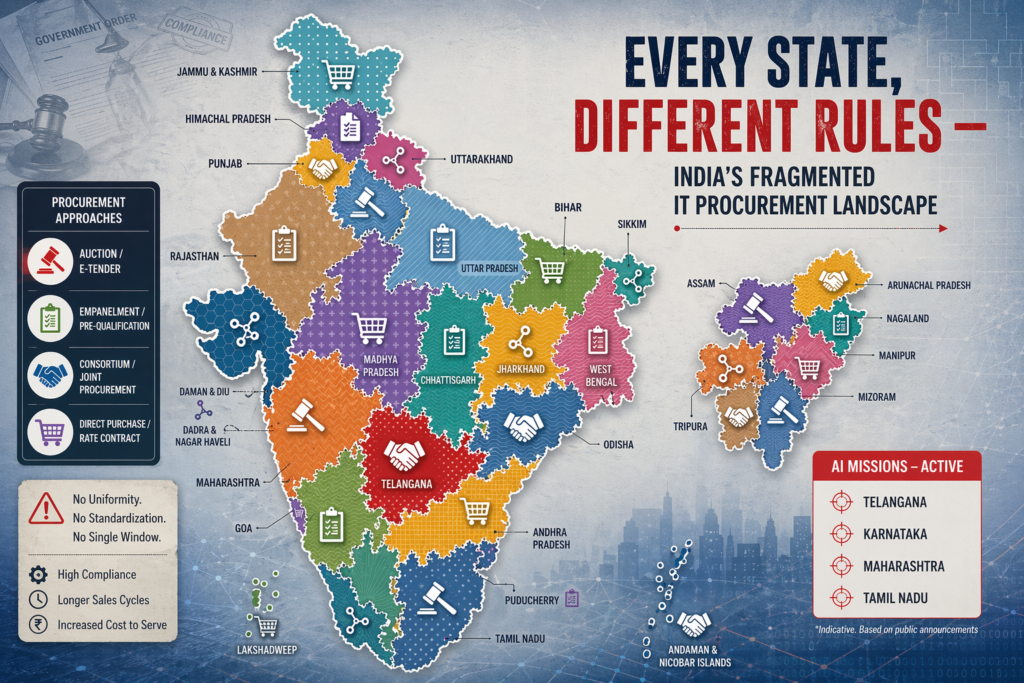
The Fragmented State IT Market
India’s state governments control procurement that moves billions annually, yet the market is radically heterogeneous. The Andhra Pradesh AI Mission operates as a venture-capital style accelerator backed by a dedicated SPV (special purpose vehicle) that evaluates hardware and compute partnerships through a R&D-first lens. Karnataka’s Digital Mission, by contrast, runs as an empanelment model where vendors qualify centrally and then respond to individual department RFQs. Telangana’s AI Mission sits somewhere between — highly strategic, directly negotiated, with a preference for consortial partnerships that bundle compute, software, and services.
Each model demands different OEM capabilities. An SPV-driven state expects you to co-invest in pilots, publish research outputs, and accept partial-margin structures that front-load ecosystem value over unit economics. An empanelment state wants systems integration partners and competitive pricing discipline because departments will pit you against each other. A reverse-auction state with shortlisting — like Uttar Pradesh’s e-Governance rollout — wants financial stability guarantees, after-sales service SLAs, and the ability to scale production rapidly on three-month notice.
The OEM that treats all states as variants of “government IT” will lose to the OEM that builds distinct playbooks for each operating model.
Andhra Pradesh AI Mission: The Venture Model
Andhra Pradesh’s approach to AI infrastructure is fundamentally different from older e-Governance missions because it was designed post-pandemic, with direct input from the World Economic Forum and the state’s own startup ecosystem. The mission has a dedicated SPV, a hardware procurement philosophy, and an expectation that partners will not only supply equipment but co-author India’s AI compute narrative.
This means hardware OEMs bidding for Andhra Pradesh must be prepared to operate more like venture-capital partners than traditional vendors. The state IT secretary does not want a price quote; they want to see your R&D roadmap, your manufacturing timeline for next-generation AI chips, and your willingness to establish a state-based integration lab that trains state engineers and produces joint IP. The Andhra Pradesh Fibre Grid and the state’s push toward data sovereignty create an expectation that OEMs will bundle hardware with localized software stacks and edge-inference capabilities.
For an OEM, this is the highest-friction, highest-barrier-to-entry state mission. But it is also the one that, if won, becomes a reference customer that opens Telangana, Tamil Nadu, and the central government. Andhra Pradesh’s AI Mission is run by engineers and founders, not bureaucrats. They expect 18-month pilots before any commit-to-scale conversation. They measure success in AI models trained, not PCs shipped.
Karnataka’s Empanelment Model: Scale through Compliance
Karnataka’s approach is the inverse. The state has an established Digital Mission infrastructure dating to 2018, a mature set of departments (IT, Health, Education, Revenue), and procurement discipline. Karnataka’s IT secretary wants vendors who can join an empanelment list, price competitively against GeM benchmarks, and reliably deliver to individual departments without drama.
The empanelment model is lower-barrier but higher-volume. Once you clear the central empanelment hurdle — typically a financial audit, BIS certification for servers, and a track record with GeM — you gain access to dozens of department-level procurement opportunities. A school digitization program run by the Education Department becomes separate from a health IT rollout run by the Health Department, but both draw from the same empanelment list. The OEM that wins in Karnataka is the one that understands departmental IT procurement patterns and can customize systems for schools (thin-client models, offline capability) versus hospitals (HIPAA-adjacent security, always-on uptime) versus revenue offices (embedded scanning, database resilience).
This is the model that rewards distribution depth and pre-sales engineering. Karnataka is not a one-deal state; it is a 50-deal state executed across five departments over three years. The IT secretary wants a partner they can delegate to without central approval for every purchase. This requires the OEM to have regional service centers, channel relationships, and department-level account management. The margin is tighter, but the volume is real.
Telangana AI Mission: The Consortium Play
Telangana’s AI Mission sits at the intersection of state autonomy and technology ambition. Unlike Andhra Pradesh, Telangana does not have an SPV model; instead, the state runs a highly selective consortium approach where compute infrastructure, software platforms, and services are bundled together as a single contracted relationship. The state IT secretary has already decided on the software stack (often TensorFlow or PyTorch-based open-source frameworks) and the deployment topology (often hybrid cloud with on-premise edge nodes). What Telangana wants from a hardware OEM is reliability, density, and the ability to integrate seamlessly into a pre-selected software ecosystem.
This is a relationship game. You must win the prime integrator (often a Tier-1 Indian IT services firm) before you win Telangana. The prime integrator will have already negotiated the software side; the OEM’s role is to provide servers and AI accelerators that integrate without friction. Telangana’s IT secretary does not care about your global brand; they care about your ability to support the state’s chosen prime integrator in productionizing an AI platform that will run revenue-critical applications (land records, health surveillance, financial inclusion initiatives).
The advantage, for an OEM, is that the deal is usually sized upfront. Telangana will commit to 200 server nodes or 1,000 AI PCs as part of the consortium contract, not as a series of small RFQs. The disadvantage is that you enter as a subcontractor, not a principal, which means margin compression and limited direct relationship with the state. The OEM that wins Telangana is the one willing to execute at scale under a systems integrator’s specifications without requiring independent negotiations or change orders.
Uttar Pradesh e-Governance and Tamil Nadu Digital Missions: The Scale Playbook
Uttar Pradesh’s e-Governance mission is the largest sub-national IT procurement in India. The state is rolling out integrated financial management systems, land record digitization, and citizen-facing portals across 75 districts. The IT secretary’s primary concern is not innovation but reliability at scale. UP wants OEMs that have survived similar programs at other states and can commit to aggressive timelines: 2,000 PCs per month, 50 server installations per quarter, with penalties for delays.
Tamil Nadu’s digital mission, by contrast, is smaller in absolute scale but older in implementation, dating to the late 2000s. Tamil Nadu’s IT secretary is looking for refresh-cycle partners — the state has existing infrastructure and is rotating hardware every five to six years. The relationship is ongoing and predictable, but it demands deep service-level discipline and the ability to maintain certified technicians across the state’s major cities.
Both of these state missions share an operating model: reverse auction with pre-qualification. The states issue a shortlist of approved vendors (often three to five), open an e-tender on GeM, and award to the lowest-cost compliant bidder. This model is high-volume, low-margin, and heavily process-driven. An OEM wins in UP and Tamil Nadu by having the manufacturing capacity to absorb the contract, the financial strength to absorb 90-day payment delays, and the supply-chain resilience to meet delivery schedules under Indian logistics realities. There is no room for custom configurations or boutique service models. The OEM must have systems thinking: supply chain, distribution, after-sales support, and warranty claim processing must all be automated and scaled.
For an OEM, this is the bread-and-butter business. It does not have the glamour or the R&D upside of Andhra Pradesh’s AI Mission, but it is where the volume is. A company that can capture 30% of UP’s annual hardware refresh becomes profitable by pure volume discipline, not by innovation.
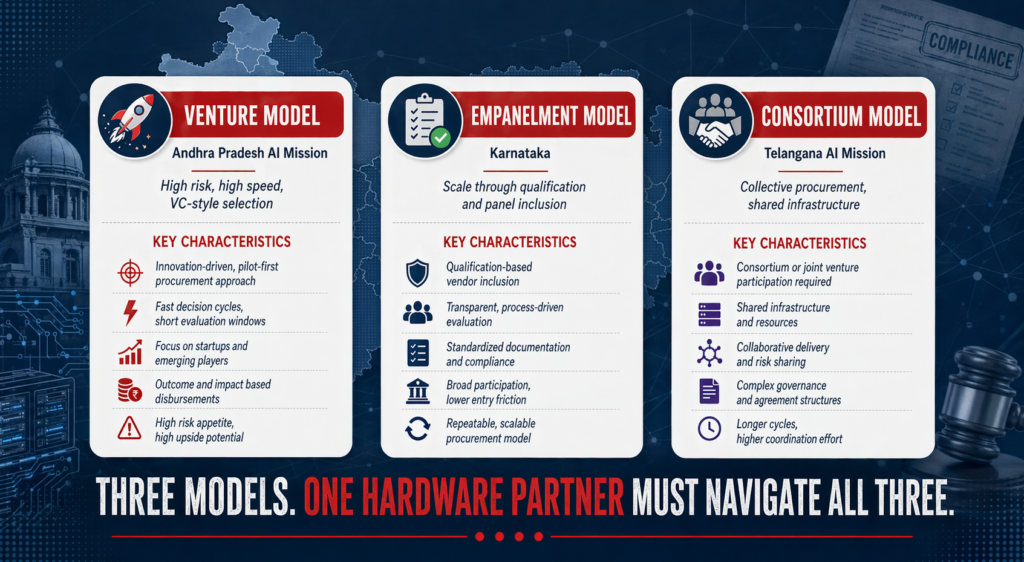
The Three Operating Patterns and What They Demand
State IT secretaries operate one of three procurement patterns, and each pattern demands a different OEM strategy. The SPV model (Andhra Pradesh, some Telangana structures) requires OEMs to invest in R&D partnerships, accept margin-share arrangements, and be willing to operate at below-market profitability in exchange for future scale and brand positioning. The empanelment model (Karnataka, parts of Kerala and Maharashtra) requires OEMs to maintain compliance infrastructure, regional support, and the ability to run 20–30 small procurements in parallel without operational friction. The reverse-auction model (UP, Tamil Nadu, Rajasthan) requires OEMs to have cost discipline, supply-chain resilience, and the financial depth to absorb payment delays and volume commitments.
An OEM cannot be equally strong in all three. The cost structure, account management model, and service architecture required for empanelment competition is incompatible with the R&D investment model of SPVs. The supply-chain discipline required for reverse auctions is incompatible with the high-touch, department-level customization that empanelment demands. The most successful OEMs will not try to be everything; they will choose their geographic and operational focus, build the right playbook for that context, and expand only by adding adjacent states with similar operating models.
Distribution as a Moat: Why State-Level Depth Matters to Investors
For venture and growth equity investors evaluating an Indian OEM, the conversation often starts with central PSU reference customers — Indian Railways, ONGC, Defence Ministry. These references are necessary but insufficient. The investor thesis should also evaluate the company’s distribution depth across state IT procurement, because state missions collectively represent larger TAM (total addressable market) than central government, longer contract terms than commercial IT, and higher repeat-rate potential than enterprise sales.
An OEM with strong relationships with ten state IT secretaries, presence in three or four different operating models, and demonstrable ability to deliver 1,000 units per month across a geographic footprint has built defensible competitive advantages that centralized procurement cannot provide. This company can absorb margin pressure in any single state because it has volume across states. It can absorb demand volatility in one mission because it has pipeline across multiple missions with different budget cycles.
The investor thesis that wins is not “we have a great product for central government”; it is “we have a repeatable go-to-market for each state operating model, we can scale horizontally across 15–20 states without changing our core capabilities, and our unit economics improve with each state we enter because service infrastructure and supply chains become amortized.” This is why state distribution depth is becoming a critical moat dimension for Indian hardware OEMs. The company with distribution wins the next five years of growth. The company with a great product but no state-level operating model will remain a boutique vendor to central government, indefinitely constrained by PSU budget cycles and political cycles.
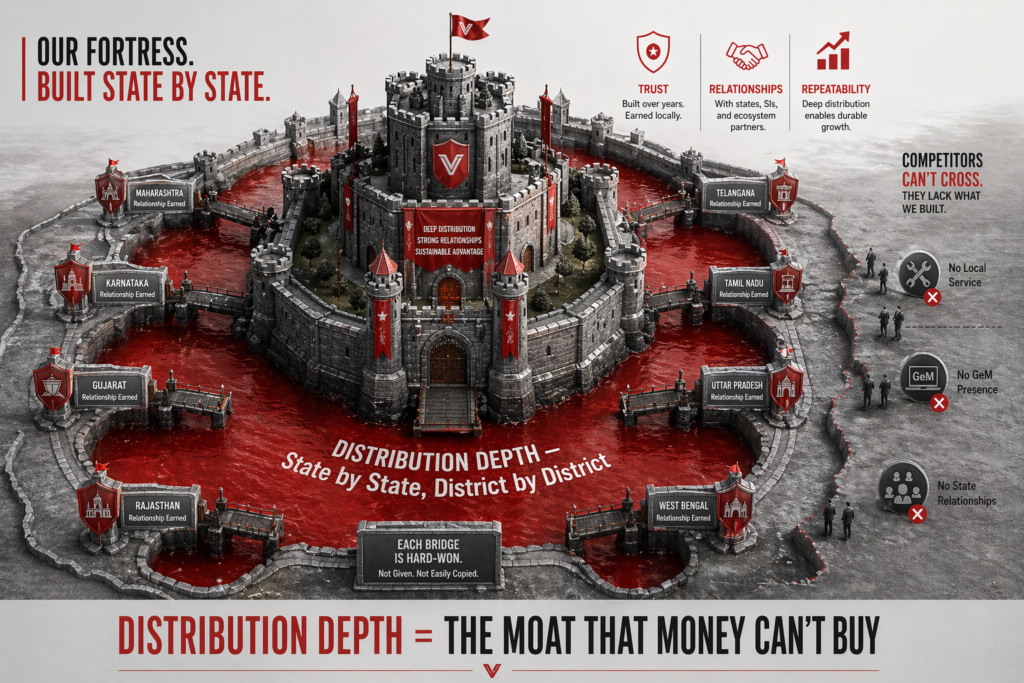
Table: State Digital Mission Hardware Requirements — Device Type, Volume, and Procurement Channel
| Mission Area | Primary Device Type | Typical Volume (per mid-size state) | Key Spec Requirements | Procurement Channel |
|---|---|---|---|---|
| e-Governance Kiosks (CSC / Jan Seva Kendra) | All-in-one PC or thin client + biometric reader | 5,000–15,000 units | BIS-certified, touchscreen optional, 4G/Wi-Fi, rugged chassis | GeM (Class-1 preference), State NIC empanelment |
| District Data Centres | Rack servers, storage arrays, UPS, networking | 30–75 server racks per state DC | Energy-efficient, IPMI/iDRAC, redundant PSU, MeitY Trusted Source | State tender / GeM rate contract for servers |
| School Computer Labs (state scheme) | Desktop PCs or thin clients | 50,000–2,00,000 units (multi-year rollout) | i3/i5, 8–16 GB RAM, BIS, 3-yr on-site warranty, FOSS-compatible | State Education Dept tender; GeM DGS&D rate contract |
| Health Informatisation (ABDM / HWC) | Ruggedised laptop or AIO for Health and Wellness Centres | 3,000–10,000 units | Offline-capable, low power, biometric integration, IP-rated chassis | NHM procurement; state health dept tender |
| Police / CCTNS Modernisation | Desktop PC + fingerprint scanner + camera at PS level | 2,000–8,000 units per state | MeitY Trusted Source mandatory; TPM 2.0, Windows 11 Pro, encrypted storage | MHA / state police HQ tender; security-cleared vendors only |
Building the Right Playbook
The OEM that understands state digital missions will not build one sales team and hope it scales. It will hire a state-focused team with prior government IT procurement experience, segment its prospects by operating model (not by geography), and build distinct playbooks for SPV partnerships, empanelment competition, and reverse-auction execution. It will maintain separate P&Ls for each model so it can track profitability and adapt quickly if any model becomes uncompetitive. It will publish case studies and metrics that matter to each state IT secretary — research outputs for SPV states, cost-of-ownership models for empanelment states, on-time delivery and warranty claim metrics for reverse-auction states.
The state digital missions wave is a five-to-seven year opportunity, not a permanent market shift. The states that move fastest — Andhra Pradesh, Telangana, Karnataka, Tamil Nadu — will complete their major migrations within five years. The window to capture state-level customer relationships and build the playbook is now. The OEM that invests in understanding state operating models, builds the right go-to-market for each model, and executes at scale across a diverse state portfolio will emerge as the dominant Indian OEM in the next upgrade cycle. Read our analysis on why Indian organizations are choosing made-in-India IT hardware for deeper context on the broader procurement shift driving state missions.
The alternative — treating all states as variants of central PSU procurement, pricing everything by comparison to GeM benchmarks, and waiting for RFQs to arrive — is the path to irrelevance. State IT secretaries do not want commodity vendors; they want partners. The OEM that figures out what each state IT secretary actually wants from a hardware partner, and then builds the organizational capability to deliver it, will own the next wave of Indian government IT procurement.
Related Reading: Sovereign AI starts with sovereign compute explores the infrastructure foundation these state missions depend on.
To map your state’s operating model to the right RDP engagement, visit rdp.in/contact.
