
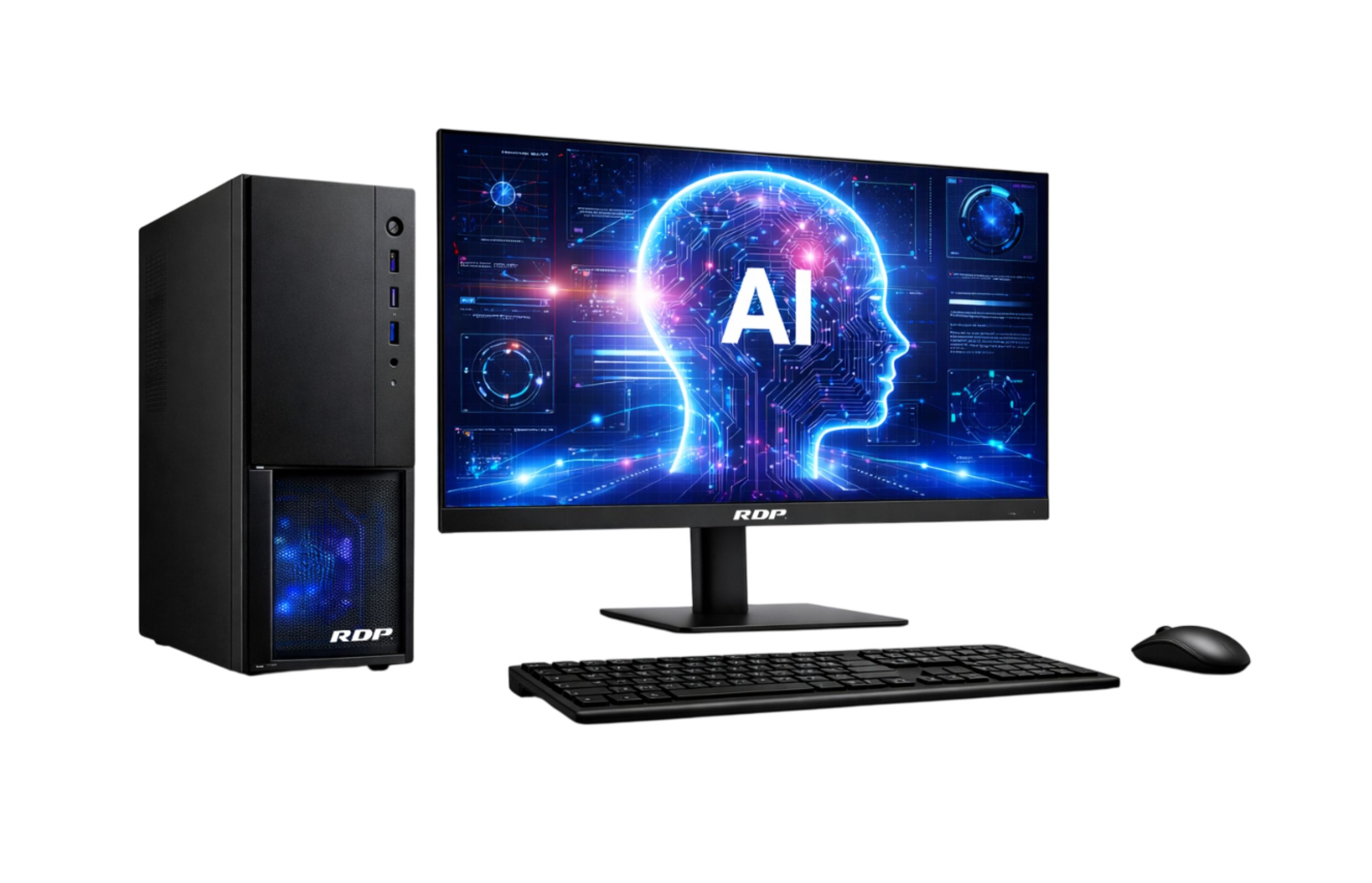



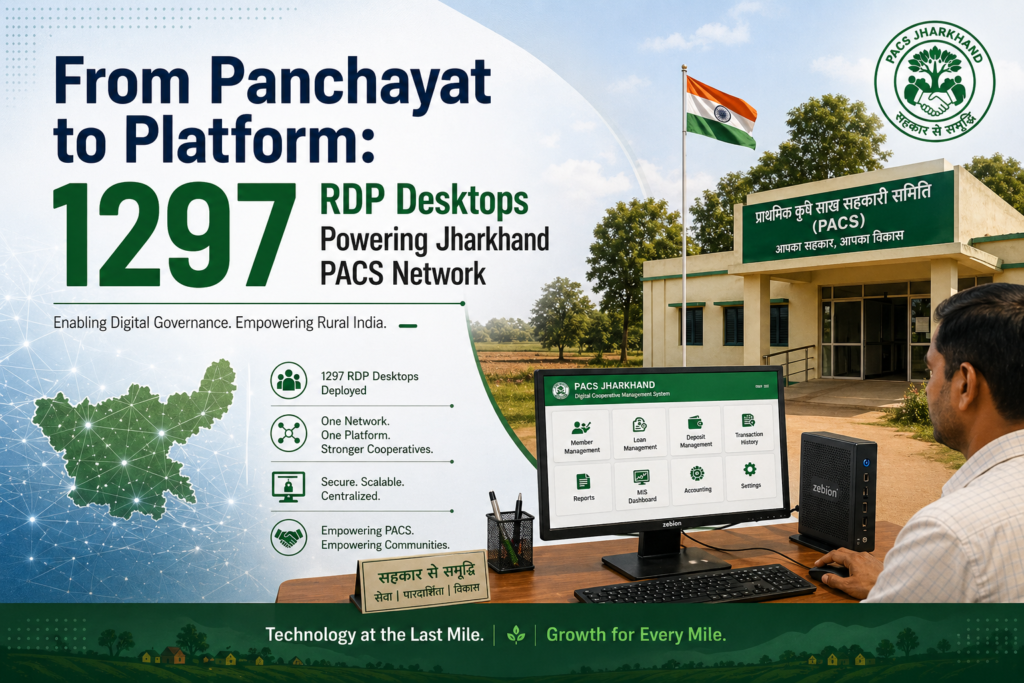
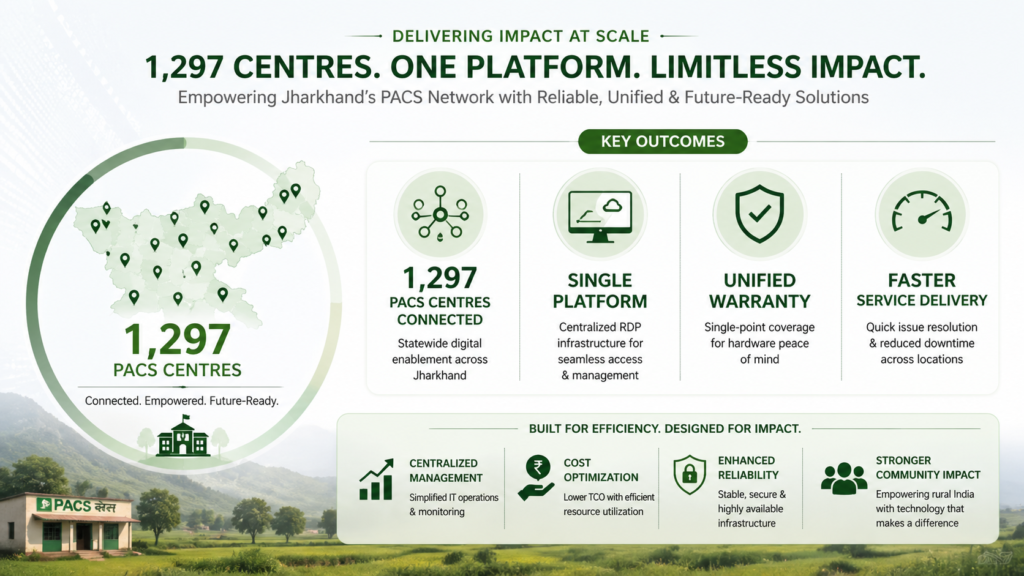
One thousand two hundred and ninety-seven desktops. Every panchayat-level PACS centre in Jharkhand — connected to a single, standardised computing platform for the first time. When a cooperative society member in Ranchi district walks into a PACS office to check a crop loan status, the machine processing that request is an RDP Desk PC 117, manufactured in Hyderabad.
This is not a procurement footnote. This is a state digitising its rural cooperative backbone — and choosing an Indian OEM to do it.
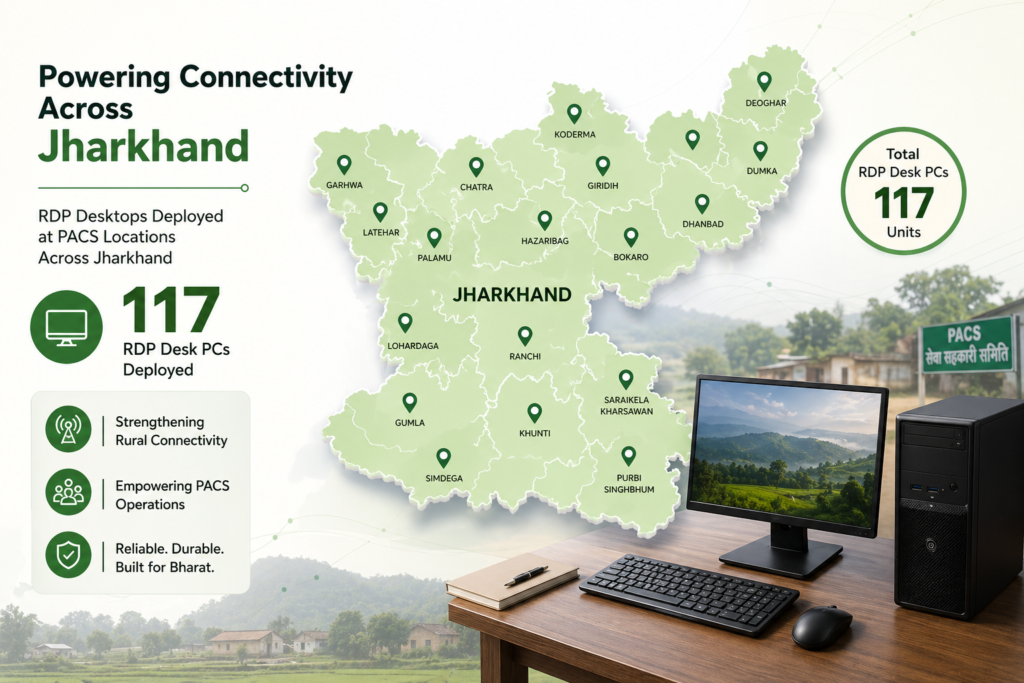
The Problem: Cooperative Offices Running on Inconsistency
Primary Agricultural Credit Societies (PACS) are the financial first-responders of rural India. In Jharkhand, they process crop loans, manage cooperative deposits, verify Aadhaar identities, and administer welfare schemes for millions of rural families. These offices sit at the panchayat level — the most granular unit of Indian governance.
Before this deployment, most PACS offices across Jharkhand operated on a patchwork of ageing hardware, inconsistent configurations, and in some locations, no digital infrastructure at all. Four structural problems defined the status quo:
- No hardware standardisation. Each district or block procured independently. Different processors, different RAM configurations, different OS versions. IT support became a district-by-district improvisation.
- Unreliable uptime. Machines sourced piecemeal had no unified warranty structure. When a desktop failed in a remote block office, replacement timelines were unpredictable.
- Limited processing capacity. Many legacy machines struggled with modern portal workloads — Aadhaar biometric authentication, DBT processing, and MIS reporting running simultaneously on hardware designed for single-task use.
- No scalable procurement model. The state needed a single vendor capable of delivering at panchayat-level granularity, with consistent specs, consistent logistics, and consistent after-sales support.
The mandate was clear: one platform, one OEM, statewide coverage.
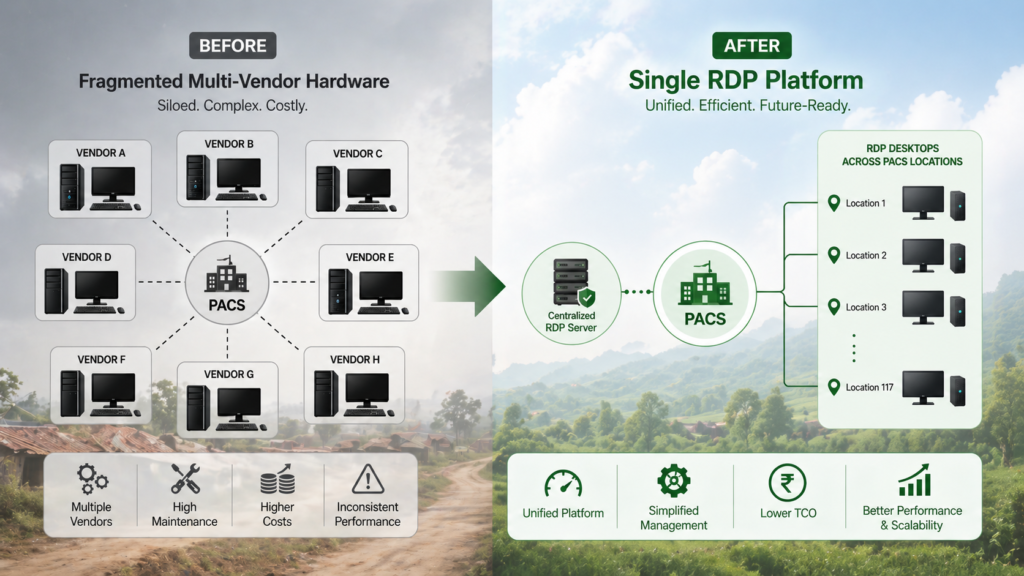
Why RDP
The Jharkhand Government selected RDP through the Government e-Marketplace (GeM) for three structural reasons that matter more than specification sheets.
First, domestic manufacturing. RDP assembles every unit at its 28,000 sq. ft. ISO 9001-certified facility in Hyderabad. For a government deployment touching 1,297 locations, supply chain predictability is non-negotiable. Import-dependent OEMs face lead-time volatility that state-scale projects cannot absorb. RDP’s Hyderabad facility eliminates that variable.
Second, statewide logistics execution. Delivering to district headquarters is one thing. Delivering to panchayat-level PACS centres across Jharkhand — including remote blocks in Palamu, Dumka, and West Singhbhum — demands a logistics capability that most OEMs don’t offer for sub-1,500-unit orders. RDP’s institutional delivery track record, built across 100,000+ devices shipped nationally, made this achievable.
Third, GeM compliance and pricing. With 6,000+ OEM SKUs listed on GeM, RDP offered the procurement transparency and competitive pricing that state digital missions and government IT procurement mandates require. No intermediaries. No channel markups. Direct OEM-to-government delivery.
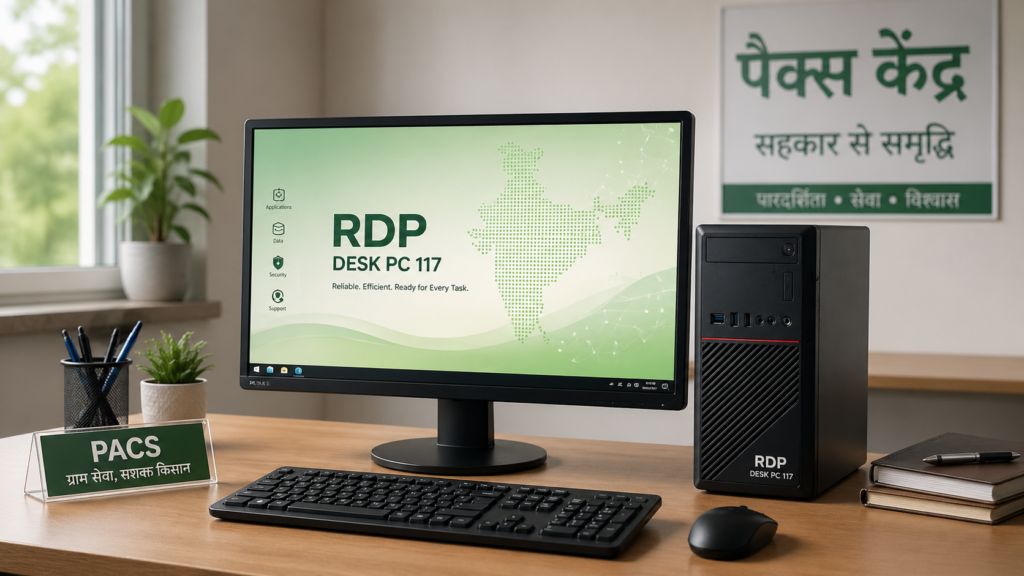
The Hardware: RDP Desk PC 117
The Desk PC 117 was specified for the exact workload profile that PACS offices run daily — not over-engineered for tasks they don’t, and not under-specified for the multi-application reality of cooperative computing.
| Component | Specification |
|---|---|
| Processor | AMD Ryzen 7 5700G — 8 cores, 16 threads, up to 4.6 GHz |
| Cache | 16 MB L3 |
| Chipset | AMD A520 |
| Memory | 16 GB DDR4 RAM |
| Storage | 1 TB PCIe NVMe SSD (M.2) |
| Display | 21.5-inch Full HD height-adjustable monitor |
| Peripherals | RDP USB wired keyboard and optical mouse |
| Quantity | 1,297 units |
| Deployment scope | Panchayat-level PACS centres across Jharkhand |
The AMD Ryzen 7 5700G is a deliberate choice. Eight cores and sixteen threads handle the concurrent workloads that define modern government office computing: Aadhaar biometric portals, cooperative banking software, DBT scheme processing, MIS dashboards, and office productivity applications — simultaneously, without the thermal spikes that plague lesser processors in environments where air conditioning is inconsistent.
The 1 TB NVMe SSD is equally purposeful. Government offices accumulate data — loan records, identity verification logs, scheme databases, correspondence. A terabyte of PCIe storage ensures PACS offices do not hit capacity walls within a standard refresh cycle, while NVMe speeds keep boot times and application launches fast enough that queued farmers are not waiting on hardware.
Sixteen gigabytes of RAM provides the headroom for multi-tab portal operations. When a PACS operator has the cooperative management portal, Aadhaar authentication window, DBT dashboard, and a spreadsheet open simultaneously — which is the actual daily workflow — 16 GB ensures no process stalls.
Deployment: The Logistics Reality
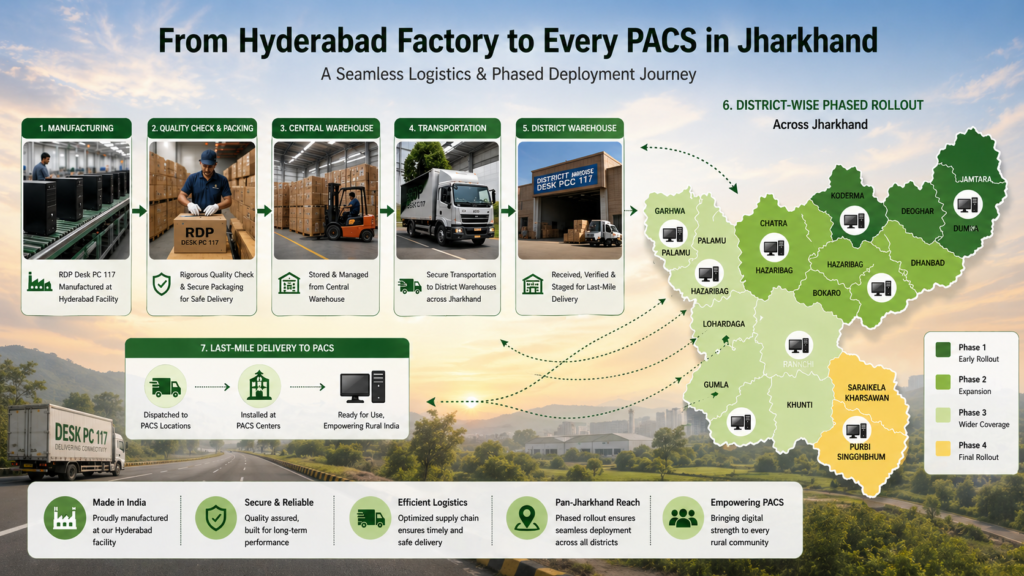
Deploying 1,297 identical systems across a state is not a shipping exercise. It is a logistics operation that requires coordination across multiple supply chains, transport networks, and installation timelines.
RDP’s execution model for Jharkhand followed the pattern refined across previous state-scale deployments:
- Centralised manufacturing at the Hyderabad facility — every unit built to identical specifications, quality-validated, and imaged with the same OS and driver configuration.
- Statewide coordinated delivery — phased rollout across districts, with priority scheduling for high-volume centres and accessible locations first, extending to remote panchayat offices.
- Standardised installation — consistent deployment protocols ensuring every PACS office receives an identically configured, ready-to-operate system.
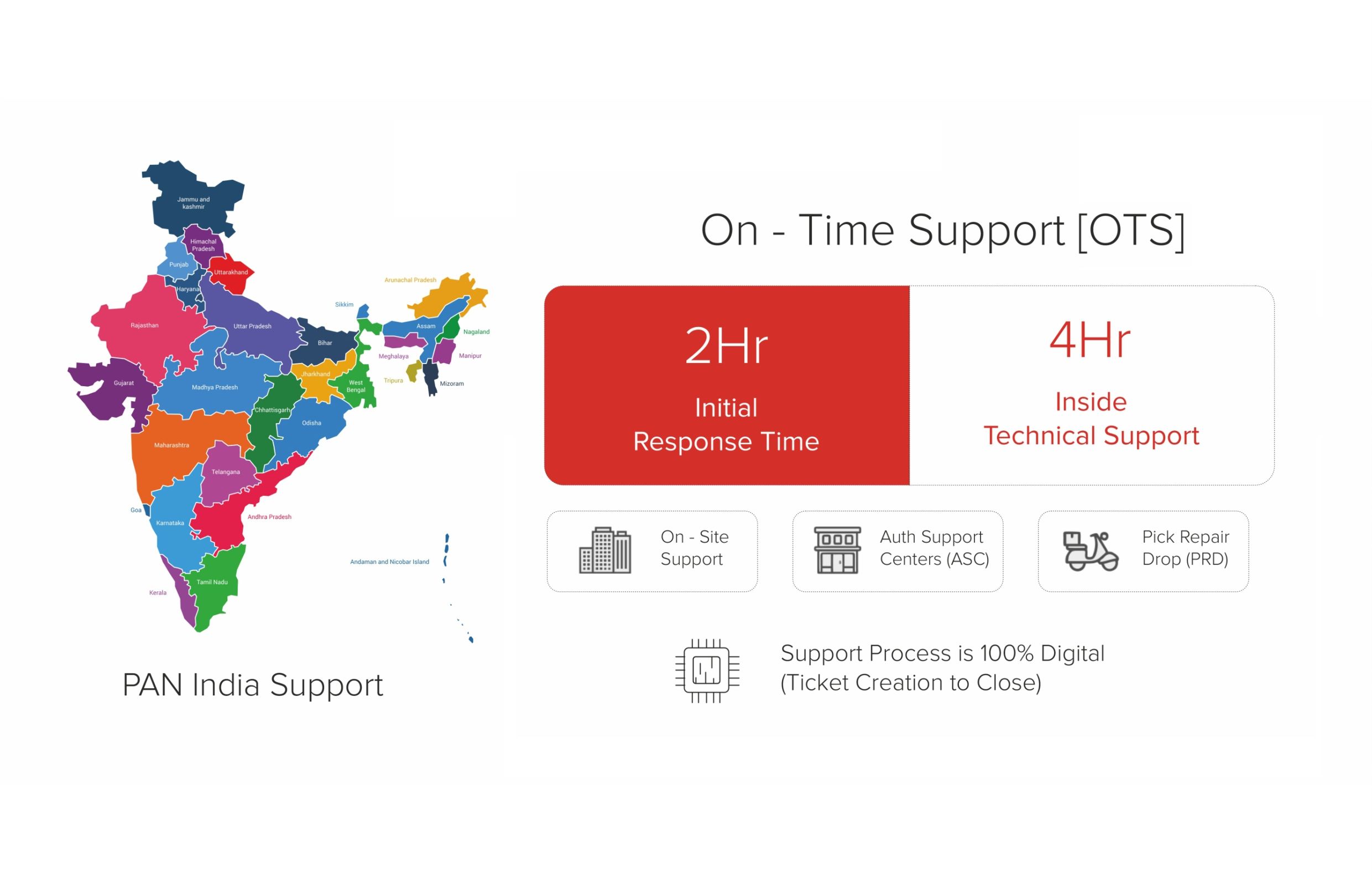
- After-sales support framework — a single warranty umbrella covering all 1,297 units, eliminating the district-by-district support fragmentation that plagued the previous setup.
The Outcome: A State on One Platform
| Outcome | Impact |
|---|---|
| PACS offices digitised | 1,297 panchayat-level centres across Jharkhand |
| Hardware standardisation | Single desktop platform, single OS image, single support structure |
| Service delivery | Faster Aadhaar verification, DBT processing, and cooperative transactions |
| Uptime reliability | Consistent performance with unified warranty coverage |
| Rural accessibility | Digital governance extended to the most granular administrative level |
The deployment transformed Jharkhand’s PACS network from a fragmented collection of inconsistent hardware into a standardised digital platform. When the state IT department needs to push a software update, manage a security patch, or troubleshoot a configuration issue, they are working with one hardware baseline across 1,297 locations — not a dozen different configurations across a dozen different vendors.
For the cooperative member in a panchayat office, the impact is simpler: the machine works, the portal loads, and the transaction completes. That is what digitisation at scale actually looks like.
The Pattern: From Chhattisgarh to Jharkhand
This deployment mirrors the playbook RDP executed in Chhattisgarh, where 2,200 Desk PC 125 systems digitised the state PACS and government cooperative network. Two states, two PACS networks, one OEM. The pattern is now proven and repeatable.
For any Indian state government evaluating PACS digitisation or rural IT infrastructure modernisation, the question is no longer whether an Indian OEM can deliver at this scale. RDP has done it — twice. Make in India. Built for an AI-Ready India. Reliability is Our Product.
Evaluating a statewide PACS or cooperative IT deployment? Talk to us.