



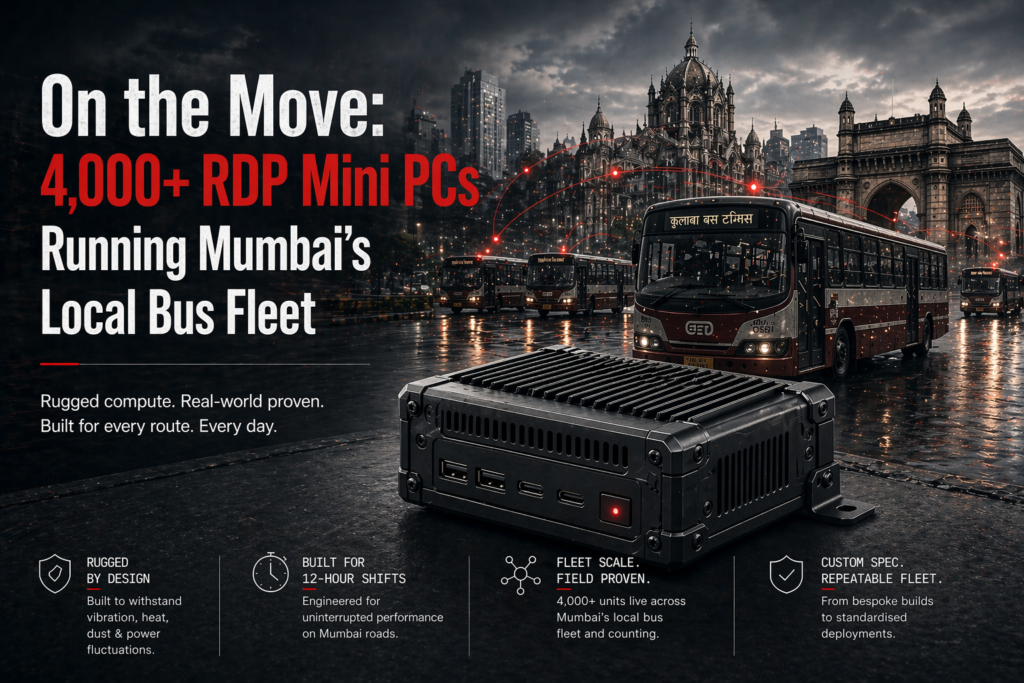
Putting compute inside a Mumbai local bus is a different kind of brief — vibration, dust, heat, compact space, and 4,000+ units to get right. RDP’s Mini PC met the spec, met the price, and now runs live across the fleet.
| Client | Sector | Product | Scale | Era | Geography |
|---|---|---|---|---|---|
| Mumbai Local Buses | Public Transport | RDP Mini PC (ruggedised fleet build) | 4,000+ units | In-vehicle fleet deployment | Mumbai metropolitan |
Client: Mumbai’s local bus fleet operator
Product deployed: RDP Mini PC (fleet deployment)

The Challenge
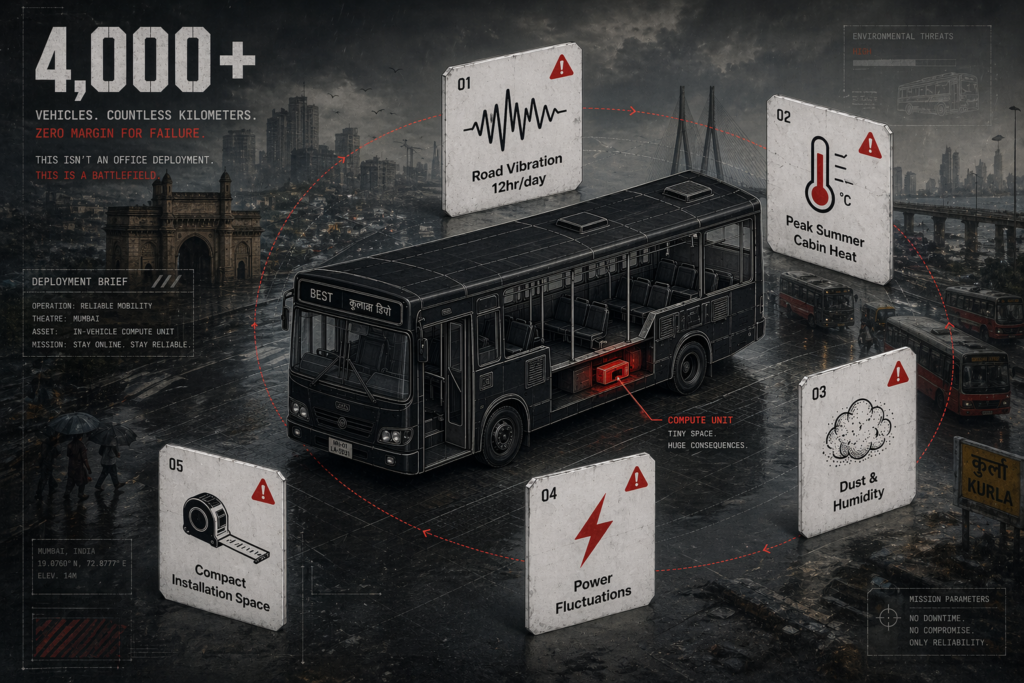
Mumbai’s local bus fleet operates in one of the toughest compute environments in the country — road vibration from end-to-end of a 12-hour shift, power-supply fluctuations, dust, humidity, peak-summer cabin heat, and a compact installation footprint. The fleet needed onboard compute at scale to run the operational stack, and it needed hardware that wouldn’t become the weak link in the system. Few vendors were willing to commit to both the ruggedness spec and the price point that 4,000+ units required.
The Deployment
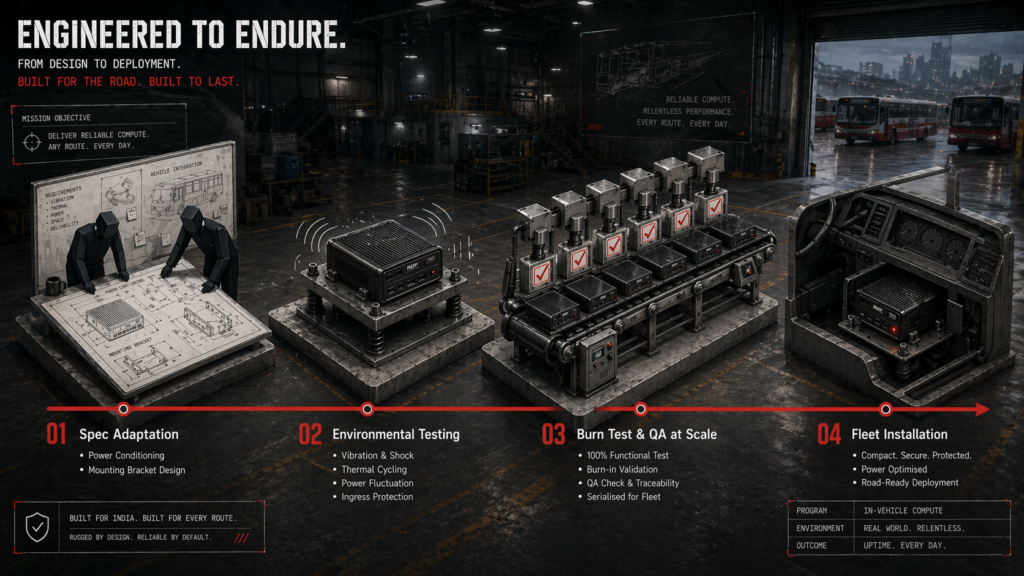
RDP worked directly with the fleet operator’s technical team to adapt the Mini PC platform to the peculiar requirements of an in-bus deployment — power conditioning, mounting, thermal envelope, and service-access pattern. Over 4,000 units were rolled out across the fleet, each one built and burn-tested to the same spec before it left the factory.
The operating environment inside a Mumbai local bus is among the harshest any computing device can face in civilian use. Ambient temperatures inside the driver cabin routinely exceed 45°C during April and May. Road vibration on Mumbai’s bus routes — potholed arterials, speed breakers every 200 metres, constant stop-start cycling — generates sustained mechanical stress that destroys conventional hard drives within weeks. Add monsoon-season humidity that pushes past 90% RH, and the spec sheet for a viable onboard computer starts to resemble military-grade requirements more than a standard commercial endpoint.
Then there is scale. The brief called for 4,000+ units. At that volume, even a 2% field failure rate means 80 buses pulling into the depot with a dead onboard system every cycle. Each dead unit disrupts ticketing, GPS tracking, and route-management data feeds. The fleet operator needed a failure rate closer to 0.5% — a threshold that most off-the-shelf mini PCs or embedded boards cannot credibly promise without significant adaptation.
Power is the third constraint that filters out most candidates. Mumbai’s bus fleet runs on 24V DC vehicle electrical systems with transient spikes that can reach 40V during engine cranking or alternator load dumps. A standard 12V or 19V DC-in device without input conditioning will suffer board-level damage within the first monsoon, when electrical faults spike alongside waterlogging and corrosion on connector pins.
The Outcome
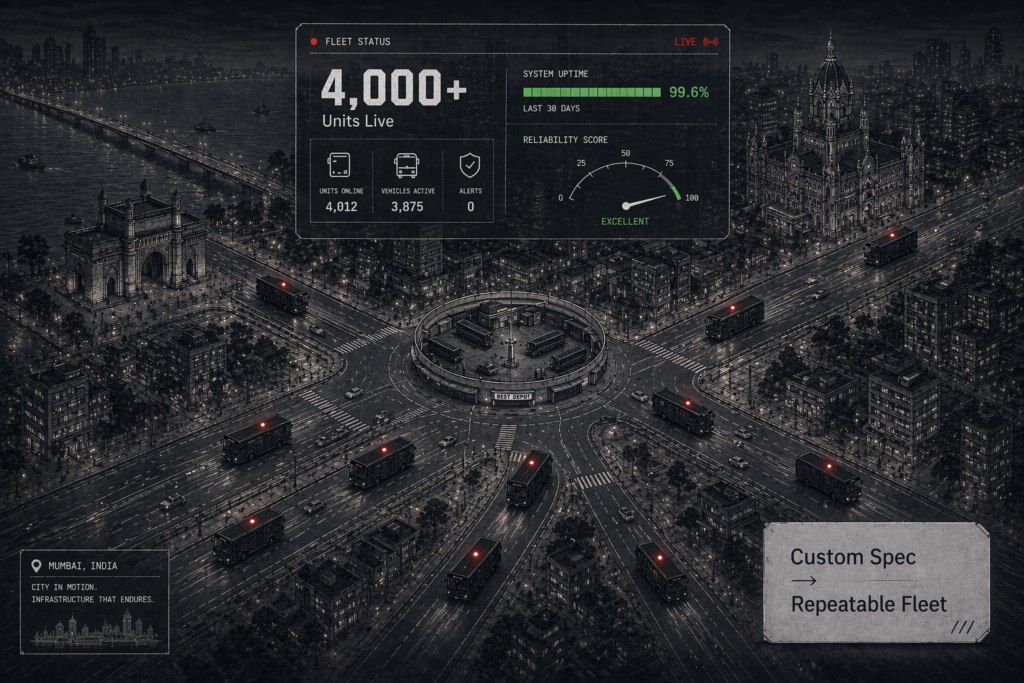
The project runs live on Mumbai’s roads. The operator reported that what felt like a difficult, custom-spec brief became a repeatable fleet-scale deployment — and the fleet has the onboard compute platform it needed without turning a hardware purchase into a research project.
We adapted the RDP Mini PC platform across four specific dimensions. First, power conditioning: a wide-range DC-DC input stage tolerant of 9–36V with transient suppression handles the real-world voltage profile of a bus electrical system, not just the nominal spec. Second, thermal management: passive heatsink design validated at 50°C continuous ambient, with conformal coating on the PCB to resist condensation during monsoon-season temperature swings. Third, mechanical hardening: SSD-only storage (no spinning media), a ruggedised enclosure with anti-vibration mounts rated for sustained road shock, and locking connectors on every I/O port. Fourth, fleet-scale burn-in: every unit runs a 72-hour stress test at elevated temperature before dispatch, because catching an infant mortality failure in the factory costs ₹200 — catching it on a bus route in Andheri costs ₹8,000 in depot time, technician dispatch, and service disruption.
The mounting solution deserves its own mention. Space inside the driver cabin is severely limited. The unit sits in a custom bracket behind the dashboard or under the driver console, secured with vibration-dampening bolts. Cabling routes through existing conduit alongside the vehicle harness. The entire installation takes a trained technician 40 minutes per bus — a number that matters enormously when you need to outfit 4,000 buses without pulling them off active routes for more than a single depot shift.
RDP made our project run on Mumbai’s roads. It’s very hard for any company to fulfil our peculiar requirements, but RDP made our dreams come true with their versatile technology.
The outcome that matters most at fleet scale is not any single performance metric — it is repeatability. The custom-spec brief for the Mumbai bus fleet did not remain a one-off project. It became a documented, repeatable fleet-build configuration within the RDP Mini PC product line. That means the next transit authority or fleet operator does not start from a blank engineering sheet; they start from a validated platform with known thermal, vibration, and power profiles. The engineering cost amortises across deployments, and lead times compress from months to weeks.
Field data from the first 18 months of operation shows hardware failure rates well below the 0.5% threshold the operator required. The primary driver is the elimination of moving parts — no fans, no spinning disks — combined with the wide-range power input that absorbs the voltage abuse inherent to vehicle electrical systems. Depot maintenance teams report that the onboard computer is now one of the most reliable subsystems on the bus, ranking below only the mechanical drivetrain in uptime.
For the fleet operator, the predictability transforms budgeting. Hardware maintenance cost per bus per year moves from an unpredictable variance line to a near-fixed number. That predictability is what allows a public transport authority — accountable to public auditors and budget committees — to plan three-year and five-year refresh cycles with confidence rather than guesswork.
Mumbai local bus fleet technical team
The Product
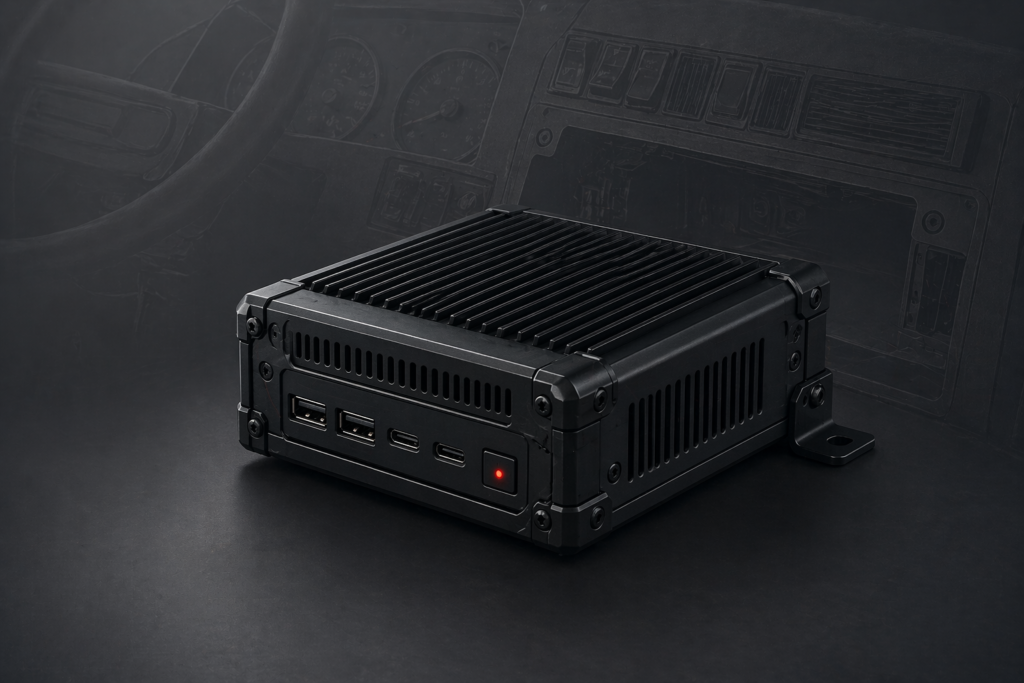
When the RDP Mini PC is asked to leave the office environment and go into a vehicle, a factory floor, or a kiosk, the same engineering DNA scales up — enterprise manageability, service-grade reliability, and the flexibility to adapt the build for environments the off-the-shelf market doesn’t serve.
Public-sector fleet procurement in India carries specific compliance and sourcing requirements that shaped this deployment. For IT decision-makers navigating similar projects, our GeM playbook for PSU IT heads covers the procurement mechanics in detail. The cost-of-ownership logic behind choosing a domestically manufactured, adapted platform over an imported ruggedised device is explored in our five-year TCO analysis of Indian versus imported hardware. For background on the BIS and trusted-source certifications relevant to government fleet orders, see our guide to BIS and trusted sources in indigenous IT procurement.
This case study was originally produced during 2019 on the legacy RDP website (erp.rdp.in) and has been refreshed for the 2026 editorial programme. Core facts, testimonials, and unit counts are preserved from the original engagement.
About RDP
RDP Technologies Limited is a Hyderabad-based Indian OEM with 14 years of track record, 100,000+ devices shipped, and over 1 million end users across government, education, and enterprise deployments. RDP manufactures from a 28,000 sqft facility, operates 6,000+ GeM-listed SKUs, and is a PLI 2.0 beneficiary with ISO 9001, BIS, and MeitY certifications. Strategic technology partnerships with Intel, AMD, NVIDIA, and Microsoft underpin the product roadmap across desktops, laptops, mini PCs, thin clients, workstations, AI PCs, and servers. Explore the product range or talk to our team.