



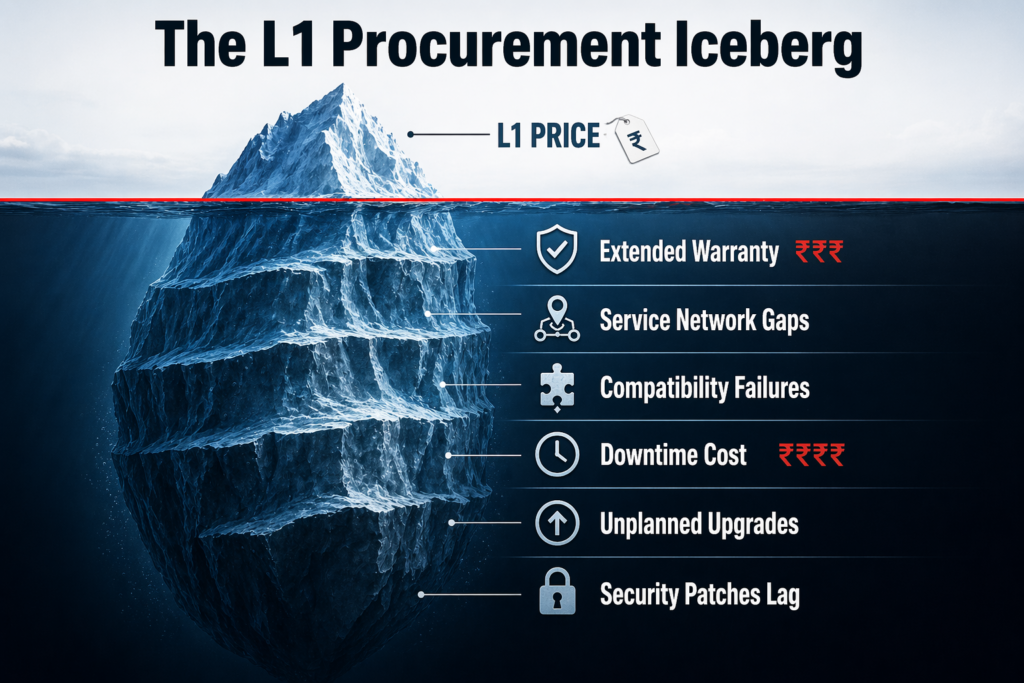
The L1 Trap Is Not About Price
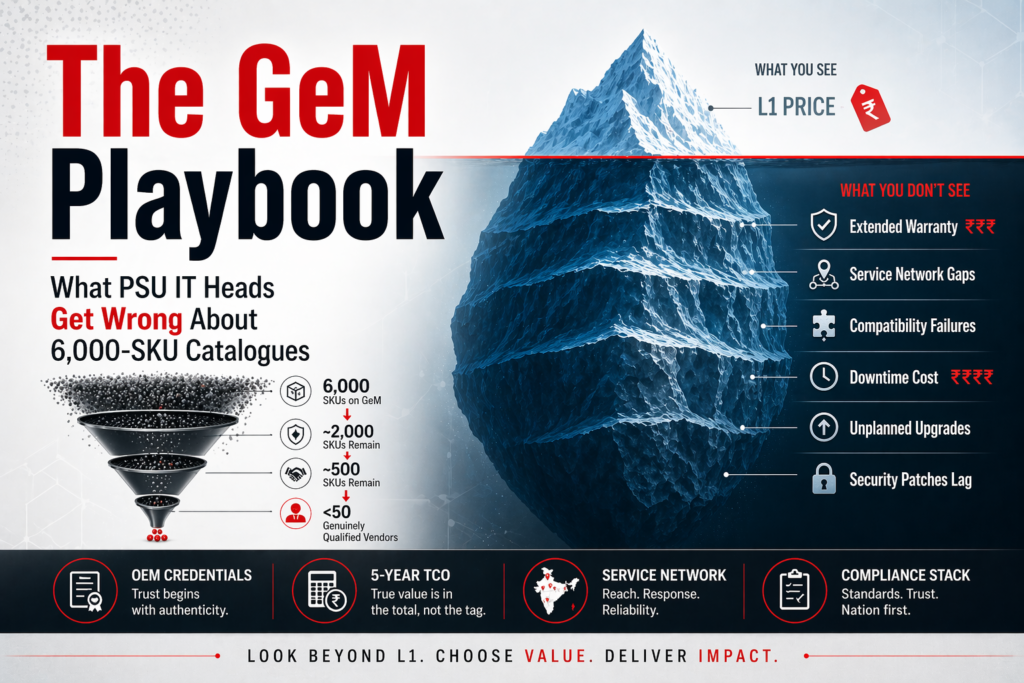
Most PSU IT heads treat GeM reverse auctions like a procurement problem, which is why they keep losing the game. The catalogue-driven marketplace isn’t designed to find you the cheapest widget at 3 pm on a Tuesday; it’s designed to lock in compliance, traceability, and MSE participation within a public system. When you optimise purely for L1 — the lowest bidder — you’re competing in the wrong arena.
This matters because GeM transacted over ₹2.32 lakh crore in FY 2024-25, and the logic that powers that volume is regulatory, not commercial. An OEM with 6,000+ SKUs in the GeM catalogue, BIS registration, PLI 2.0 eligibility, and MeitY recognition isn’t just cheaper sometimes — it’s the path of least friction when auditors, compliance officers, and treasury teams all need to sign off. Yet IT heads routinely overlook this, chase the ₹500 discount, and spend six months untangling delivery, warranty, or missing documentation.
Why Your Reverse Auction Assumptions Are Backwards
The reverse auction on GeM isn’t a race to the bottom among comparable products. It’s a filter that eliminates every vendor who isn’t pre-verified to government standards. Once that filtering happens, price becomes secondary to what happens next: Can this vendor handle PSU-grade SLAs? Can they produce BIS certificates on day one? Do they understand that a central ministry buying 2,000 units isn’t the same as 200 corporate desktops?
When RDP bid on a major state IT refresh last year, we didn’t win because we were the cheapest. We won because our catalogue entry had forward-validated gestation periods, zero tolerance for out-of-stock, and a documented supply chain that started in our Hyderabad facility. The L1 vendor in that same auction couldn’t produce a BIS certificate within 30 days of order. Within four months, the state’s procurement officer was on the phone asking if we could expedite because the L1 vendor had collapsed on delivery.
This happens because PSU IT heads — and their procurement teams — often treat GeM SKUs as equivalent to retail specs. A “Desktop PC 16GB RAM” in the GeM catalogue isn’t the same product across vendors. One vendor’s entry includes onsite support for 36 months; another’s has none. One carries BIS, another carries only factory certification. You’re not comparing apples; you’re comparing the OEM’s ability to service a government contract under duress.
The MSE-I Preference Isn’t Optional — It’s Structural
The Micro and Small Enterprises (Manufacture) category (MSE-I) preference in GeM is often treated as a nice-to-have by PSU procurement teams, especially larger ones. It isn’t. It’s a statutory gate that can swing 25% of the contract value your way if you hit it.
MSE-I registration isn’t trivial. You need to be on the Udyam Registry, maintain domestic manufacturing, and meet turnover caps. This means most large, multinational vendors can’t compete in MSE-I categories even if they want to. For PSUs buying under MSE-I policy, this creates a curated marketplace of domestic OEMs who have invested in local production and compliance. If your PSU mandate includes sourcing from Indian manufacturers, or if your CPP (Common Procurement Portal) framework emphasizes self-reliance, MSE-I is where the alignment happens — not in the general catalogue.
The mistake many IT heads make is assuming MSE-I applies only to small buys or niche products. It doesn’t. A PSU can structure a 5,000-unit IT refresh with MSE-I preference on desktops, servers, or networking gear. The preference doesn’t guarantee the cheapest price, but it does guarantee you’re funding domestic manufacturing capacity. Given DPIIT targets and GeM’s role in Make in India, this alignment is increasingly how government measures procurement success.
Confusing SKU Codes With Bill-of-Quantities
One of the sharpest divides between new and experienced PSU IT heads is how they read a GeM catalogue. New heads often assume: find the SKU code, match it 1:1 to your requirement, hit approve. Experienced ones know: the SKU code is a box you’re fitting a BOQ into, and if you get the fit wrong, the whole timeline collapses.
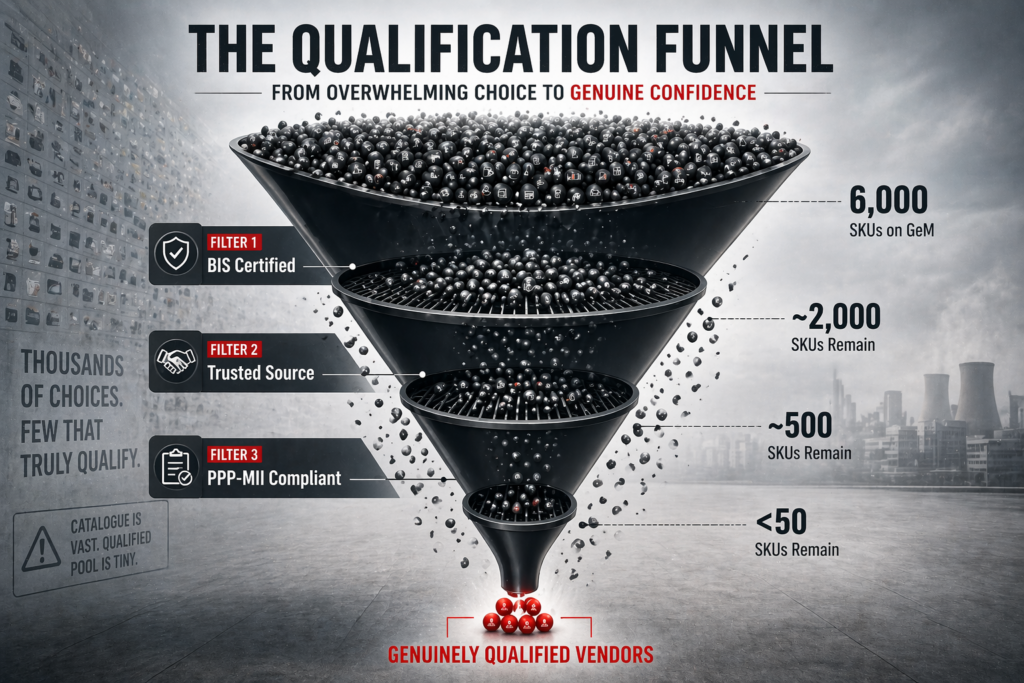
A 6,000-SKU catalogue looks comprehensive until you actually place an order and realize the vendor’s “Core i7 Desktop” doesn’t come with the monitor configuration your ministry specified. Or the “16GB Laptop” entry doesn’t include the memory upgrade path your depots need. These aren’t vendor failures; they’re specification mismatches that should have been caught in the CPP phase, before the GeM order went live.
The vendors who win PSU contracts consistently are the ones who help IT procurement teams translate their BOQ into a coherent SKU story. RDP’s approach — and this applies across serious Indian OEMs with deep PSU experience — is to work backwards from your actual requirement (number of devices, placement across locations, support structure, upgrade timeline) and then map that into GeM entries that stack correctly. A PSU buying 1,500 units often needs 8–12 different SKU codes across variants, all of which have to be in stock simultaneously.
This is why buying by SKU code alone, without understanding the underlying supply chain, leaves PSU IT heads blindsided when one of the 12 variants runs out of stock and delays the entire refresh.
BIS Is Not Optional Theatre
Some IT heads treat BIS certification as a compliance checkbox — useful on paper, nice to have in meetings, not actually critical to functionality. This is dangerously wrong, especially as central and state governments tighten cybersecurity and data residency audits.
BIS (Bureau of Indian Standards) registration for IT hardware has moved from optional to mandatory in many government frameworks. A desktop or server without valid BIS isn’t just non-compliant; it’s uninsurable within a PSU’s IT insurance and audit trail. If your finance team runs a compliance audit and discovers 500 computers in your DC don’t carry BIS, you’ve got a six-month remediation window, procurement delays, and possibly budget reallocation.
The OEMs you should be talking to are the ones with forward-dated BIS certificates (not retroactive ones) and a documented track record of maintaining certification across product families. This matters because BIS renewal, product line changes, and component substitutions can all create gaps in coverage. An OEM like RDP, with ISO 9001 certification alongside BIS, has built compliance into manufacturing, not added it afterwards.
Comparative Catalogues Will Reveal What L1 Hides
Here’s a practical move that separates sophisticated PSU procurement from the tired cycle: build a comparative catalogue before you open the reverse auction. Pull the top 8–10 vendors in your product category from GeM. For each vendor, list (1) their full SKU range in your category, (2) forward-validated lead times, (3) BIS status, (4) warranty and SLA terms, and (5) MSE-I eligibility. This takes two hours. It will show you immediately which vendors are serious about PSU supply and which are spot-bidders hoping for an L1 hit.
When you run the reverse auction, you’ll already know whether the L1 winner is a vendor with a 6,000-SKU catalogue and a manufacturing facility, or someone who will scramble for 90 days and then call your procurement officer with excuses. The comparative catalogue is your insurance policy against the false economy of chasing ₹500 per unit.
The Sovereignty Bet Is No Longer Hypothetical
The last five years have shown every PSU that sourcing IT hardware from geographically fragmented supply chains carries geopolitical and operational risk. This is why Make in India isn’t rhetoric anymore; it’s insurance. When you buy from an OEM with demonstrated domestic manufacturing, BIS compliance, and PLI 2.0 eligibility, you’re not paying a premium for nationalism — you’re paying for supply chain resilience.
GeM’s 6,000-SKU Indian OEM catalogues exist because the government has correctly identified that self-reliance in IT hardware strengthens both procurement speed and national capability. This is also why Indian organizations are choosing Made in India IT hardware. The vendors who will matter to PSU IT over the next decade are the ones investing in Hyderabad, Bangalore, and Pune facilities — not the ones using GeM as a price arbitrage play.
The calculus is simple: a vendor with 100,000+ devices shipped, a 28,000 sq ft manufacturing facility, and a decade-plus track record in PSU supply is less likely to vanish mid-project than a vendor optimizing for the next L1 win. Over a five-year IT refresh cycle, that matters more than the 8% price difference you might catch in a single reverse auction.
What This Means For Your Next Refresh
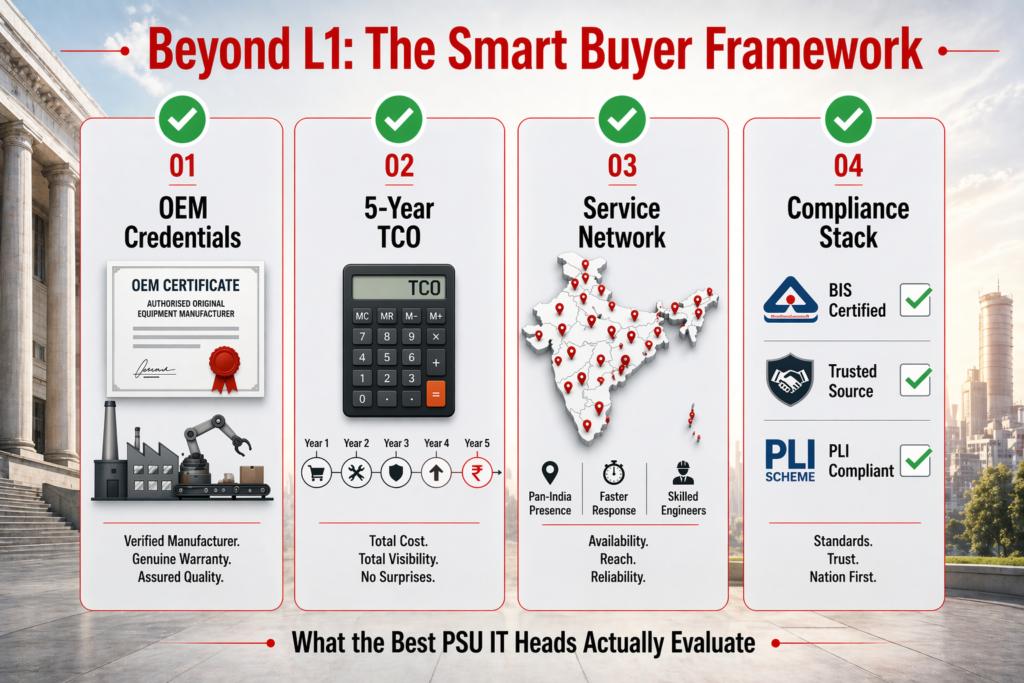
If you’re a PSU IT head planning a refresh or consolidating vendors, stop optimizing for L1. Start optimizing for supply chain integrity, compliance automation, and vendor sustainability. The GeM playbook isn’t broken; you’re just playing it wrong.
The vendors in your preferred category — the ones with MSE-I registration, BIS certification, full SKU coverage, and documented PSU experience — are there for a reason. They’re not the cheapest in isolation, but they’re the cheapest over the lifetime of the contract because they don’t collapse, don’t miss timelines, and don’t hand you compliance problems six months into a refresh. That’s the actual math. The marketplace knows it. The best PSUs know it. And as of today, you do too.
Your next reverse auction is a chance to bid differently: not for the unit price, but for the vendor who will still be in business, compliant, and productive 36 months from order.
Table: GeM Procurement — Common Mistakes vs Best Practice
| Procurement Area | Common Mistake | Consequence | Best Practice |
|---|---|---|---|
| SKU Selection | Buying single SKU for all use cases to simplify ordering | Over-spec for basic users; under-spec for AI/data roles; audit flags | Define 3–4 standard configurations mapped to job roles |
| Lifecycle Cost | Selecting lowest L1 price without AMC or energy cost modelling | TCO 40–60% higher over 5 years than a slightly costlier but efficient device | Evaluate 5-year TCO including power (watts × uptime), AMC, and refresh |
| BIS Compliance Check | Assuming GeM listing = BIS compliance | Rejection at internal audit or MeitY inspection; potential re-tendering | Verify BIS certificate number independently before PO issuance |
| Bid Comparison | Comparing only headline price; ignoring delivery terms and SLA | Lowest bidder delivers late, out-of-spec hardware with no on-site warranty | Score bids on price (60%), delivery SLA (20%), and warranty terms (20%) |
| Make-in-India Preference | Not applying Class-1 / Class-2 local content filter | Non-compliant procurement; procurement officer liability under PP-MII order | Apply Class-1 filter first; document exception if waiver is needed |
| Catalogue Maintenance | Ordering from outdated product listings (EOL SKUs) | Receiving discontinued hardware; no spare parts availability | Validate product lifecycle status with OEM before raising PO |
Related Reading
For the deeper compliance stack behind GeM tenders, see BIS, Trusted Sources and what “indigenous” actually means for IT procurement. To discuss PSU deployment with the RDP team, visit rdp.in/contact.
