



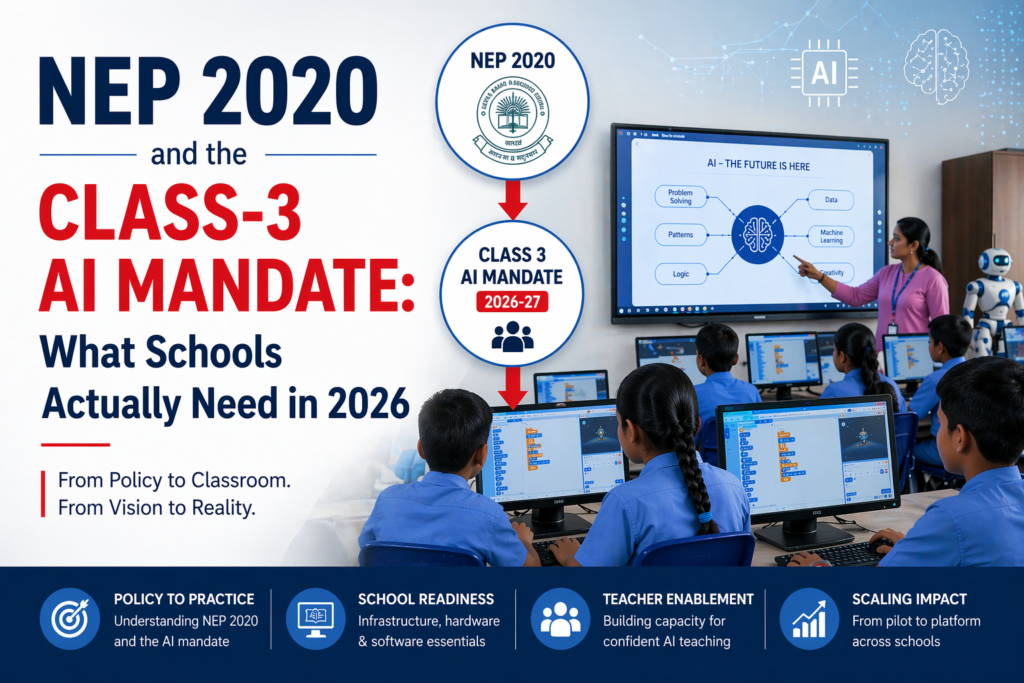
For India’s schools, the AI curriculum is no longer a 2030 aspiration—it is the next academic year. In AY 2026-27, Class 3 students across CBSE-affiliated schools will begin learning foundational AI concepts, marking the first mandatory, nation-wide rollout of AI education at the primary level. With over 26 crore K-12 students in India and roughly 15 lakh active schools, this is not a pilot. It is a structural mandate.
The National Education Policy (NEP) 2020 positioned AI literacy as a core competency for the 21st century, and the CBSE has operationalised that vision through its Class-3 AI curriculum framework. Yet schools across India—from metro-tier-1 institutions to district-level government schools—are now facing a common question: what, exactly, do we need to make this work? Not a prototype. Not a showcase. A functioning, sustainable AI lab that serves 40 students per class, trains teachers who may have never coded, and integrates into a daily timetable that already strains resources.
This post addresses that question directly. We examine the hardware, software, training, and institutional frameworks that distinguish a school AI lab from a computer lab with aspirations.
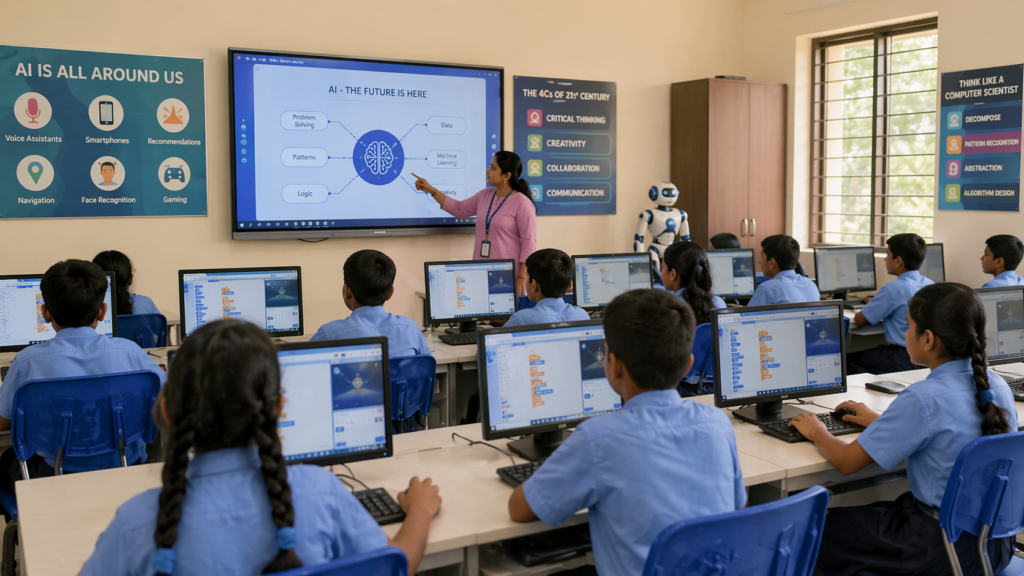
The Structural Moment: Why 2026-27 Matters
The CBSE’s Class-3 AI curriculum is not optional. Schools enrolling students in Classes 3 onwards are mandated to deliver AI foundations starting AY 2026-27. This affects an estimated 2.5 crore Class 3 students across India. For state boards and ICSE-affiliated schools, parallel curriculum pushes are underway, meaning the addressable student population is significantly larger.
What makes 2026-27 a hard deadline, not a soft goal? The CBSE has tied curriculum compliance to school affiliation renewal. Schools cannot postpone. They have 6-9 months—from now until June 2026—to design, procure, and pilot an AI lab infrastructure. More critically, they must identify or train teachers. A Class 3 AI curriculum is not advanced mathematics or coding bootcamp material; it is logic, pattern recognition, and problem-solving. But it requires instructors who understand the pedagogy, not just IT technicians who can reboot a server.
The National Education Policy’s 10th principle emphasises experiential, hands-on learning. AI education in Class 3 is expected to be practical. That means device-per-student or small-group terminals, not one shared projector and a demo laptop. For a school of 1,000 students with roughly 60-80 Class 3 learners across two to three batches, this translates to concrete procurement: entry-level AI PCs or workstations, curated software, and physical space redesigned for group work, not lecture-format.
What an AI-Ready School Lab Actually Requires
A functional school AI lab is not a computer lab. The distinction matters because it shapes every decision downstream. A traditional computer lab focuses on content delivery and basic digital literacy. An AI lab must enable students to build, experiment, and iterate.
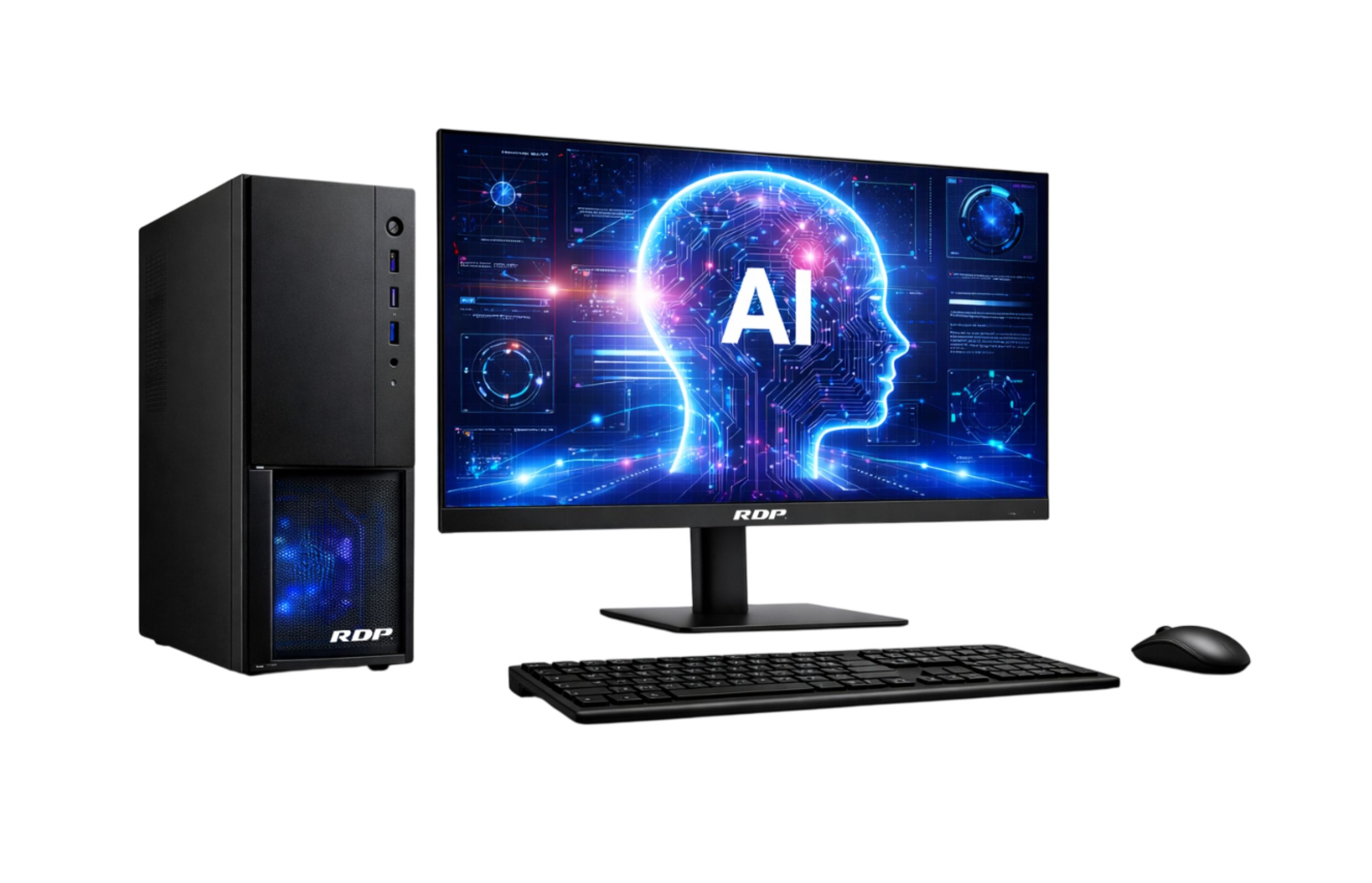
Hardware. Entry-level AI PCs—machines with 8GB RAM, modern multi-core processors (Intel N-series, AMD Ryzen 5000-series or equivalent), and solid-state storage—form the baseline. Why not lower? Class-3-level AI exposure tools (visual programming environments, beginner ML platforms, AI sandbox applications) require enough memory and processing power to handle real-time feedback without lag. A machine that freezes every third command breaks the learning loop. A school lab serving 40 students across 4-6 stations typically needs 8-10 AI PCs. For larger institutions with multiple Class-3 batches, the number scales: a school with 200 Class-3 students across five or six sections might provision 15-20 devices with two-shift scheduling.
Software and Curriculum Integration. The CBSE Class-3 AI curriculum framework includes units on data awareness, pattern recognition, algorithmic thinking, and basic AI applications in daily life. Schools need software ecosystems that align with these units: visual programming (Scratch, MIT App Inventor derivatives), beginner-friendly AI platforms (Google’s Teachable Machine, Hugging Face-hosted educational tools), and simulation environments that let students see AI in action without requiring code literacy. Critically, these tools must be accessible offline or on low-bandwidth school networks. Cloud-dependency is a fault point in Indian schools where internet reliability varies by location and time of day.
Teacher Preparation. This is the structural bottleneck. India’s schools employ over 35 lakh teachers. Very few have formal AI training. The CBSE curriculum expects teachers to guide Class 3 students through AI concepts, but this demands more than a three-day workshop and a workbook. Schools need sustained professional development: online modules, in-person mentoring from AI educators, peer-learning circles, and access to curriculum designers who can contextualise AI learning within existing subjects (mathematics, environmental studies, language arts). RDP’s AI VIDYA programme anchors this through partnerships with teacher-training bodies and state education departments, embedding structured support into the school’s calendar, not bolting it on as an afterthought.
Infrastructure, Connectivity, and the Real-World Bottleneck
Infrastructure in Indian schools is heterogeneous. A metro-tier school in Delhi may have fibre connectivity and a dedicated IT administrator. A government school in rural Odisha may have unreliable power and shared IT staff. An effective school AI lab design accounts for this variance.
Power and cooling are foundational. AI workstations generate more heat than traditional office PCs. A lab with 15 devices running simultaneously requires adequate ventilation and stable power supply. Many Indian schools operate on shared power grids with load-shedding cycles. UPS (uninterruptible power supply) backup and power-conditioned power distribution are not luxuries—they are prerequisites. A sustained power interruption mid-experiment demoralises students and wastes training time.
Connectivity should be designed with offline-first principles. Cloud synchronisation and collaborative features are nice-to-have. Offline execution of curriculum-aligned tools is essential. A school lab where students can work on local AI projects, run visual programming simulations, and save outputs to a local server—even if internet is down—is resilient. This also addresses data privacy: student work stays within the school’s network, not stored on external platforms where consent and data governance become complex questions.
Physical space design matters. A school AI lab is not a typing hall. It is a space for small-group exploration. Circular or clustered seating, with 4-6 students per AI PC or workstation, reduces frustration and enables peer learning. Dedicated storage for devices, cables, and project materials prevents the degradation that makes many school labs look abandoned by mid-year. And signage, protocols for device care, and a rotation schedule (so Class 3 students share machines with other grades) are part of the day-to-day reality.
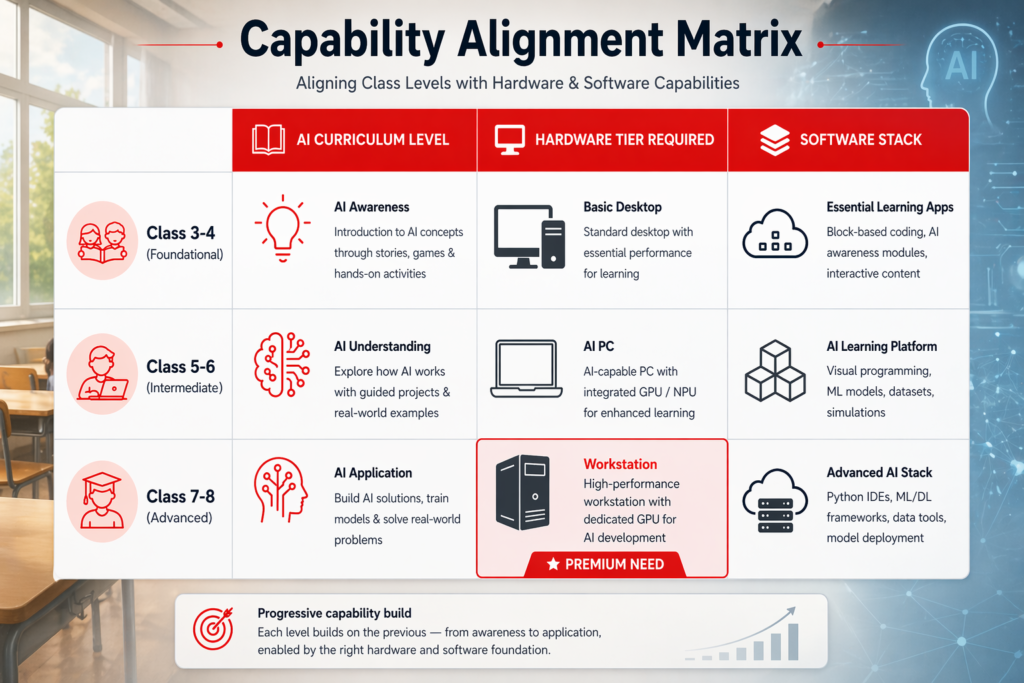
The Curriculum-Hardware Alignment Question
The CBSE Class-3 AI curriculum does not specify hardware brands or configurations, but it does specify learning outcomes. Students should understand data as a concept, recognise patterns, and grasp how machines “learn” from examples. They should be able to build simple algorithmic solutions and recognise AI in everyday contexts (smart phones, recommendation systems, weather prediction).
Aligning hardware to these outcomes means choosing machines that are reliable, intuitive, and positioned to grow with the student. Entry-level AI PCs serve this well: they are cost-effective (reducing school procurement burden across a large install base), they are durable (important for handling 40 students per shift), and they run the open-source, education-first tools that the curriculum ecosystem is built on. As we explore in our broader analysis of building an AI factory in India, hardware selection is downstream of curriculum intent. Get the curriculum and pedagogy right first; hardware follows.
Sourcing, Support, and the Made-in-India Imperative
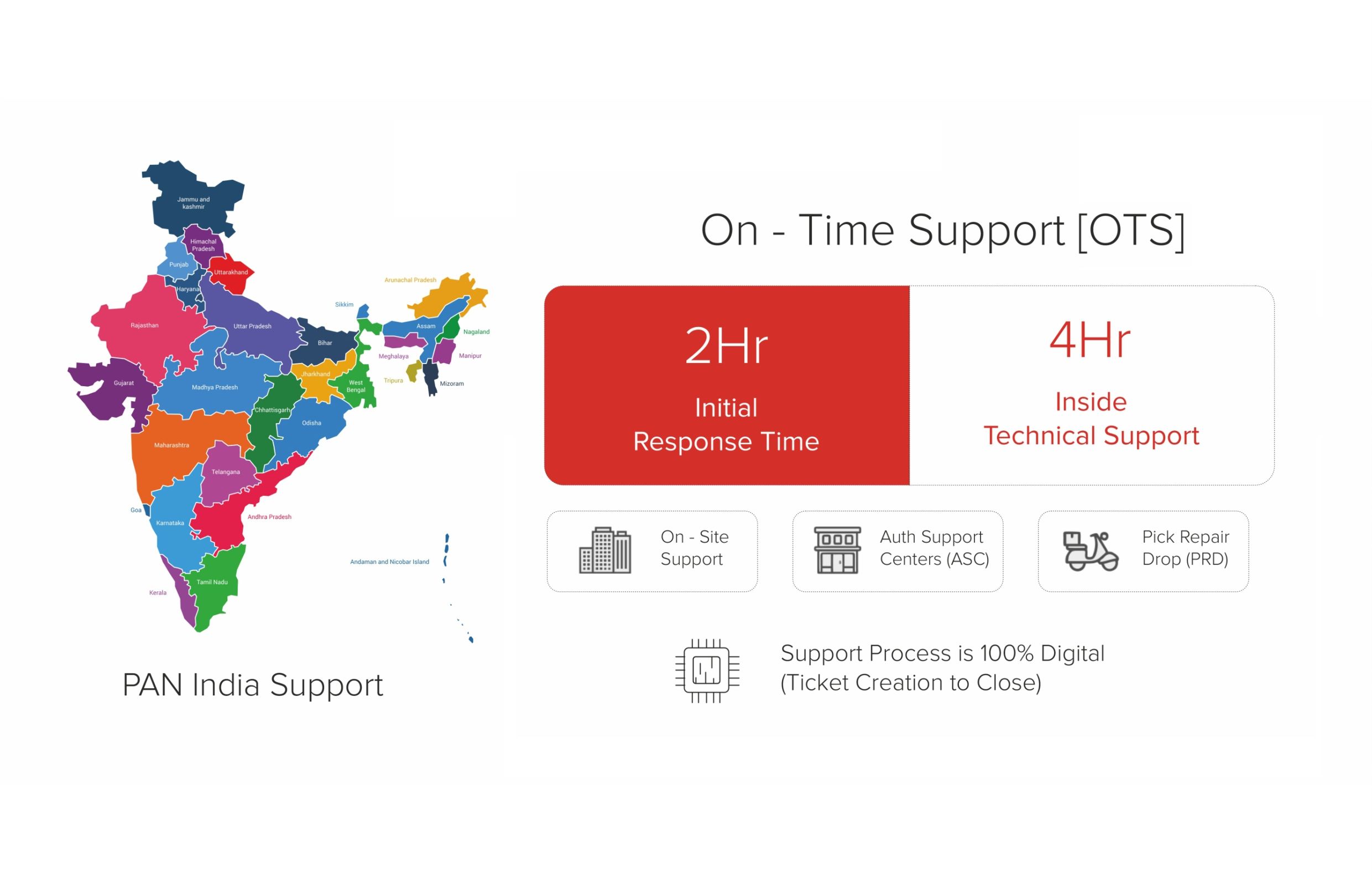
Indian schools procure through capital budgets, government grants (PMPoshan funds, state education allocations), and increasingly, CSR contributions. They are price-sensitive and require long-term service support. A school cannot afford to order devices from a supplier that evaporates in 18 months. The procurement must yield machines with parts availability, local service networks, and warranty terms that span the device’s expected 5-7 year lifecycle in a school environment.
This is where made-in-India sourcing gains traction. Domestic OEMs certified under Make in India, PLI 2.0, and MeitY frameworks—and ISO 9001 certified for quality—offer schools three assurances: local manufacturing (reducing import dependencies and lead times), local support infrastructure (service centres in state capitals and district hubs), and compliance with Indian education standards and data residency norms. As documented in our analysis of why Indian organisations are choosing made-in-India IT hardware, this is not nationalism masquerading as procurement. It is practical procurement: shorter delivery cycles, lower total cost of ownership, and alignment with India’s digital sovereignty goals.
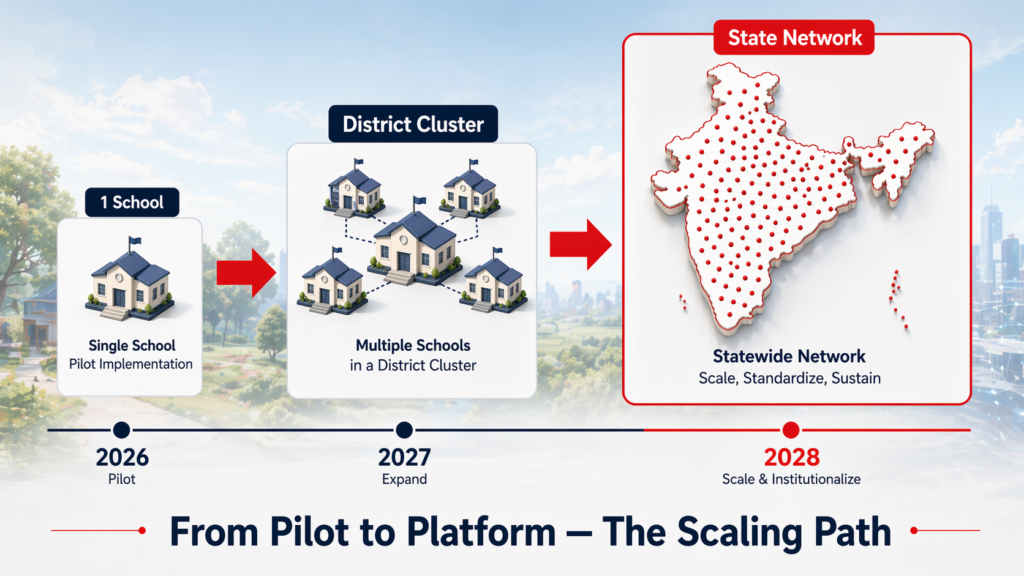
Scaling the Model: From One School to the System
A single school AI lab is achievable. But the Class-3 AI mandate is a system-level play. India has roughly 15 lakh schools. If 50 per cent operationalise functional AI labs by AY 2026-27, that is 7.5 lakh institutions. At 10-15 AI PCs per school (conservative for multi-batch scheduling), we are looking at 75-100 lakh devices. The teacher-training pipeline must reach lakh-scale educators. Curriculum support must be decentralised to state and district levels.
RDP’s AI VIDYA programme targets this scale through a federated model: national curriculum alignment (anchored to CBSE and NEP 2020), state-level partnerships (with education secretaries and board officials), school-level rollout (hardware, software, training bundles), and continuous feedback loops (teacher forums, student outcome tracking, iterative curriculum updates). The 10/10/10 mission—10,000 AI-ready institutions, 10 lakh AI PCs, 10 crore students—is not hyperbole. It is the number required to move the needle nationally.
The Moment of Action
Schools and state education departments are in active procurement mode now. Cabinet approvals for AI lab funding are being finalised. Tender timelines span April through July 2026. The schools that move decisively—that define their AI lab spec, engage with educators and technologists to validate it, and initiate procurement—will be ready for Class 3 intake in June 2026. The others will scramble in August and September, operating at partial capacity for the first term.
For educators, administrators, and procurement officers reading this, the question is not whether to build an AI lab. The curriculum mandate answers that. The question is how to build one that actually works—that survives the first year, scales to the second, and genuinely shifts what students can imagine about their own capabilities. That requires specific hardware, careful software curation, sustained teacher development, and honest acknowledgement of what Indian schools face: connectivity gaps, power constraints, and a shortage of AI-literate educators. A functional school AI lab addresses all of these, not in theory, but in practice.
AY 2026-27 is the next academic year. Schools have months, not years. The time to move is now.
Related Reading
Learn more about AI VIDYA — RDP’s full-stack education AI programme. For the institutional-scale follow-through, read about the 10/10/10 Mission for AI-ready institutions.
Table: School AI Lab Configuration — Minimum vs Recommended vs Ideal
| Component | Minimum (NEP 2020 Baseline) | Recommended (Class 3–8 AI Mandate) | Ideal (Future-Proofed) |
|---|---|---|---|
| Student PCs | 20 units, Intel i3 / 8 GB RAM, no discrete GPU | 30 units, Intel i5 / 16 GB RAM, integrated AI accelerator | 30 units, AI PC (NPU-enabled), 16 GB RAM, SSD |
| Teacher / Demo Station | 1 unit, same spec as student | 1 workstation, i7 / 32 GB / discrete GPU (RTX class) | 1 AI workstation with local inference capability |
| Lab Server | None (cloud-only model) | 1 × edge server, 64 GB RAM, 1 GPU | 1 × GPU server (2–4 × RTX 4090 or equivalent) for on-prem AI |
| Networking | 10 Mbps shared broadband | 100 Mbps dedicated, 1 Gbps LAN | 1 Gbps fibre, Wi-Fi 6 in lab, redundant uplink |
| Software | Free tools (Scratch, Python basics) | Licensed AI/ML platform + offline fallback | Full MLOps stack, local LLM deployment, digital twin tools |
| Annual Budget (lab ops) | ₹1.5–3 lakh | ₹4–7 lakh | ₹10–15 lakh |
RDP Technologies Limited designs, manufactures, and supports IT hardware in India — desktops, thin clients, mini PCs, AI PCs, workstations, servers, and rack-scale AI infrastructure. 14 years. 100,000+ devices shipped. Over 1 million end users. 28,000 sq. ft. facility in Hyderabad. ISO 9001, PLI 2.0, MeitY and BIS registered.
Make in India. Built for an AI-Ready India. Reliability is Our Product.
If you are evaluating IT hardware for your organisation — speak with our team. No sales pitch, just an honest fit review.
